“Once you make a decision, the universe conspires to make it happen.”
Ralph Waldo Emerson
Today’s gardening with my grandchild, so lovely, we cleared moss and grass from cement on the path to the front gate, she with her new wheelbarrow that she was given for her birthday, proudly wheeling it to a ditch to dump the stuff, loving it all. All we left was this little bunch of daisies as it was such a brave and beautiful little plant to grow where it does. We left it to grow in its own place where it had fought to be, it had seen an opportunity to grow on a little bit of soil between the cracks of the cement, and the rain had given it water. Always lovely to see this happening. Resilient little plant, brave too.
Just when I thought that it could not get any better, and this while I was taking delight in the garden the day after we arrived home again in Ireland, mother nature has given me another two beautiful surprises, first I discovered that there were several patches of forget-me-nots flowering, their blue a delight to the eye, then I discovered that there are several lilies of the valley flowers almost opening, how truly magical! I had not known what to expect of the garden on our return, no sooner were we home than I went to inspect, and that’s when I found lots of surprises, vegetables wild and not so wild, and waiting for me to make soup of them, kale and leeks and other goodies, they were not ready when we left in March, but now they are just waiting to be made into delicious dishes. Herbs too are doing well and looking very lush, the lemon balm has never looked so good, rosemary, lavender, comfrey and others are all ready to be used. Then I saw that the cold frames looked a bit bulky, and checked it out, to my amazement there was one plant of lettuce which had grown to become a monstrosity, the leaves so huge that one leaf would do a whole meal 🙂 Not sure what happened there! Some grass had also grown large inside. Lots of work to be done that is for sure, but I already have helpers lined up, my grandchildren, one of them had a birthday today, she is now four, and she wants a wheelbarrow, she wants to do gardening, and no fear of that, because she is small she can fit into the cold frames easily so she can do the weeding in there if she likes, looking forward to that. Anyway we are back in West Cork, and we are now already fully occupied with our work here in garden and house. Plans have been made for later in the year when we will be returning to the island of Gozo where we spent a wonderful two months, a time that will stay with us for very long.
On the last lot of photos, some onions which I had left in the kitchen sprouted, and are now ready to plant out. Also I had some oca tubers in a pot and I found the shoots creeping through a hole in the lid and the whole pot filled with sprouts, how funny!
Today I did a spot of cooking, but first I took the bus to Victoria, only ten minutes away, and I searched for and found the Fish Shop where I bought one large steak of fresh tuna, and two fillets of ling, the man in the fish shop offered me a recipe for cooking the tuna, it’s a great recipe he said, you will need oregano and other items, and as he said it he added a bunch of fresh oregano to the bag of fish, all for only €7 which I thought was very reasonable. I then visited a vegetable stall, in Victoria these stalls are at the large car park near the bus terminal, and they are there most days. From what I can see the produce is very fresh. A friendly man helped me to a number of vegetables, as well as lemon, parsley, and an orange that I needed for my recipe. He added a bunch of free celery leaves to my other shopping free of charge, the herbs and vegetables smelled good. I love cooking with fresh herbs, and that is why I am enjoying the cooking quite a bit here, fresh fragrant herbs, especially oregano, rosemary, mint, basil, and sage, as well as tomatoes, olive oil, lemon, garlic, broad beans, green beans, and fish. I may add that the long type of onions also are delicious, I’ve been enjoying those here. To finish the tuna story, I made the marinade as instructed and cooked the fish according to the recipe, and it was really delicious.
The man at the vegetable stall also informed me that the local produce would be best if I was looking for organic, which of course I was and I told him that, and he was selling a lot of local produce which is very nice. Why would one import foods when they can be grown at home.
I was in a sort of garden centre shop as well this morning as I wanted to check what the situation is in Gozo regarding the use of ’roundup’ seeing that now it has been recognised by the WHO that the Glyphosate contained in roundup is a cancer causing ingredient. The nice girl that I was talking to did not know about these matters, she did say that yes they sold roundup and that it is needed as it is very hard to grow produce on Gozo, and this is the second person that tells me that. Some people that I encountered in the last few days have also told me that it would be impossible to grow organically on Gozo because of the drought, I wonder if I am overlooking something, as I never realised that you need more water to grow organically than with using fertilizer/pesticides. It is all very interesting to learn how other countries/people think about these matters.
The produce that we have enjoyed here a lot are the local honey. Depending on what month of the year it is, the honey will taste different and come from different plants. The prickly pear jam was something new to us, for me it is too sweet, but I just got to try new things, so we bought some. The basmatic vinegar of Gozo is delicious, I love it in a tomato dish. The capers, which are grown locally too, are lovely and add a kick to the mixture which all people of the Maltese islands love on toast. Joso, a nice woman I got to know in Malta, a neighbour of ours there, gave me this recipe for a nice breakfast, she told me to cup up some nice tomatoes, or use tomato paste and put that on toast, then add capers and some basil, it does taste delicious.
Another woman in the shop the other day showed me how the Gozitans use their herbs, also mixed with tomatoes and olive oil, left for half an hour to soak it all up, and then served with capers and toasted bread. I am sure that this food is all very healthy, it does taste nice that is for sure.
I still wanted to add some photos of what we were discussing in my last post, about the swales, because today I took some pics in the park which is in the middle of the town of Victoria. A lovely and well kept place where it strikes you how much attention is given to each individual plant or tree. I saw how they use the swales, and water harvesting. They dig a ditch around the plant or tree individually, which then keeps any water near the roots and lets the plant utilize the water to the full. They also make ditches along plants so that even more water is harvested. Though these photos I took in a park, I am sure these methods are being practised in general.
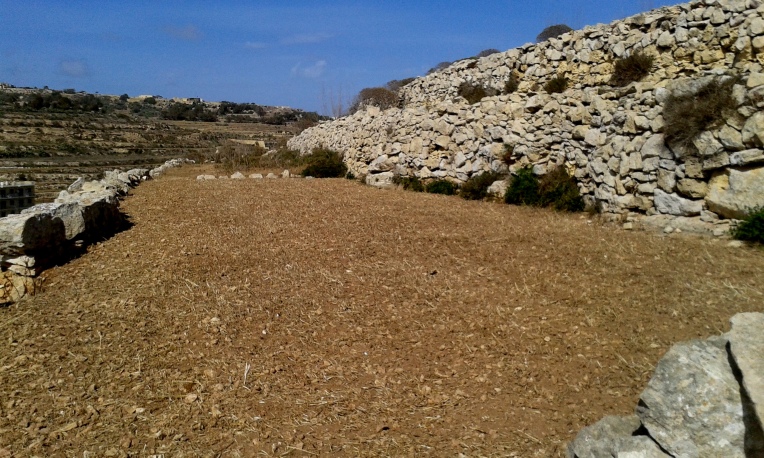
Just a few examples above. Below an example of terraced crop growing, where the water will not just run down the slope but will stay on the terrace watering the crops growing there, or in this case the crops that will be sown here.
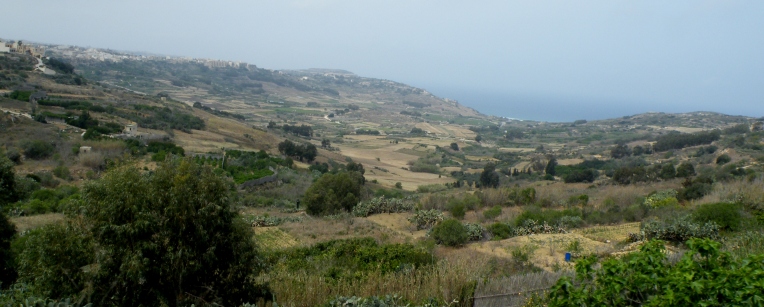
Terraced small fields at Xlendi
I’m enjoying all this getting to know about the life here, so interesting, but also what it does to me is, it makes me think more, and ask more questions to how things are done back in Ireland, where things are on a far larger scale because of the size of the country and the larger population, but still comparisons may be made in certain areas.
One question I still have for Gozo, I still have not seen any cows, sheep, pigs, only three goats, and one chicken, where is all the smallholders livestock? Are they really all inside like I am told? And if so how are they fed. It seems most unusual not to see cows or other livestock on the land. I look forward to getting answers to those questions some day.
Even though I only wrote these observations the other day, I have gleaned more information today that I would like to add to this blog entry as it is relevant. As well as that, some of my dear blogger friends have asked me questions about the water situation in relation to farming and growing crops which I have tried to answer, but I am constantly learning more about the situation on Gozo and so I want to update my writing, it is still only my own observations, and they will change as I learn more about this beautiful and attractive island. Thank you to Lydia (Lyart) and Mary Tang for asking me questions which made me think deeper and search for more answers.
Ever since we came to the Maltese islands nearly two months ago I have been looking for signs of agricultural activity, and in particular have I wondered if there were people practicing permaculture, or growing vegetables organically. I have looked for signs, asked around and checked the internet, and slowly I am forming a picture of what is happening on this front here on Gozo. I think from what I gather from the papers that back in 2008 some people wanted to see Gozo turn into an ecological island, growing crops organically, preserving water and stone, but there are many challenges and they are not easily overcome, and I don’t think much progress has been made, but don’t take my word for it. I am only observing, one needs to be longer in a country to be sure of what the real story is, what the problems are, and what progress is…
Even though I only wrote these observations the other day, I have gleaned more information today that I would like to add to this blog entry as it is relevant. As well as that, some of my dear blogger friends have asked me questions about the water situation in relation to farming and growing crops which I have tried to answer, but I am constantly learning more about the situation on Gozo and so I want to update my writing, it is still only my own observations, and they will change as I learn more about this beautiful and attractive island. Thank you to Lydia (Lyart) and Mary Tang for asking me questions which made me think deeper and search for more answers.
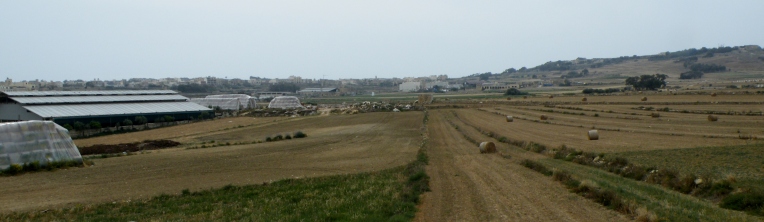
Ever since we came to the Maltese islands nearly two months ago I have been looking for signs of agricultural activity, and in particular have I wondered if there were people practicing permaculture, or growing vegetables organically. I have looked for signs, asked around and checked the internet, and slowly I am forming a picture of what is happening on this front here on Gozo. I think from what I gather from the papers that back in 2008 some people wanted to see Gozo turn into an ecological island, growing crops organically, preserving water and stone, but there are many challenges and they are not easily overcome, and I don’t think much progress has been made, but don’t take my word for it. I am only observing, one needs to be longer in a country to be sure of what the real story is, what the problems are, and what progress is being made. I did see quite a few crops even this early in spring, the grains such as barley or oats seem to have been harvested already. Large cabbages were in some of the small fields, as were plenty of onions. When we came early in March the vineyards were still looking very bare, but now they are beautifully green and flourishing despite the drought. Yes, it actually has not rained here since the New Year, you can see some of the wild plants are wilting, and growth is stunted. From what I notice there are a lot of small farms, or areas for growing crops, apparently there are not that many full time farmers on Gozo, but quite a few part-timers, people who have inherited farmland and work the land as a matter of course. It is very noticeable when travelling around the island that an effort is being made to utilise every bit of available land to grow crops. But today we had a chat with a local woman at Dwejra, she gave us information about the small farmer, the ordinary householder who will have a garden full of vegetables, will keep chickens for the eggs, will grow plenty of tomatoes, and some of those who have more land will even grow some grapes for wine making. She told us that when the produce was plentiful people would share out to family and friend, a practise which is age old and so sensible and to be appreciated.
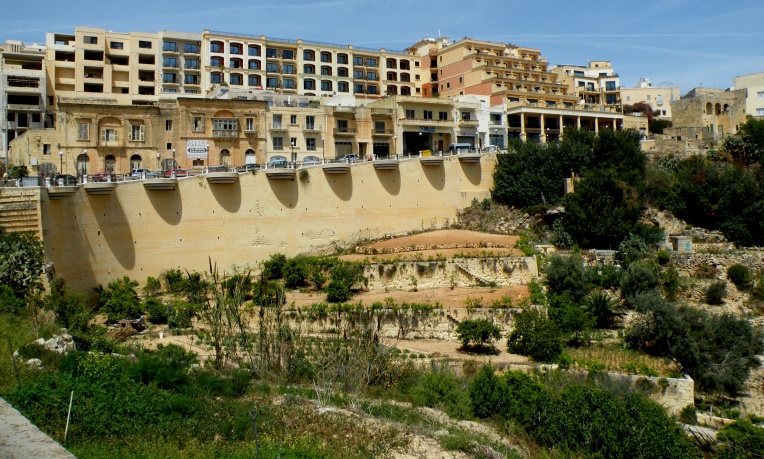
Terraced small fields at Xlendi, soil looking good.
The prickly pear is used in jam and liqueur making, the local wines are delicious.
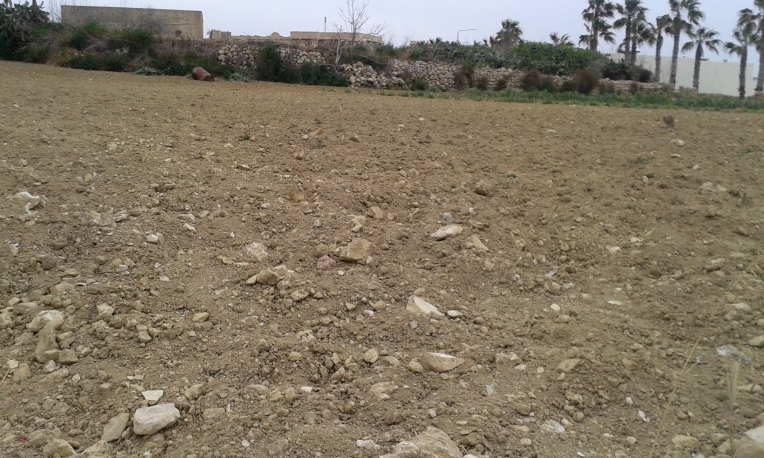
Some of the soil is very stony, just like it is in Ireland! Of course seeing that it is a very dry climate here, the soil everywhere I looked was totally dried out, still the crops looked fresh and full of foliage, when items are planted the Gozitans make a bit of a pit and put the plant in there and water it, this keeps the plant more moist and preserves the water I guess. The darker the earth, the more fertile it is.
On the water questions, many of the people on Gozo use their own wells, but the water table is becoming lower and lower because of the lack of rain. The Maltese islands do have a problem with drought, they get their water for a certain percentage from wells and the rest from desalination using electricity to transform it. Small organic farms may still be possible but there are other factors to consider, when it does rain there is often flooding. A lot of area on the island is urbanised but not enough water is collected and stored in cisterns (I read recently). According to our local source the ground water is being depleted, which is not surprising when there is not enough rain to replenish it and at the same time there is more tourism and this industry uses a lot more water than does local living, what with swimming pools and many more people actually utilising water. I am sure that there is much more to be said and thought about with regard to water provision and regulation, that I do not know about. Gozo does have water reservoirs, and I read that there is constantly improvement being done. Check this document too http://www.fao.org/3/a-a0994e.pdf
Some kitchen gardens at Mgarr, typical between the high-rise flats
This is a farm where, we were told are cows but we did not see any and were told that the cows are kept inside here on Gozo, not sure if this is true but I did not see more than two or three cows outside. Some of the milk is imported from Italy. There is excellent sheeps cheese produced on Gozo, a favourite of mine. I also saw goats but was not able, so far, to source goats milk.
There is great potential for permaculture, and for growing vegetables, crops and vines without using pesticides and fertilizers, imagine what it could mean for Gozo if it became know for its pure and healthy food production, as there is a growing market for such produce all over Europe, and as the Maltese islands would not be at a danger of becoming contaminated with genetically modified pollination once seeds are kept out of the islands, this could be an ecological paradise.
I took a walk around the garden this mild spring afternoon. I went to see what vegetables are still growing, and what young tender shoots or flowers are hiding here and there, and of course they were. I came across a whole range of fresh young growth that shot up all of a sudden because of the sunshine in the past week.
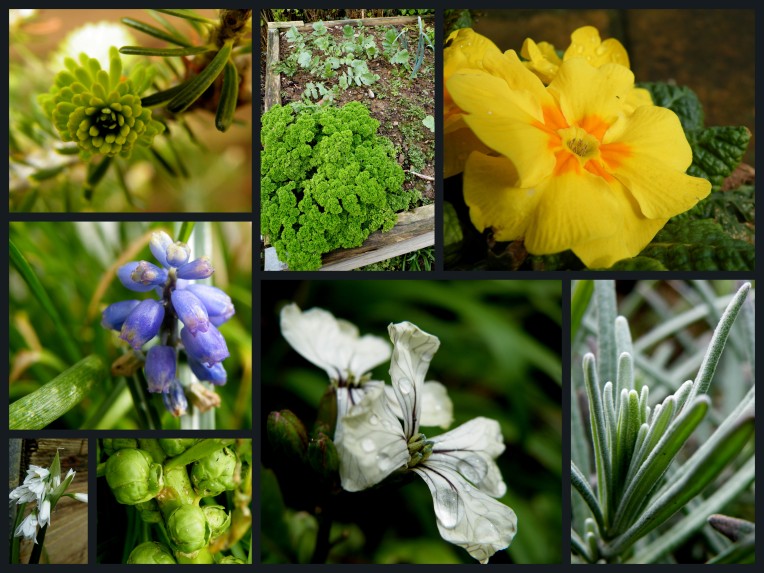
The comfrey, tansy, lungwort, hypericum, foxglove, wild leeks, are all throwing out young shoots, some are near flowering. My winter garden did not produce as much as I had planned, partly because the slugs ate some of the produce, and partly because the rain and storms destroyed some of the vegetables, in fact the soil became too wet for anything to grow. But the Brussels sprouts are still growing strongly, small as they are, they are looking good enough. My white round radishes are doing well, as are the beetroots and the leeks. And the kale is still lasting, even if we ate from the plants regularly. One of my kale plants has grown over 1.50m and is looking fabulous, I am leaving it as an experiment, it is now growing new small leaves among the large old ones, I want to see what happens next. The lavender plants are shooting up well, the grey green young leaves adding to the variety of colours now in the garden, as are the primroses and grape hyacinths, they are just about flowering, they too are bringing some very welcome colour to the garden. And our little Korean fir tree is really doing well, ever since I put it outside again after Christmas it has been showing an abundance of shoots, leaves but also cones, beautiful.
In another week or so we shall be going away for a month, and so my garden will have to take care of itself, which I am sure it is very well capable of, I am already curious what I will find when we return, will there be a lot of wild plants, to be sure there will be, I remember from last year that the goose grass had overtaken the garden fast enough. I will let it be, I’ll tell my grandchildren to come and take away the produce that is there though. One job that I will try and fit in is to spread some leaf manure over the raised beds, I think the soil will benefit from it greatly and I have plenty of it.
And now soon for us it will be looking at the flora, the insects, the architecture, the folklore, the rocks, and the people of the island of Malta, a whole new experience awaits.
Back in February 2014 I published this write up in my blog, I was only writing for one month. Because today was such a beautiful day I decided to re-blog this.
Tonight was the first meeting this spring of the local GIY group in Skibbereen, the town where I live. It was well enough attended and all those there shared some of their own wisdom and garden lore, this made the meeting very interesting and motivating. One of the persons had issues growing coriander and was looking for tips on how to succeed, one of us suggested that he would start showing the seeds straight away, saying that February, is the ideal time to sow coriander because of the short amount of daylight still at this time, and to sow the seeds against a North facing wall. Another person brought up growing basil and yes of course it is not easy to grow basil here because of the climate. There was advice about growing blight resistant potatoes, I was actually surprised that blight is still a problem in these days. There was chat about growing more flowers to facilitate the bees. I brought up the question about trees, should we be growing fruit producing trees, or should we stick with the decorative trees. I am leaning very much towards taking down our larger trees and growing apple or pear trees instead, but the jury is still out on this. Another person said she was looking for ideas to use in the school where she works, for the children. Then there was the person who was disappointed that her rhubarb had disappeared, she was given advice to try and use Rock phosphate but to keep it away from the leaves, other advice I heard was to use fishbone meal and to scatter that around the soil to improve the growth of sweet peas, and lots more. I think of course we need to use discretion, but also to remember that some of these people are well seasoned gardeners and vegetable growers.
The link to the GIY website is: http://www.giyinternational.org/
But before all this we had been shown a video about the ‘Incredible Edible West Cork’ initiative, this is an initiative where the community is encouraged to grow vegetables anywhere they find a space, be it in containers, in corners, along roads, little plots, elderly peoples gardens etc… and the food produced should all be for people to take away free, it is a lovely initiative and actually all the participants in the meeting showed enthusiasm for this idea.
We also discussed our local community garden and how we see the new growing season, volunteers were requested for a variety of jobs, including taking school groups and showing them around and helping the children to help with the garden work. We were told that last year children grew potatoes there and each child went home with a couple of potatoes at the end of the growing season which of course is lovely and a great encouragement to these kids.
We finished up the night with swapping seeds, and sowing some, and of course more chatting about seeds and growing…
It was a very enjoyable and inspiring meeting. My hands are getting very itchy to start work in our garden, though right now the soil is still too wet, but I will be sowing some seed in the next few days.
What better to think about and plan while the weather remains wet and stormy, and yet we feel that the new gardening year will soon enough be upon us. Flowers, wild and cultivated, beautiful and colourful, reminding us of summer, of sunshine and warmth.
Looking back at many of the flowers we had in the garden last year, I know that some of them I will certainly repeat this time around. The sweetpeas gave us such pleasure, we picked bunch after bunch, the scent was heavenly and made for a very cheerful breakfast table, so that is a definite Yes. The coriander and oregano are also a definite Yes! These are herbs my kitchen simply cannot do without, and the flowers, though small are pretty, when plentiful they can be used as part of a herbal flower decoration. The nasturtiums are always there also, I sow them yearly, they are pretty for their flowers but I also use both leaf and flower in salads, or I might eat some of the leaves while walking in the garden. As for the hydrangea, I have four different bushes growing, a deep lapis lazuli blue one, a pretty pink one, and two pure white ones. Some years ago I tried to change the colour of one of my white hydrangeas with a product I bought in the garden centre, but I did not succeed, and it did not matter, I will try again some time. The Ph of the soil here in my raised beds is 7, so total balance between alkaline and acid, and the colour depends on the Ph of the soil.
Marigolds grew profusely in the garden last summer, they just kept on flowering, I like the orange types, they are definitely on the list for this season also. The poppies are self seeding, they are beautiful and great for the bees and other flying creatures, but they do have a habit of coming up among the vegetables and become too large sometimes. The fuchsia flowers are seen all over West Cork, in a good year some of the hedgerows are coloured red with them, lovely. They flower from May onwards, and might still be in flower in November. I have them only at the back of the garden, in the hedge.
The big bright yellow flower was going to be a lovely round pumpkin, only last summer all my pumpkins rotted, so while the promise was there in the flower, it did not come to fruition. The blackberry flowers are frilly and white, they also just form part of the hedge and I let them grow mainly for the bees and butterflies. It is great to see all the insects and butterflies come and feed in the garden.
Finally after about three years my wall flowers have started to produce lots of dark rose velvety flowers, nice, and they give off a faint scent, it brings me memories of gardens and flowers in another period of my life, precious memories of flowers.








 agoyvaerts