ONCE I HEARD A BLACKCAP SING

Recently I heard a delightful warbling song coming from the garden, it stopped me in my tracks.  I did not recognise this song and so I turned on Merlin app on my phone to identify it, and was told that it was the song of the blackcap.  I knew that, from time to time there are blackcaps in our garden, both male and female.  They are easily recognisable by their black (male) or chestnut brown (female) cap on their head.  They come to my peanut filled bird feeders.  It was some years ago also in January that I first saw them in our garden.  Another identifying mark is their beak which is black and sharp, useful as they feed on insects and berries, but also on peanuts it seems!  It is a handsome bird, its wings and tail some shade of grey.  And like I mentioned above its song is beautiful, no wonder then that it is sometimes called ‘the northern nightingale’.

Blackcaps (Sylvia atricapilla) belong to the warble family, they are found these days also during the winter in Ireland, they used to spend their winters in the Mediterranean regions.  I read that they nest in this country but they originate from mid-Europe.  Their conservation status in Ireland is ‘green’, so we don’t have to worry about their disappearing yet, luckily.

It is no wonder that they like our garden as we have lots of berry bushes and even a currant tree (amelanchier lamarckii) which also produces a multitude of lovely berries. As well as cotoneaster (Franchetii) and a hawthorn tree (crataegus monogyna), and Berberis darwinii, all attracting and feeding birds.  Another plus point is our very thick hedges, originally we planted cuttings, and they grew into an ever expanding hedge, among them are privet, griselinia, fuchsia, escallonia, spiracaea nipponica, and last but not least the evergreen spindle (euonymus japonicas). I know that there are wrens nesting there for years, also blackbirds, and the sparrows disappear in the hedgerow often, I sometimes wonder if that is where they go at night, or when it rains!  Anyway, I digress, the blackcap is known to nest in hedgerows, and our hedges only get a cut once a year in September or there about.

Female blackcap

Now that I’ve heard the blackcap, I’ve become interested in other birds of the warble family, birds like the chiffchaff (phylloscopus collybita) for example which I hear here all day long recently.

Another lovely singing bird is the Dunnock, I have two of them every winter and even now, they are there picking up the grains on the ground that fall from the bird feeders (I’ve stopped feeding though now).  Striking brown colouring, easy to mix up with sparrows but having a distinctive different beak, their colour move vivid.  I love their song and hear them regularly.

It is amazing how many bird species are found in suburban gardens.  I was delighted last winter to spot a flock of long-tailed tits feeding and flying very fast among the shrubs close by, delightful birds. Lovely to spot them.

The two collared doves (it used to be six), also come every winter.  And the blue and great tits are plentiful always, as are the starlings, jackdaws, rooks, and sparrows.  Recently also pied wagtails came to feed.  But the chaff finches are diminishing, only about four of them now visiting our garden.  We do have a resident wren, robin and two blackbirds, thankfully.  They nest nearby, most probably in our hedges.

Goldfinch have been in our garden every winter due to the seed heads that I grow especially, or rather grow plants like evening primrose, tansy and others, and leave the seed heads for them.  And last winter I saw a bullfinch, the one bird that I seldom see, and a very beautiful bird I think.  

I do the Irish Garden Bird Survey every winter and I spend a lot of time looking after the garden birds, watching them and recording, in the end it becomes easy to even identify them just by their silhouette or by their behaviour.  Much fun actually.

Our houses here were built in 1933 which meant that for a long time their eaves would have been exposed, and birds like the swifts and swallows used to nest there.  Today this is not the way as a lot of houses have closed eaves.  My neighbour told me that long ago there were a multitude of swallows flying over these houses and nesting here, but much less so now.  The swifts which I have watched myself for many years have much reduced numbers now.  One can get swift nesting boxes, my next-door neighbour has them and every summer I hear the young swifts, such a delight.  But the swift numbers above our houses have dwindled from two dozen some 20 years ago to about 6 arriving and raising about 2 or 3 young during the summer.  A real disappointment, but hoping that the numbers will increase again, there is a lot of awareness about swift conservation these days, I think in fact that the numbers are rising.  We could all add some nesting boxes to help things along…. (Note to self).

Collared dove

Some of our hedges below

THIS MOMENT IN TIME

The scairbhin (scaroveen) has almost come to an end.  For the past few days there was an icy east wind, quite blustery, a little crazy, it blew over the land.  Locally this wind is known to arrive between mid-April and mid-May. Also around here it is known as the “rough weather of the cuckoo”, as happens around the time that the cuckoo arrives, it is also the final bit of cold before the summer.  But the days are getting warmer all the same.  Yes this moment in time is just perfect, I look out at the trees, moving in the wind, and their young leaves a vibrant green, and I sometimes wish I could stop time.  Early spring in nature is awesome!

The sodden feeling underfoot in the garden is gone and so it is time to take the growing season more serious, whipping out detailed plans and giving them an overview, while being on the ground so to say.  Taking in what is happening, and bearing in mind that my garden more of less dictates what goes on in there, I adjust my ground plan.  My garden is mostly filled with wild plants and herbs, and also some quite residential shrubs which supply good and strong colour.  New for this season, is that a little plant, which I have been pulling up year after year, I’m now going to allow it to grow, it is the herb Robert, it usually thrives well, I love its scent when I crush a leave or disturb it in any way.  Beautiful, it grows in an interesting way, the fine red stems and light green leaves radiate from the centre, the little pink flowers delicate.  

At the moment the three cornered leeks have rather taken over the borders, beautiful nodding white flowers streaked with fine green lines, I also love their delicate garlic taste.  Buttercups have started to bloom, they are some of my favourite flowers.  Daisies, white with a flourish of pink are also willing partakers of my garden, as are dandelions, all these are so important for our pollinators especially early in spring.  From year to year evening primrose, mullein and the different willow herbs have become well established.  Besides all this the usual herbs are enjoying regrowth and looking robust already.

What used to be a lawn is now just tufts of grass, part of it marked for winter vegetables like leeks, celery and kale.  And I set up the small tunnel today, I’m going to try my hand at growing some tomatoes this year, my sister Eveline is very good at growing big bright red and deliciously tasting tomatoes year after year, and she is giving me advice.  It is nice to try something new.  So I bought some tomato plants at the market earlier

In the next few days attention will go to getting the new large planter ready for my summer greens and small herbs like thyme and chives. 

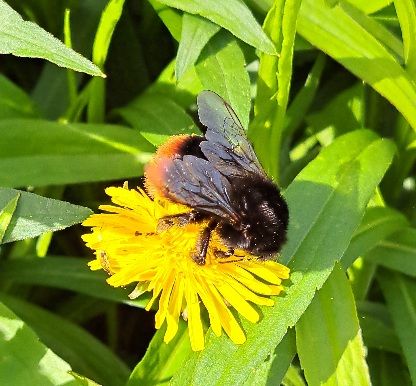
Thankfully the garden is already alive with bumblebees, so nice to see the pollinators.

My garden is an adventure, an experiment, a place of observance, a real joy, where I find solace in this chaotic world.  It is a place where I feel good, relaxing on the bench under the hawthorn tree, cup of tea in hand, listening to the birds singing, or just soaking up the sunshine. 

AN UPLIFTING WALK

On one of the first beautiful, sunny and warm days this year I made a walk at Lough Hyne and the forest that overlooks this salt water lake.  At the lake it was very busy with swimmers and kayakers enjoying their Sunday morning.  Folks have been soo browned off with all the rain we have been getting, so there was a pretty happy atmosphere all round.

Lough Hyne

I met by chance a friend of mine walking her little dog, and it was lovely catching up with her. After a while I started on my walk up the hill as I wanted to check the wild plants and the trees.  It was an ideal day for it, the sun showed the bright yellow green of the emerging sycamore leaves beautifully,  while underground there was a multitude of interesting wild plants and flowers.

It is of great interest to me lately of what is growing underneath trees as my garden is slowly becoming a forest garden due to our tree canopies growing larger and lager. 

Overlooking Lough Hyne, so peaceful.

I’m quite interested in what is happening to the trees at the moment seeing it’s Spring time.  I finally enrolled in an online course on woodland trees id. Trees in the different seasons are discussed and giving all the information to identify them in order to look up a whole lot more information about them. Encouraging nature connectedness and awareness of forest ecology. Looks like it’s going to be very interesting, especially coupled with enjoyable forest walks for practical identification.

Magestic!

Even the bumblebees were delighted with such a sunny beautiful day, and of course they were hungry too! 

OPPORTUNITY FOR ADVENTURE

While seagulls and other sea birds fly in the wind to the sound of their own piercing keow, and the crow family fight them for the food that an elderly man is putting on the sea wall, I stroll past them on my way to the coast walk in beautiful Schull.  They, the birds, don’t bat an eyelid and continue their fervent snatching and feeding. The man never looks up, so intent on his dedication to the birds.

It is a sunny but very windy winter’s morning.

I’ve just past the path where a robin took my attention, it came up close and was making some sounds but not singing, that started later.  It was the most beautiful little creature, its colours vibrant, this got me thinking that it was a male bird and that the mating season is not far off.

What fascinates me on this path are the trees.  Ever since I did a short course last year on tree identification during the winter season, I keep wondering what this or that tree is called.  I can recognise the obvious ones of course, and now I know an ash tree when I see one, its seeds, winged samaras or keys hanging down from twigs with black buds give them away.  Seeing that we have a fair (but not huge) amount of trees here in West Cork, I’m thinking of taking a further course in tree identification as it’s fun to recognise what we learn.

Celandine leaves, and here and there the yellow of the flowers are already to be seen, as are a more plentiful sight of winter heliotrope plants in flower, their pink breaking their greyish leaves along the path.  Ferns and old man’s beard are plentiful along this walk, as is ivy covered in thick berries.

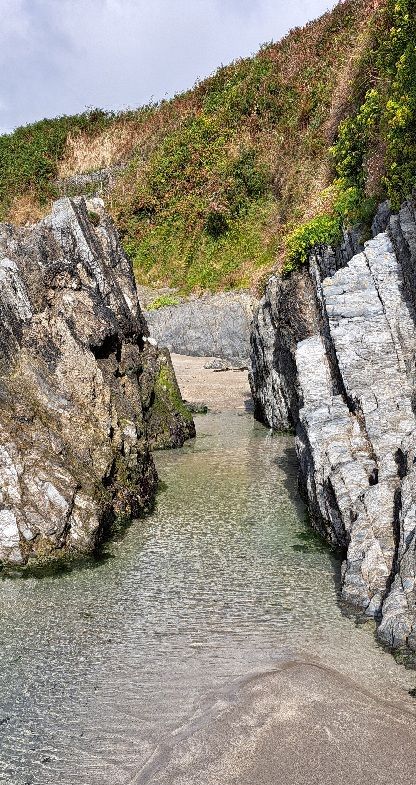
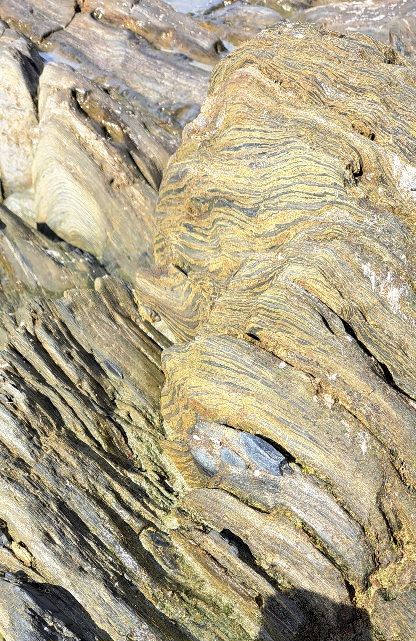
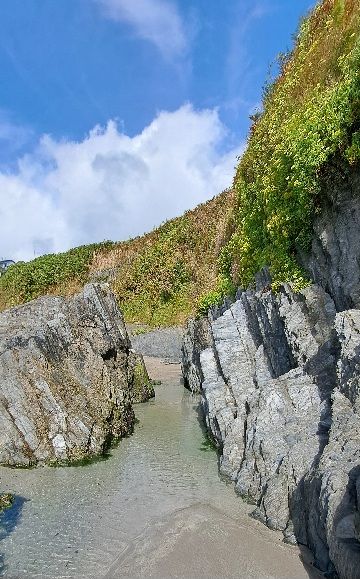
Walking further along the coastline, there is plenty to see, the rocks are covered with interesting lichens, as well as seaweeds, and sea glass can be found.  The rocks themselves Devonian mud and sandstones, look dark and some of them are quite jagged but some are really smooth.

The sea here is part of Schull Harbour which opens onto the Atlantic Ocean, where it is studded with a variety of islands.  During the calmer months the harbour is a lovely sight with all the yachts and plenty of activity.

Mount Gabriel overlooks this whole area, it is a hill 407 m high. Two radar domes are to be seen on top, they monitor civilian aircraft in parts of Ireland’s air space.  Recently I have travelled along the western side of this mountain on the way to Bantry, I drove through the Barancleeve Gap along which is where archaeological evidence of extensive copper and barite mining operations during the Early to Middle Bronze Age is found.  I would like to explore.  And looking at my map I have just discovered a few more little roads in the surrounding area which might be of interest.

Barancleeve Gap

Memories of the area… Once, when I first came to Ireland with my family, I spent a year in Cork city as an au-pair, and the family took me with them for a month’s holiday to Crookhaven.  I still have wonderful memories of that time, all I had to do was walk the toddler to Barley Cove beach and entertain him.  It is there that I discovered coral and the bleached skeletons of sea urchins, and walking along the roads I noticed many wild seaside plants.  Crookhaven is about 23km from Schull, it is a peninsula and has a very rocky shore towards the top end facing the Atlantic, looking over this view, it was an amazing sight, and very invigorating as strong winds blow relentless there.

Views from the nursing home which is situated at Colla road in Schull and is a lovely place.

Seeing that I have the occasion to travel to Schull twice a week to visit Ian in the nursing home, which also lies along this coast line and has lovely views overlooking Schull Harbour, I’m spoiled really with a wealth of interesting walks and great photo opportunities. And with spring and summer coming up I look forward to this, map in hand and Google for research as a stand by. There is lots to discover I think, and I will take full opportunity of combining both seeing Ian and discovering this amazing landscape and what it has to offer.

AND WE ARE OFF AGAIN

February has started and thoughts move in the direction of what we’ll be creating in our gardens. Planning new projects, and welcoming new growth is the order of the day.   Already there is lots happening out there, even while most of our garden is fairly water logged, and it requires a good pair of wellingtons to navigate towards the elderberry bush and the back gate.  Even then, it is great to see new growth and even the odd wild flower, or the beautiful colours of the croccusses. 

Daffodils,  and a young self-seeded mullein plant.

And an atmospheric view of an early spring sunset.  According to some folks, spring starts on the first of February here in Ireland,  but I’m never sure. I can see things happening though, which definitely point to an awakening in nature, so if not on the first of February,  then spring cannot be far off and the evenings are getting brighter too. 

Every year I purchase a few more bulbs, the last few years it has been a variety of old fashioned gladioli, I love them. But because of the heavy soil and the heavy winter rains I have to dig the bulbs up and store them. I grow lilies in containers for similar reasons, as well as alliums and agapanthus.  By now I’ve got a tidy collection of container plants.

Tulips,  grape hyacints, croccusses, and many other bulbs also seem to grow best in containers here.

Seeds are germinating inside, this year I’m trying out asters.  I picked an aster resembling a spider chrysanthemum, the flowers look lovely on the packet.  We will see.

A glimpse into our putting shed, not quite sorted or decluttered.  I was looking at a new wheel barrow recently  but they cost around €150! I think the old rusty one will get a clean up instead.

All things to enjoy or look forward to.

THE GARDEN AFTER FROST

Yes, Jack Frost has been paying West Cork, as well as the rest of Ireland, and I believe other parts of Europe too, a nightly visit. That in the middle of it I ran out of heating oil through my own lack of attention is beside the point. I was able to solve the problem very quickly thanks to a loyal plumber and heating oil providers. This did not take awake from the beauty which greats me while attending to some domestic chores like emptying the kitchen waste into the compost bin at the end of the garden. I could not resist taking some photos at least. Meanwhile a little robin has been coming closer all winter and even sang to me the other day, how totally lovely.

And what I would really like to do this year is to make my garden into a lovely space, that is nurturing to the soul, a space where my family, friends and myself can rest and find quiet and peaceful admiration for nature. And a space for wildlife, where bees and other pollinators enjoy all the flowers and find nectar. Where birds can build their nests and sing their hearts out, for a mate when the time comes. I’ve had up to five goldfinch everyday feeding on the seedheads of the Evening Primrose, such a wonder. The usual bird population is fine this winter, I’m taking part on the survey again. The chaffinches are definitely down, the sparrow count is up. There is only one dunnock whereas there have been two for years. The wren is our resident bird, as are two blackbirds, a couple. Everyday there is now a Pied Wagtail feeding in the front garden, a first for our garden. Of course the robin is always there, but some years there are two, so far there is only one, I read that the males come feeding earlier than the females so I hope that the female is still on the way. It is nice when a robin comes up to you and it feels like they are really trying to communicate with you, and when they then start to sing so close, that is wonderful!

I wish you all a peaceful, joyful, healthy and happy 2026, enjoy!

WINTER IN IRELAND

We are ending the month of November and with routine changes and many things to attend to recently I’m only now starting to slow down and to dwell on what I’m at and what I would like to focus on in the next few winter months.  I love winter.

Right now I like how there is such attention on gratefulness by so many people, so many friends.  When looking at the small gifts we receive everyday, it’s easy to feel gratitude.

Well, my garden is full of seedheads attracting goldfinches. And new life is to be seen in primroses starting to flower.

The sun is out today and there is ony a little breeze.  The garden has not yet died down so far, our really cold weather only arrives in January and usually last untill April. Our daffodils are already showing their head above soil. I could do work out there but I’m inclined to leave the seedheads for the birds, and as well as that the soil, the grass, everything is sodden, the rains having taken care of that.  So I will leave the outside work for now, and I will make my adventkrans instead. 

Wishing everyone an enjoyable Thanksgiving day

THE BATHOUSE – BAT CONSERVATION

Along the road, somewhere in county Kerry I recently did a discovery. While on one of my journeys I stopped to take autumn photos and also to take a look at this cottage. I had often wondered while passing who would have lived there long ago, and why the people left, and where did they go, maybe across the sea to America as a lot of Irish people emigrated there in the late 19th or early 20th century. Anyway the house is boarded up but still looks in good repair. It is nestled among beech and other native trees, now beautifully coloured, and it looks out down the valley with hills in the distance. Some of the land is bog-like with a variety of grasses and sedges, some rocky outcrops and low bushes, and lots of bracken, beech and birch trees, a mixture of colour at this time of year.

To my surprise I found a notice fastened to the wall of this cottage, it happens to be a roosting place for bats, and in particular for the lesser horseshoe bat. An organisation covering both Ireland and England called the ‘Vincent Wildlife Trust’ has a long and successful history of establishing and managing reserves for rare bat species. It manages 37 sites in Ireland, England, and Wales, all of which are roosts of the greater or lesser horseshoe bat. In Ireland, the Trust manages 12 reserves for the lesser horseshoe bat. And so this cottage has been put to very good use.

Website: Vincent Wildlife Trust Ireland | Managing Bat Reserves

The beautiful surroundings and peaceful countryside is a great place to let the bats find their space and hopefully continue to survive.

The landscape during autumn

Futher reading: https://vwt-production.ams3.digitaloceanspaces.com/uploads/VWT-Ireland/Resources/Lesser-Horseshoe-Bat-Species-Action-Plan.pdf

It was a great discovery, seeing how much effort is put into conservation of native wildlife.