END OF THE YEAR

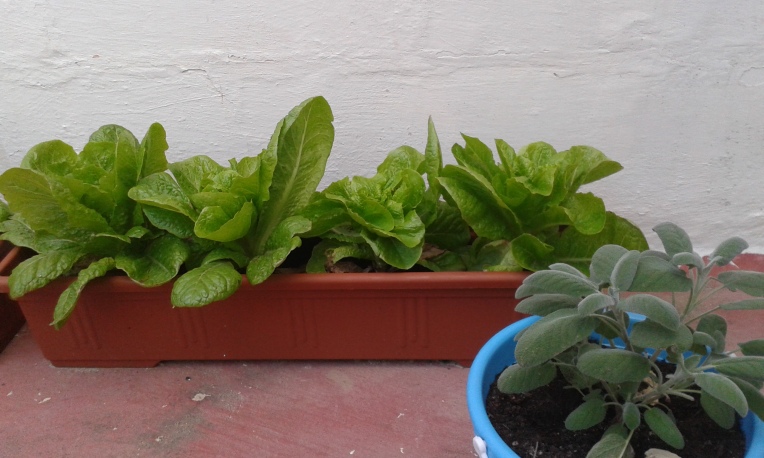
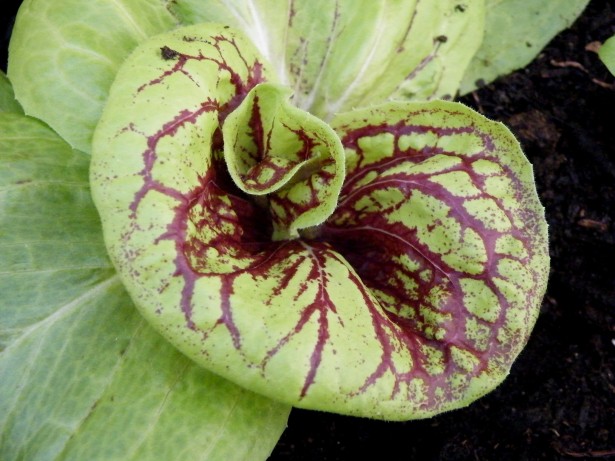
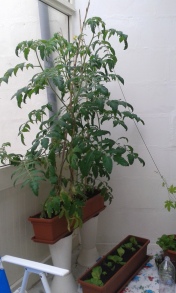
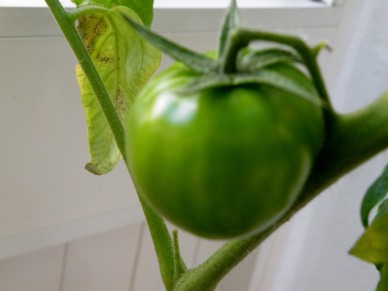
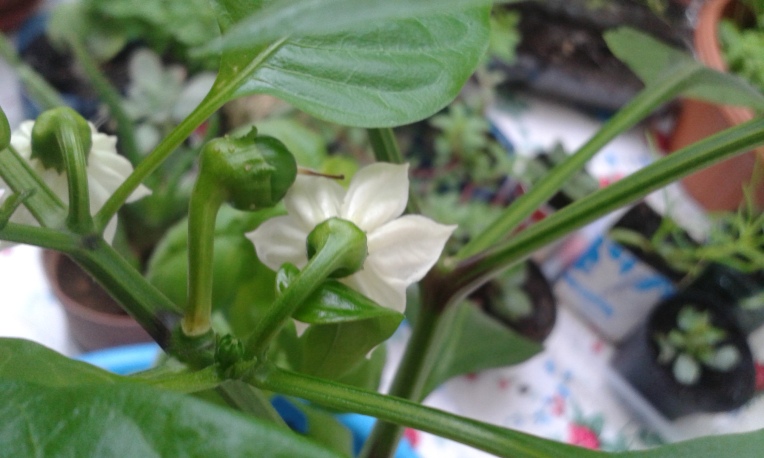
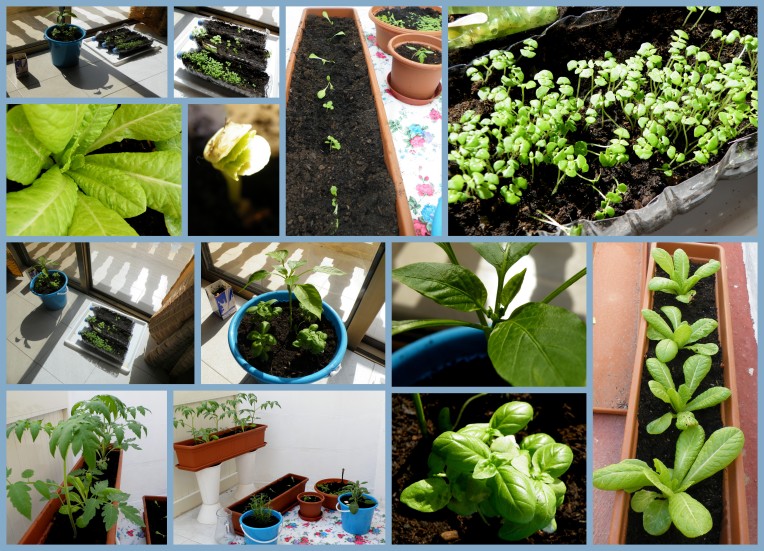
On these last days of 2016, it is good for me to have a look at how my container garden experiment went, what the results are, the successes and also the failures. For a start I have found that my vegetables did not grow as quickly as I had expected. Some I grew from seeds and they are still not that large, one of them is the Lemon Balm, I was hoping to use its leaves for tea but dare not touch them yet as the plant would be gone very fast. Patience is the order of the day! The Mediterranean Basil grew quite well but is still to small to actually cut. I did buy some young plants though, the minute we arrived early in October, and they grew enormous, the tomatoes are much higher than myself, the lettuce are almost bolting and we are eating from them regularly. If I ever grow tomatoes again in containers I will not make the mistake to grow the type I bought, no I will grow a small variety, these large tomatoes may never get big enough and ripen at the rate they are growing. I only just bought them some bananas and made a mixture with coffee grinds and banana skin to give them some potassium and other nutrients. I also have one pepper plant that is doing very well, the peppers are small yet but growing. The sage and the rosemary are doing very well too outside on the balcony.

My thoughts about the whole project are that it is a learning curve, and I made some mistakes, I also did not really know what to expect climate wise, and the soil I bought did not seem to be of such good quality – all things that one would have to look out for. I used all sort of containers, though for the more robust plants I bought proper planters.

The whole project did not cost me much at all and it was very worthwhile. There is of course, still the problem of finalising the whole project before we eventually leave the flat. I will have to get rid of all the soil, of any left over plants, the tomato plants for example, some thought will have to go into that. Luckily there is a lady who does a pop-up charity shop at weekends and who sells plants, I will bring my herbs to her, also all the little succulents which I have picked up from the streets, rooted and are now thriving.

As the year ends I am happy that I did try to grow some food here, even when we are living in a first floor flat. It has taught me that it is not as simple as all that, it takes planning and dedication, and informing oneself about the climate where one is staying.

When all is said and done, the greenery around me in the conservatory, where I usually sit to do my lace, has given me much pleasure, it is just so nice to have some living plants around you all the time.

2016-12-02-15-48-03

dscf9171

2016-12-06-14-43-08     dscf9172

2016-12-06-14-41-49


A GOZITAN MID WINTER

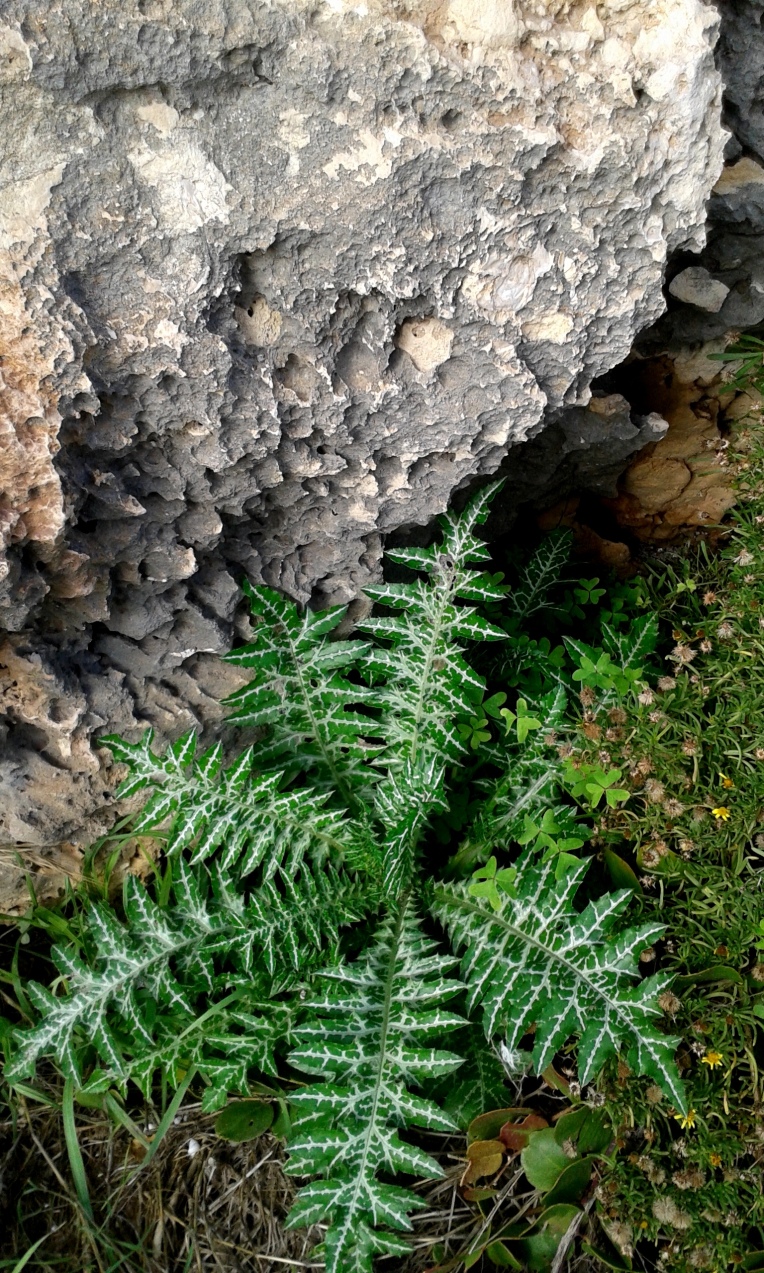
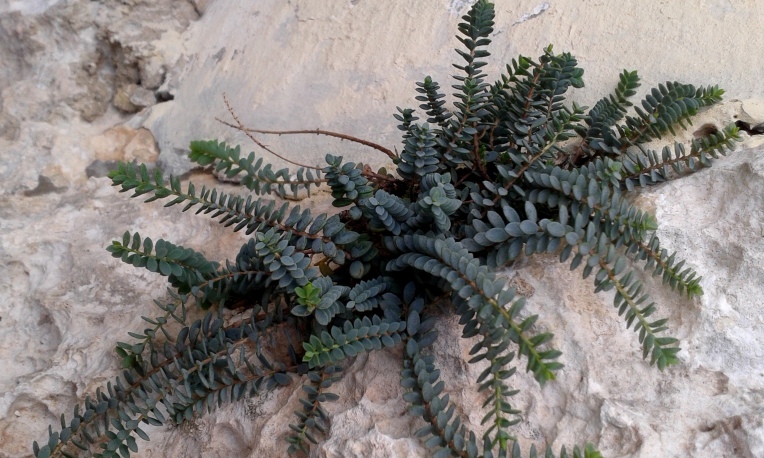
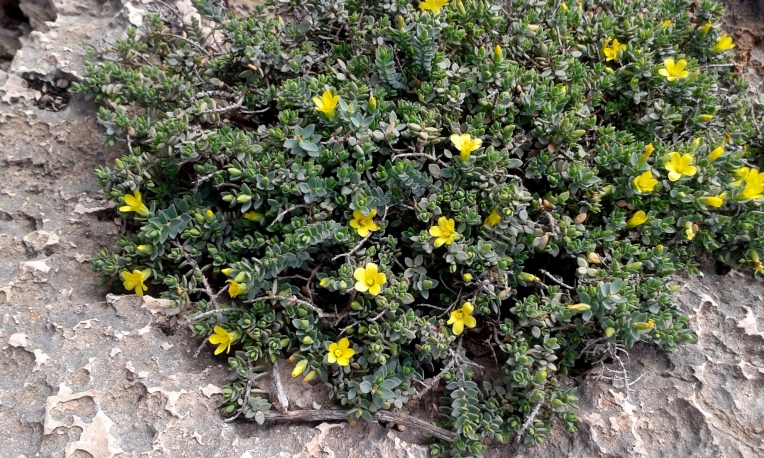
Under a bright sun on this midwinter day we took a walk among the limestone rocks and wild plants in Xlendi, a seaside fishing village on Gozo.
It feels so good to be among these beautiful honey coloured rocks, and to see the fresh young green after the days of rain we have experienced.
How beautiful this earth really is and how everything regenerates even when the drought of last year threatened to destroy so many trees and plants. It is a joy to behold all this freshness.
My partner said earlier “today is the shortest day, from now on the days are lengthening again”. Yes ‘light’ is coming, that is what we celebrate on Christmas day after all isn’t it, the ‘light’ coming into the darkness.
There is hope yet for mankind and for the earth, I will never give up hope. Every new little plant that comes up out of the earth even through the rock gives me that hope. People are much more beautiful than we think they are. Love to all my friends at this Christmas time.

20161221_134528

20161221_133908

20161221_134554

20161221_134456

BOBBIN LACE MAKING ON GOZO

Last spring while we were visiting Gozo I discovered that there is a tradition of bobbin lace on the Maltese islands that is similar to our Flemish bobbin lace, and it was then that I made the decision that if we would find a flat and come here for the winter, I would join a lace making class. Some forty years ago I acquired a lace pillow and bobbins from a friend, I even learnt a little on how to use the bobbins, but alas life got in the way and I never really took it up as a hobby, still I did keep the pillow and the bobbins to this day, the pillow is back in Ireland, the bobbins I brought with me.

Here the people use an oblong type of pillow mostly, while ours is round. When we arrived here beginning of October I set out to find a class as planned, but soon realised that I was too late and all classes had been filled. While I was disappointed I just got on with my other interests and while walking, some weeks later, through the narrow streets of Rabat (the old part of Victoria)  I happen to see a woman sitting in her doorway and doing her lace, so I got chatting with her, she was called Victorina and she offered to talk to her teacher and ask if I could join her class, without further ado I spoke with her teacher, was accepted, bought my supplies and joined the class as a total beginner. I immediately found it a very peaceful activity and enjoyed it. Soon, after a few weeks the pattern became a little more difficult and concentration is needed very much. Last week I even had difficulty getting to grips with the complicated arrangement of stitches and design, but after undoing my work twice I got it – that is what is necessary in lace making, you got to ‘get’ it and then it is a piece of cake. Tying the weavers knot caused me some problems too, but after lots of practice, now I also got to grips with it. All in all it is good exercise for the brain as well as the hands and I love it.  I am enjoying very much the interaction with Gozitan women, though a lot of Malti is spoken, of which I love the sound, they are very encouraging and talk to me in English, I feel included among them.

Here is an 82 year old Gozitan woman who sits doing her lace, selling some of her work to tourists, her work is exquisite.

A little bit about the history of lace making in the Maltese islands.

During the sixteenth century, bobbin lace was brought to the Maltese islands it is believed to have been by the Knights of St.John, who had become familiar with it either in Flanders or Italy where beautiful bobbin lace was already being produced.  The Knights had learnt to use lace in the embellishment of their garments.  Bobbin lace became an import from Northern Europe, but soon the women of Malta and Gozo started to weave their own lace, a century later their lace had become the envy of the Italians and the Belgians.  On and off through the centuries lace making had its ups and downs, various people encouraged the making of it along the way.  Apparently around 1864 the Gozitan lace took a different turn from the Maltese lace, I read that it was based on a model of Genoese lace and that two Gozitan sisters copied the style and made it their own, so the Gozitan lace was probably based on lace from Genoa but the sisters then developed their own patterns and the lace produced as a result became Gozitan lace as we see it today.  According to one source Gozitan lace has more swirls in its design than the Genoese lace.

Lace making became more important as a means of helping to make a living during the 1860ies when many Gozitans suffered from poverty.  Lace was made at this time mainly in the home and by the family, mother and daughters would work together.  The lace produced then became used to barter for food.  Eventually lace making industries were set up by a parish priest,  Dun Guzepp Diacono.  These were set up in Xaghra and Victoria, which lie close together though they are different towns.  In these industrial houses classes in lace making were taught and more patterns were developed as time went by.  Lace in today’s economy of Gozo is mainly produced for the thriving tourist industry.  The lace is very beautiful and is mostly still produced by hand.  There is a lot more to say about Gozitan lace and its history and its modern economic value and use, I only wanted to give a little  information on it here. What most of the people here say when talking about the future of lace making, is that they are worried that it is a dying art as not many young people are taking it up.  At the same time it is being taught in the university as a two year course.  I do think it has a future, it is too beautiful an art to be lost and the Gozitans are actually very proud of their lace making.

Some examples of lace, and lace making here on Gozo.  To me what lace reminds me of is the intricate embellishments in the architecture of their cathedrals, it also reminds me of the beautiful honey coloured limestone when it has been eroded and is full of holes, a very lacy effect.

The Gozitans themselves also love lace and when I walk through any of the towns I constantly see lace being used to hang in front of doors presumably to keep flies out.  These curtain are nowadays often machine made though, like in the photos I put together in a collage.

blog-about-lace-in-gozo

Some preparations and off to my first class where I was taught the cloth stitch in three different ways.  The linnen tread that we are using is Irish, believe it or not, it has been imported from Ireland.  It is a very strong and lovely tread to work with.

Some pictures of my first works, it is very easy to make a mistake by forgetting a stitch and only discovering a bit later and having to undo many stitches, and while that is pleasant enough work to do too, it does mess up the tread and makes it fluffy, so I try and concentrate real good.

My latest works, the patterns are getting just a little more complicated but also more interesting, what is interesting is how some basic stitches can be used to make an intricate pattern, and I am only in the very beginning right now.  Thursday is my next class and then we are packing up for Christmas.  I am already looking forward to starting up again in the new year.  I hope that before we return to Ireland I will be able to work away on my own and follow a pattern with ease.  There are, of course, some very good YouTube videos and websites to learn more about bobbin lace.

To help me in some of my research on the history I read this interesting work:  “Bobbin lace. it’s economic and social role on Gozo”  by Adrienne Foster and I also read a WordPress article at https://vassallohistory.wordpress.com/maltese-crafts/comment-page-1/#comment-14763, and I spoke with a variety of Gozitan lace makers and sellers over the months that I have been living here.

Last but not least I would like to show an example of Irish Carrickmacross lace which my sister Maria, who died of cancer when she was just 50, used to make, it is a very intricate lace embroidered on fine netting, I guess not easy to do.  Below are examples of what Maria made.  This is a totally different type of lace in comparison to Gozitan lace of course.


ROCK FORMATIONS OF GOZO

The Maltese islands, what a hold you have come to have over me! It all started at the airport last spring when we arrived on a sweltering hot night and I could sense a scent that I was not used to, at the time I did not take too much notice but later I remembered it and I got to know what it was that I could smell. It was the scent of limestone! I know this sounds a little unbelievable or impossible, but I swear by it myself. It was the start of my love affair with these islands, and it’s not only the scent – because of course that was only the first impression, later other scents took over, a variety of flowers for example.

In the light of day though, it was not the scent either that made me love this place so much, it is the limestone, the honey coloured limestone which surrounds me here, I breathe it, I see it with my eyes constantly because the houses and other buildings are all built in it, and it is so very pleasing to the eye. In fact I think it feeds one’s soul, no I am sure of it.

So after spending a month on Malta and a month on Ghawdex (Gozo) we went back to Ireland for the summer, and on the first of October we were back, we rented a flat from a very nice man, this in the heart of Ir -Rabat (Victoria). I am totally relaxed here, I probably absorb the calcium from the limestone and this is exactly what I need. (I was born and raised in the Kempen and Antwerp, a sandstone area, sandstone has its origins in quartz rock, it contains silicon. But what this has to do with the limestone here actually is nothing, it is just that I seem to be sensitive to what soil or rocks I am living on and this limestone suits me so very much, I feel happy and relaxed here. It is also the beauty of this rock type all around me, wherever I look I see the stone, and in the evening sun the stone turns to pure gold.  I cannot get enough of it.

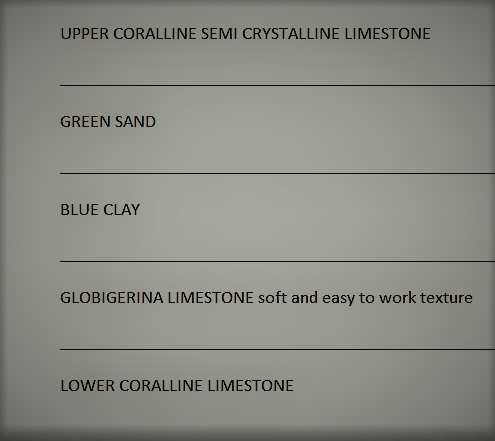
So I am trying to educate myself a little in the geology of the Maltese islands, I took out some books from the library and did out a table of the different layers of rock that are to be found here.

geological-chart

The lower Globigerina limestone is the stone that is mainly used as a building material, they call it Franka on Gozo.  This stone is made up of a fine grain and is easily workable.  It is a most beautiful stone to look at and it makes the houses, churches and buildings on Gozo very attractive. It is an easy medium to carve and this is done with great skill here.

Because this stone is soft it erodes easily too over the years.  Very often fossils can be seen plainly, mainly planktonic fossils.

I am not well up in geology, therefore I cannot talk freely as I would like to do about the rock formations, but I am learning.

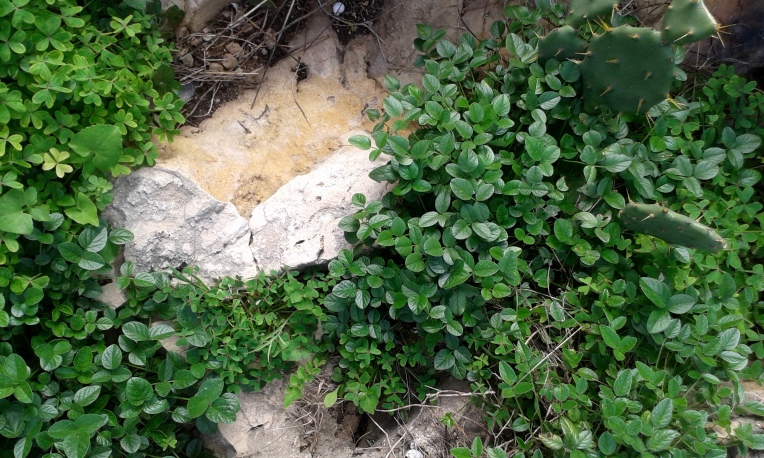
More examples of limestone, and carvings.  Below are examples of the limestone found at the cliffs at Xlendi, magnificent to look at.

Then  (below) there is an example of the blue clay rock formation, it overlies the Globigerina Limestone formation and erodes easily.

dscf5258


The two books that I used for information, I took them out from the library and was glad to have found them.

Alas this is my incomplete discussion on the rock formations of Gozo.  There is so much more to say about these rocks.

GGANTIJA TEMPLES

It has been quite a few days since I wrote in my blog, so now I am back and with pleasure. My sister was with us and we had so much to see and talk about that nothing came from writing. It was, of course, a very valuable time.

Gozo is still a place where, now after nearly two months I’m totally happy, relaxed, and feeling joy in everyday walking around the beautiful limestone houses, churches, other buildings and landscapes. The flowers, plants and insects are very attractive to me and to learn about them is a delight. The people are friendly and very nice. I have now attended two of my pillow lace making classes and have become friendly with the women there, delightful, and I just totally adore making the lace – well that is to say – learning the first stitches. It is a very relaxing activity and the work is beautiful to look at.

With December coming up there is a lot of activity planned by the local people to celebrate Christmas, religion is still very much part of it, which is only normal in my view and it is refreshing not to be in a total commercial way of celebrating Christmas. It is warm, feels like it is around 20C and sometimes over 20C. We have had thunder storms and one week of much needed rain, you could see the fields becoming greener as the days went by. Now I see farmers tending to their vegetable plots.

I cannot help taking photos, some of which I hope to use in starting to draw in pencil, and I like to share them too. This place is a photographer’s paradise if you are interested in architecture – which I am too. But also if you just like to document the local flora and fauna. I know that in the coming month I will have the opportunity to photograph people at their festivals and that too will be interesting.

And so I will share our last day together. My sister and I delighted as we visited the ancient temples in Xaghra and walked for two hours around that really charming town. We had a lovely lunch in the square as well. And we descended 10 meters down into the earth to look at caves, it was a strange feeling being in the bowels of the earth, very strange and my first time being in such a low cave, our heads nearly touching the ceilings.

20161123_112549

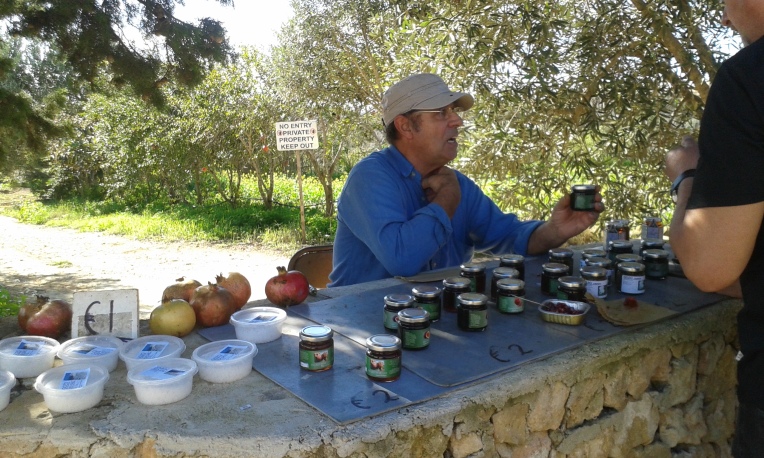
Man selling little jars of Carob syrup or honey on the way to the  temples.

Views of the Ggantija temples which date back to between 3600 and 3200 B.C.  The outer shell of the temples has been well preserved because it has been made from Coralline limestone which is hardwearing, while the inner structures like doors or altars had been made in the softer Globigerina limestone.

Lunch at a nice little eating place near the church and in the square was delicious.  We walked for hours along the narrow roads of this town, we saw beautiful lacy curtains on the double doors which is traditional here.  I love the arches, the different features in the architecture of the houses, and the use of a little colour is striking as seen in the blue paint on the gold stone.  Often people may be sitting on a bench or chairs and enjoying the peace of the place here in Gozo.  My sister Josefine posing near a beautiful historical door.

Inside the caves.  Though fascinating it is not totally my cup of tea, I was too aware of being so deep underground.

We came across this man making his lace.  My teacher later told me that he is the only ‘man’ in Gozo that makes lace.  His work was so very neat!

And this are the leaves, bark, fruit, and flower of the Carob tree (Ceratonia silique), and evergreen tree the pods of which are used here to make a syrup used for cough and sore throats.  Originally also used as animal fodder, the tree belongs to the pea family.

I hope to be back now to writing as I have so much to share of this amazing place.  All my senses are at top performance to take it all in and reflecting on it is what my blog at the moment is all about.  I hope my friends and followers will enjoy some of it too.


THE LAND – AFTER RAIN

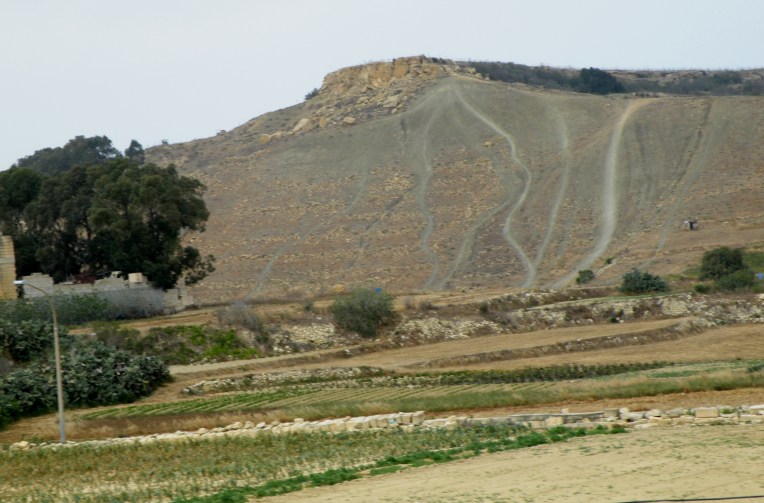
It is nice to see that after the recent heavy rains on the Maltese islands, the land is showing signs of breathing easier, of coming to life again after the long drought which in some cases made the trees start to show signs of stress and the land of totally drying out. As can be seen on the photos, and these I took around Victoria, there is still a lot of small area farming going on, vegetables and grains are grown small scale by part-time farmers.

According to Philip von Brockdorff, (Department of Economics at the University of Malta), there are several challenges of agriculture on Gozo. Full-time farmers are becoming fewer and fewer, it is the way like it seems to be in other countries too, farmers are becoming older and their children are less and less interested in farming as a means of living. On the other hand part-time farmers have been very much on the increase. To help with the future of agriculture on Gozo, reliance on EU subsidies is unavoidable and useful and should help a lot with rural development.

Dairy and vegetable growing, especially tomatoes which are used for processing, of ketchup and sauces which are exported to many European countries, UK and Ireland being the largest importers.
There is some local wine produced too, and of course lovely local honey. It is lovely to see cottage industries on the rise where foods are produced locally.
One of the problems with food production on Gozo is the lack of regular precipitation. When we arrived here in beginning of October it had not rained for many months and you could see it on the land, the farmers sure were praying for rain! And now they got some of it and the growing can continue. There is a lovely acre of potatoes growing vigorously close by here. The photos I took on one of our walks around the outskirts of Victoria, show lots of small but fertile plots of land being worked on and producing some sort of crop. It is good to see, and to see similar all over Gozo.

I’ve only loosely written down some of my own observations and thoughts about agriculture on Gozo and I read the article which Philip von Brockdorff wrote back in 2013 in the Times of Malta. I’ve a lot more to read and understand about agriculture on the Maltese islands and in particular on Gozo. One of the observations which I made very soon after we arrived is that you see none or very little cattle on the land here, coming from Ireland that is really a big difference. It means that the animals both for consumption and for dairy are never on lovely green grass and I think that would make a large difference in the quality of the end product, this also goes for the eggs and poultry production. I guess we are very spoiled in this regard, but then every country needs to have its own ways of dealing with particular problems, in this case it is the lack of lots of lush grass to feed the cattle, the lack of precipitation and the thin layer of topsoil which plays a role I think.

One development I would like to see on Gozo is more organic farms, but then I don’t know if a lot of pesticide and fertilizer are being used here, I asked a vegetable seller at a stall in Victoria about this and he said that some of the vegetables he sells are produced by what they call the ‘old way’ he indicated that this meant that no or very little chemicals were used in the growing of them. Well, who knows.

You see all the lovely terraced fields around Gozo and you think that in times past the place must have been totally self sufficient when it came to food production. Something for me to read up on I guess.
20161031_164541

20161031_164606

GETTING TO KNOW IR-RABAT

20161024_131743

St.Francis square and church, this is where the library is found also, beside the old hospital on the right.  It is a busy square and the café at the corner is where one can find the locals drink and chat.  In the old hospital, besides a beautiful courtyard is a place where regular exhibitions are held of work by Maltese or Gozitan artists.

Close to where the National Research Library is situated, I found this little bookshop, it was closed as it was around one o’clock, but in the window were displayed the sweetest and most beautifully sculpted little portrayals of life on Gozo, people in all sort of work and play, I will visit there again and hopefully the shop will be open.  The old door is one of much found style here, the arches are plentiful in local architecture, I think that it looks real nice.  It is in the little streets like the one above on the left that one finds all these treasures, and there are plenty of these streets.

In another one of those narrow streets I came upon a lady, her name is Victoria, she was making her lace in the doorway and we got chatting, seems I can take classes after all, she is going to talk to her teacher around the corner, that would be lovely and I will take the opportunity if it presents itself.  The interesting thing was that the lady hardly spoke any English, wish I could speak Malti but so far only a few words like bonju, and triq….

Shop where religious statues are painted or restored

Another interesting shop I came across was this one where the man was restoring religious statues, he did a marvellous job by the look of it.  The place smelled of paint.  It is interesting about the culture here in Gozo that religious objects are still part and parcel of everyday life.  I entered another little shop just beside the St.George church where a nice man called Martin informed me about the sisters (a religious order instigated by Don Bosco in Italy called the Salesians) that are still working with orphans and young people right here in Victoria, he told me to go and see them and they would tell me all about the more social aspects of the place, as in what sort of social work is being done and what problems, if any, are most prominent here on Gozo.  I will take him up on it and go see the sisters.  If you live in a place you have got to know a bit more about the people, the culture, and the community.  It is what interest me most beside the architecture, the plants and insects, and the limestone.

What a pleasant and most interesting morning I experienced, now more than ever I believe that if I want to get to know a place and its people, all I have to do is talk to whoever is open to chat.  It is amazing the knowledge you gather that way.  And what a lovely and interesting place this island really is.


GROWTH IS GOOD

Yes growth is doing well, the sun and warmth are certainly helping. What a new experience in growing here in this climate. The pepper plant is already throwing some flower buds, and the basil is doing just fine and already I can get a delicious scent from the seedling, some of which I planted out. Most of all I am happy about the seeds I put down which my friend from Kerala sent me last year, it is the bitter gourd and one of its seeds has sprouted, exciting that is as the last time I tried to grow them in Ireland I only got one gourd, a lovely climbing plant though. The tomatoes and lettuce are growing fast now, soon I will have to stake the tomatoes with the bamboo I found, hope that will work.

Meanwhile I keep picking up stalks which I find in the dusty street while we walk, I root them and already I have collected about eight different succulents, most of them have rooted and some are flowering, it is fun to see this happening, and it costs us nothing. Plants are not cheap here, I am surprised because most of the houses have plants outside their front door and in their front gardens, which are mostly tiled. This makes the street scene quite attractive. You see a lot of succulents here but also cacti of course.
22/10/2016 CONTAINER GARDEN - GOZO

XAGHRA VILLAGE IS PEACEFUL

For some days now I’ve been saying that I should visit the village that we can see from our walk on the outskirts of Victoria, high up on the hillside it towers above the countryside. I was intrigued to know more about it. On the map I could see that the village is called Xaghra (pronounced shara with the ‘SH’ of Schindler) Its population is around the 5000! Seeing that the Ġgantija megalithic temples, as well as a stone circle are found there – it must be one of the earliest areas on Gozo of human habitation.

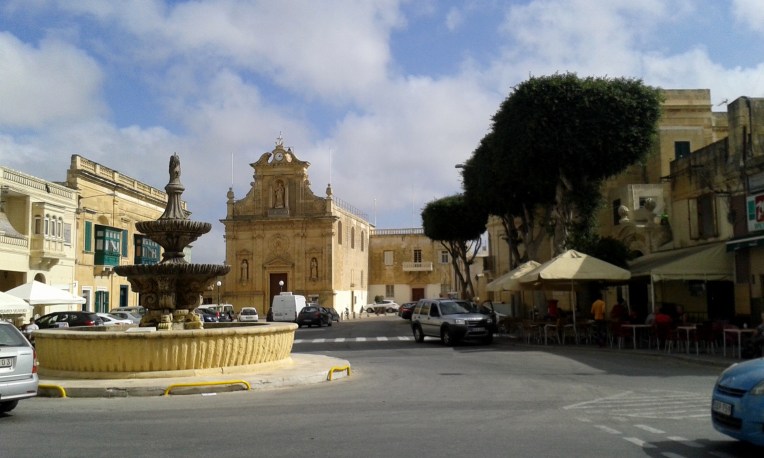
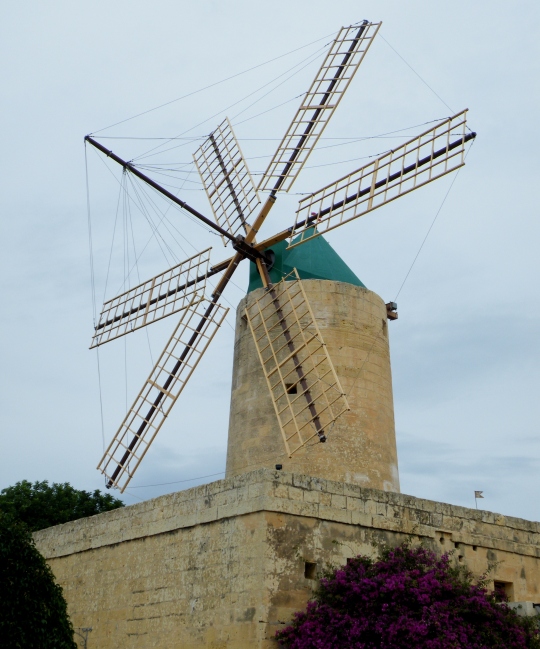
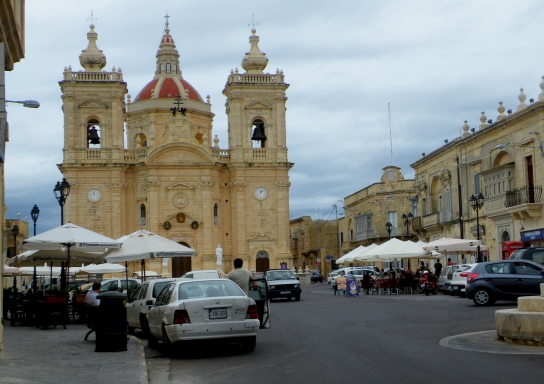
I found the village very peaceful, the little streets picturesque, and the ambience friendly. On this visit I did not go into the temples, nor visited the windmill which, by the way, dates back to 1725. That, as well as the caves with its stalactites and stalagmites, is planned for a visit in the near future. I started off by visiting the church (our Lady of Victories) always curious about what the magnificent Baroque façade will reveal on the inside. It was well worth it too, though too ornamental for my taste. After that I walked for a long time along the narrow streets, just enjoying the limestone houses, some really old and brittle, some quite new. I eventually ended up at a museum of toys where I was shown around all the amazing things of the past, a very interesting place and very nice people to welcome you.

One very interesting building I came across, and will talk about this further down among the photos of it.

I walked for hours (my workout for the day) and took the bus home to Victoria which drove there in 5minutes, I still cannot believe how close together all the places are here.
A wonderful day it was!
dscf8360

dscf8324

Below are the photos of the building I wanted to talk about.  Though I know nothing about it actually, only what I can see and deduct.  Both the older and the newer building are literary built on rough rock, I just wonder how this is possible, it looked as if the buildings were just plunked loosely on top, but I am sure that cannot be the case.  Also the grey rock seems different material to the regular limestone that is used here as building material.  It’s killing me and I just have to find out more about it.  The last two pictures I took to the side of the older building, there seems something going on with the cement (not sure what type of cement it is)  it gives an interesting and lovely design in the last photo.  I did see this sort of thing also on some of the other buildings in the village.  On my next visit I will go to the town council and try and find out more.  The limestone of the Maltese islands has me totally bewitched.

The lady at the toy museum is a goldmine of information, she showed me so many of the toys, explaining all about them.