Even though I only wrote these observations the other day, I have gleaned more information today that I would like to add to this blog entry as it is relevant. As well as that, some of my dear blogger friends have asked me questions about the water situation in relation to farming and growing crops which I have tried to answer, but I am constantly learning more about the situation on Gozo and so I want to update my writing, it is still only my own observations, and they will change as I learn more about this beautiful and attractive island. Thank you to Lydia (Lyart) and Mary Tang for asking me questions which made me think deeper and search for more answers.
Ever since we came to the Maltese islands nearly two months ago I have been looking for signs of agricultural activity, and in particular have I wondered if there were people practicing permaculture, or growing vegetables organically. I have looked for signs, asked around and checked the internet, and slowly I am forming a picture of what is happening on this front here on Gozo. I think from what I gather from the papers that back in 2008 some people wanted to see Gozo turn into an ecological island, growing crops organically, preserving water and stone, but there are many challenges and they are not easily overcome, and I don’t think much progress has been made, but don’t take my word for it. I am only observing, one needs to be longer in a country to be sure of what the real story is, what the problems are, and what progress is…
Even though I only wrote these observations the other day, I have gleaned more information today that I would like to add to this blog entry as it is relevant. As well as that, some of my dear blogger friends have asked me questions about the water situation in relation to farming and growing crops which I have tried to answer, but I am constantly learning more about the situation on Gozo and so I want to update my writing, it is still only my own observations, and they will change as I learn more about this beautiful and attractive island. Thank you to Lydia (Lyart) and Mary Tang for asking me questions which made me think deeper and search for more answers.
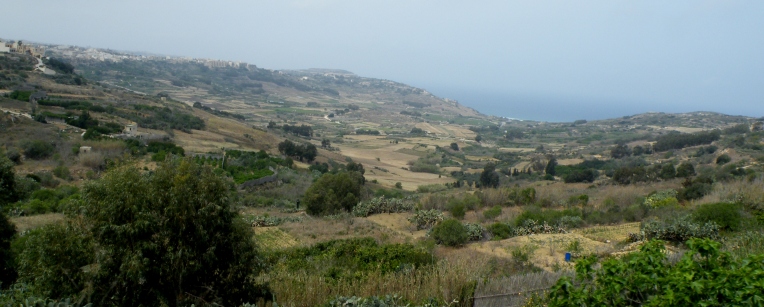
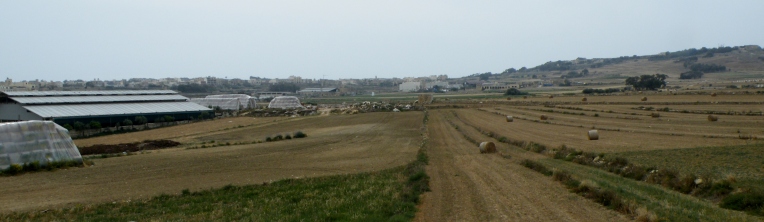
Ever since we came to the Maltese islands nearly two months ago I have been looking for signs of agricultural activity, and in particular have I wondered if there were people practicing permaculture, or growing vegetables organically. I have looked for signs, asked around and checked the internet, and slowly I am forming a picture of what is happening on this front here on Gozo. I think from what I gather from the papers that back in 2008 some people wanted to see Gozo turn into an ecological island, growing crops organically, preserving water and stone, but there are many challenges and they are not easily overcome, and I don’t think much progress has been made, but don’t take my word for it. I am only observing, one needs to be longer in a country to be sure of what the real story is, what the problems are, and what progress is being made. I did see quite a few crops even this early in spring, the grains such as barley or oats seem to have been harvested already. Large cabbages were in some of the small fields, as were plenty of onions. When we came early in March the vineyards were still looking very bare, but now they are beautifully green and flourishing despite the drought. Yes, it actually has not rained here since the New Year, you can see some of the wild plants are wilting, and growth is stunted. From what I notice there are a lot of small farms, or areas for growing crops, apparently there are not that many full time farmers on Gozo, but quite a few part-timers, people who have inherited farmland and work the land as a matter of course. It is very noticeable when travelling around the island that an effort is being made to utilise every bit of available land to grow crops. But today we had a chat with a local woman at Dwejra, she gave us information about the small farmer, the ordinary householder who will have a garden full of vegetables, will keep chickens for the eggs, will grow plenty of tomatoes, and some of those who have more land will even grow some grapes for wine making. She told us that when the produce was plentiful people would share out to family and friend, a practise which is age old and so sensible and to be appreciated.
Terraced small fields at Xlendi, soil looking good.
The prickly pear is used in jam and liqueur making, the local wines are delicious.
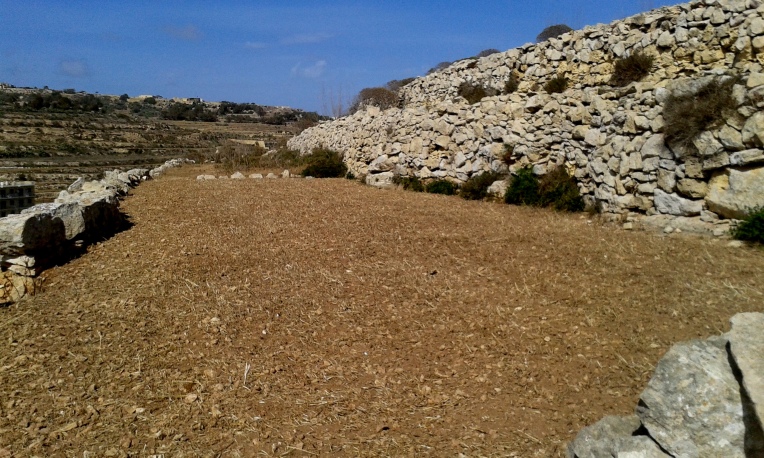
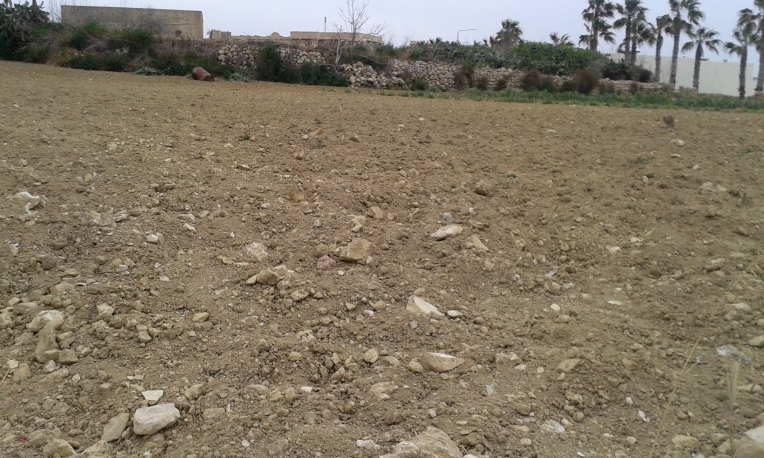
Some of the soil is very stony, just like it is in Ireland! Of course seeing that it is a very dry climate here, the soil everywhere I looked was totally dried out, still the crops looked fresh and full of foliage, when items are planted the Gozitans make a bit of a pit and put the plant in there and water it, this keeps the plant more moist and preserves the water I guess. The darker the earth, the more fertile it is.
On the water questions, many of the people on Gozo use their own wells, but the water table is becoming lower and lower because of the lack of rain. The Maltese islands do have a problem with drought, they get their water for a certain percentage from wells and the rest from desalination using electricity to transform it. Small organic farms may still be possible but there are other factors to consider, when it does rain there is often flooding. A lot of area on the island is urbanised but not enough water is collected and stored in cisterns (I read recently). According to our local source the ground water is being depleted, which is not surprising when there is not enough rain to replenish it and at the same time there is more tourism and this industry uses a lot more water than does local living, what with swimming pools and many more people actually utilising water. I am sure that there is much more to be said and thought about with regard to water provision and regulation, that I do not know about. Gozo does have water reservoirs, and I read that there is constantly improvement being done. Check this document too http://www.fao.org/3/a-a0994e.pdf
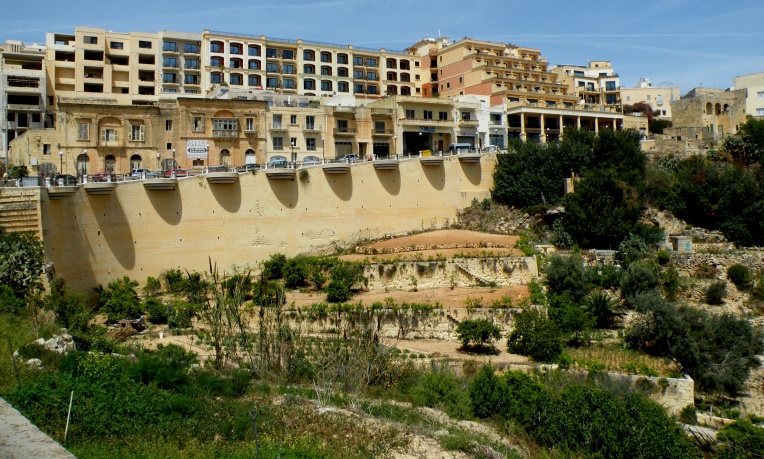
Some kitchen gardens at Mgarr, typical between the high-rise flats
This is a farm where, we were told are cows but we did not see any and were told that the cows are kept inside here on Gozo, not sure if this is true but I did not see more than two or three cows outside. Some of the milk is imported from Italy. There is excellent sheeps cheese produced on Gozo, a favourite of mine. I also saw goats but was not able, so far, to source goats milk.
There is great potential for permaculture, and for growing vegetables, crops and vines without using pesticides and fertilizers, imagine what it could mean for Gozo if it became know for its pure and healthy food production, as there is a growing market for such produce all over Europe, and as the Maltese islands would not be at a danger of becoming contaminated with genetically modified pollination once seeds are kept out of the islands, this could be an ecological paradise.
I took a walk around the garden this mild spring afternoon. I went to see what vegetables are still growing, and what young tender shoots or flowers are hiding here and there, and of course they were. I came across a whole range of fresh young growth that shot up all of a sudden because of the sunshine in the past week.
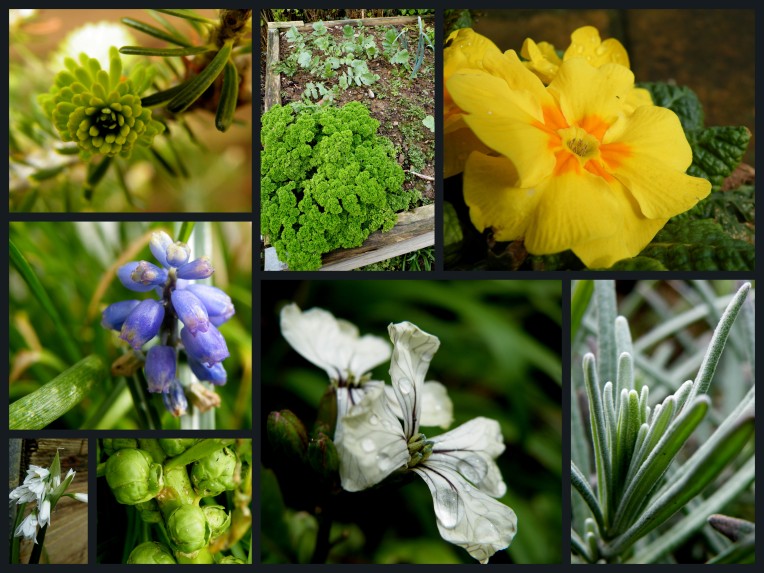
The comfrey, tansy, lungwort, hypericum, foxglove, wild leeks, are all throwing out young shoots, some are near flowering. My winter garden did not produce as much as I had planned, partly because the slugs ate some of the produce, and partly because the rain and storms destroyed some of the vegetables, in fact the soil became too wet for anything to grow. But the Brussels sprouts are still growing strongly, small as they are, they are looking good enough. My white round radishes are doing well, as are the beetroots and the leeks. And the kale is still lasting, even if we ate from the plants regularly. One of my kale plants has grown over 1.50m and is looking fabulous, I am leaving it as an experiment, it is now growing new small leaves among the large old ones, I want to see what happens next. The lavender plants are shooting up well, the grey green young leaves adding to the variety of colours now in the garden, as are the primroses and grape hyacinths, they are just about flowering, they too are bringing some very welcome colour to the garden. And our little Korean fir tree is really doing well, ever since I put it outside again after Christmas it has been showing an abundance of shoots, leaves but also cones, beautiful.
In another week or so we shall be going away for a month, and so my garden will have to take care of itself, which I am sure it is very well capable of, I am already curious what I will find when we return, will there be a lot of wild plants, to be sure there will be, I remember from last year that the goose grass had overtaken the garden fast enough. I will let it be, I’ll tell my grandchildren to come and take away the produce that is there though. One job that I will try and fit in is to spread some leaf manure over the raised beds, I think the soil will benefit from it greatly and I have plenty of it.
And now soon for us it will be looking at the flora, the insects, the architecture, the folklore, the rocks, and the people of the island of Malta, a whole new experience awaits.
Back in February 2014 I published this write up in my blog, I was only writing for one month. Because today was such a beautiful day I decided to re-blog this.
Tonight was the first meeting this spring of the local GIY group in Skibbereen, the town where I live. It was well enough attended and all those there shared some of their own wisdom and garden lore, this made the meeting very interesting and motivating. One of the persons had issues growing coriander and was looking for tips on how to succeed, one of us suggested that he would start showing the seeds straight away, saying that February, is the ideal time to sow coriander because of the short amount of daylight still at this time, and to sow the seeds against a North facing wall. Another person brought up growing basil and yes of course it is not easy to grow basil here because of the climate. There was advice about growing blight resistant potatoes, I was actually surprised that blight is still a problem in these days. There was chat about growing more flowers to facilitate the bees. I brought up the question about trees, should we be growing fruit producing trees, or should we stick with the decorative trees. I am leaning very much towards taking down our larger trees and growing apple or pear trees instead, but the jury is still out on this. Another person said she was looking for ideas to use in the school where she works, for the children. Then there was the person who was disappointed that her rhubarb had disappeared, she was given advice to try and use Rock phosphate but to keep it away from the leaves, other advice I heard was to use fishbone meal and to scatter that around the soil to improve the growth of sweet peas, and lots more. I think of course we need to use discretion, but also to remember that some of these people are well seasoned gardeners and vegetable growers.
The link to the GIY website is: http://www.giyinternational.org/
But before all this we had been shown a video about the ‘Incredible Edible West Cork’ initiative, this is an initiative where the community is encouraged to grow vegetables anywhere they find a space, be it in containers, in corners, along roads, little plots, elderly peoples gardens etc… and the food produced should all be for people to take away free, it is a lovely initiative and actually all the participants in the meeting showed enthusiasm for this idea.
We also discussed our local community garden and how we see the new growing season, volunteers were requested for a variety of jobs, including taking school groups and showing them around and helping the children to help with the garden work. We were told that last year children grew potatoes there and each child went home with a couple of potatoes at the end of the growing season which of course is lovely and a great encouragement to these kids.
We finished up the night with swapping seeds, and sowing some, and of course more chatting about seeds and growing…
It was a very enjoyable and inspiring meeting. My hands are getting very itchy to start work in our garden, though right now the soil is still too wet, but I will be sowing some seed in the next few days.
What better to think about and plan while the weather remains wet and stormy, and yet we feel that the new gardening year will soon enough be upon us. Flowers, wild and cultivated, beautiful and colourful, reminding us of summer, of sunshine and warmth.
Looking back at many of the flowers we had in the garden last year, I know that some of them I will certainly repeat this time around. The sweetpeas gave us such pleasure, we picked bunch after bunch, the scent was heavenly and made for a very cheerful breakfast table, so that is a definite Yes. The coriander and oregano are also a definite Yes! These are herbs my kitchen simply cannot do without, and the flowers, though small are pretty, when plentiful they can be used as part of a herbal flower decoration. The nasturtiums are always there also, I sow them yearly, they are pretty for their flowers but I also use both leaf and flower in salads, or I might eat some of the leaves while walking in the garden. As for the hydrangea, I have four different bushes growing, a deep lapis lazuli blue one, a pretty pink one, and two pure white ones. Some years ago I tried to change the colour of one of my white hydrangeas with a product I bought in the garden centre, but I did not succeed, and it did not matter, I will try again some time. The Ph of the soil here in my raised beds is 7, so total balance between alkaline and acid, and the colour depends on the Ph of the soil.
Marigolds grew profusely in the garden last summer, they just kept on flowering, I like the orange types, they are definitely on the list for this season also. The poppies are self seeding, they are beautiful and great for the bees and other flying creatures, but they do have a habit of coming up among the vegetables and become too large sometimes. The fuchsia flowers are seen all over West Cork, in a good year some of the hedgerows are coloured red with them, lovely. They flower from May onwards, and might still be in flower in November. I have them only at the back of the garden, in the hedge.
The big bright yellow flower was going to be a lovely round pumpkin, only last summer all my pumpkins rotted, so while the promise was there in the flower, it did not come to fruition. The blackberry flowers are frilly and white, they also just form part of the hedge and I let them grow mainly for the bees and butterflies. It is great to see all the insects and butterflies come and feed in the garden.
Finally after about three years my wall flowers have started to produce lots of dark rose velvety flowers, nice, and they give off a faint scent, it brings me memories of gardens and flowers in another period of my life, precious memories of flowers.
The garden’s trees as seen through a rain drenched window today. And a watery sunshine illuminating the rain and storm clouds in the early evening sky.
The Rainy Day by Rabindranath Tagore
Sullen clouds are gathering fast over the black fringe of the
forest.
O child, do not go out!
The palm trees in a row by the lake are smiting their heads
against the dismal sky; the crows with their dragged wings are
silent on the tamarind branches, and the eastern bank of the river
is haunted by a deepening gloom.
Our cow is lowing loud, ties at the fence.
O child, wait here till I bring her into the stall.
Men have crowded into the flooded field to catch the fishes
as they escape from the overflowing ponds; the rain-water is
running in rills through the narrow lanes like a laughing boy who
has run away from his mother to tease her.
Listen, someone is shouting for the boatman at the ford.
O child, the daylight is dim, and the crossing at the ferry
is closed.
The sky seems to ride fast upon the madly rushing rain; the
water in the river is loud and impatient; women have hastened home
early from the Ganges with their filled pitchers.
The evening lamps must be made ready.
O child, do not go out!
The road to the market is desolate, the lane to the river is
slippery. The wind is roaring and struggling among the bamboo
branches like a wild beast tangled in a net.
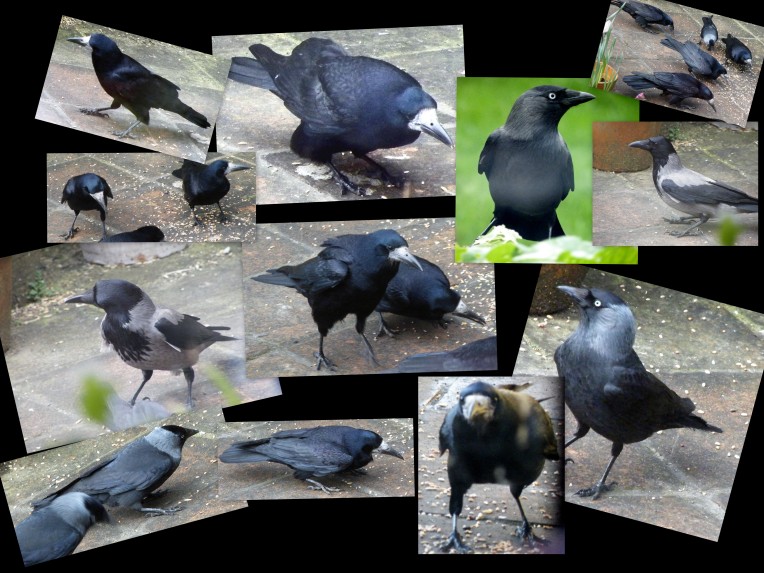
For many years some of the crow family have felt very much at home in our garden and on top of the roof, eating from the bird table and nesting in an old empty chimney. When seen in detail they are all very beautiful birds. The rooks have a bluish shine on their very finely preened feathers, they shine. The hooded crows have both black and grey feathers and they only venture on to the patio from time to time, they mostly feed on carrion somewhere else. The jackdaws, also belonging to the crow family feed side to side with the rooks, they are not afraid of these black birds with huge beaks. One of the rooks, we call him Charlie, is very noisy and demonstrates his superior voice quality whenever there is something happening that he does not like around the place. Rooks are very sociable and we see them in groups of about a dozen, intermixed with jackdaws. They are said to hide food into a hole but I have never seen them do that around here. I have seen them play catch in the skies above the garden here, while being very vocal they fly after each other creating great manoeuvres. At times when I go into the garden, one of them, sitting on the roof will give out being very vocal and goodness knows what he is communicating to the others, they know I feed them every day in winter (mainly seeds and peanuts, sometimes table leftovers).
It is a pleasure to have them around, though in a way I might be fonder of the little birds with highly coloured feathers. The crow family are very welcome in our garden, and quite interesting to observe.
What a most beautiful day it has been, full sun and quite warm for the time of year. This evening I happen to be in the garden getting in the washing and noticed what beautiful light surrounded me, and how the evening sun was bringing out all the colours of vegetables and herbs alike. Magnificent especially as not long after that the moon came up, large and beautiful.
I feel so blessed with all the beauty that surrounds me. Really good to counter balance all the sadness and strife that is going on in our earth.










 agoyvaerts