SERRA DA ESTRELA IN CENTRAL PORTUGAL

Some years ago Ian and I spent a few weeks in Central Portugal.  In memory of all the forest fires which destroyed so much trees plants and animals (and most of all human life) that was lost there over last summer, I have decided to enter a few thoughts, photos, and words from my journal of those days.  It will show the fresh beauty of the place, and like many I hope that the land will recover in all its glory.

We were staying in a small village called Orca in the centre of Portugal, close to the town of Penamacor and Castello Branco.  It was very hot already during our stay even though it was only towards the end of April.  One day we decided to travel to Covhila which lies on the foot of the Serra da Estrella Natural Park and mountain range.  Here is a little of what I noted down at the time.

DSCF0552

Journal entry of April the 28th ~ INTERESTING ROCKS AND MAGNIFICENT VIEWS
We made a day trip to the Serra da Estela mountain range, the highest mountains in Portugal, while we were staying in a lovely little hotel in the historical centre of Covilha. It was possibly one of the most amazing days we spent in Portugal. The beauty of the landscape, plants and rock formations, topped up with actually being able to hold snow in my hand, while we had been baking in temperatures of over 30 degrees Celsius in the valley below, was lovely. There were interesting stones and flowers to discover. We drove down into the Glacial Valley where the village of Manteigas was to be found, the views leading up to discovering this village were wonderful.  It is a trip I would advice anyone to take when visiting central Portugal.

DSCF0394

LOOKING DOWN TO THE GLACIAL VALLEY

This was not only a fantastic view, it was also very interesting of geological interest.   This U-shaped valley was gouged out by a glacier during the last Ice Age. Manteigas is a very lush and quite large village surrounded by mountains, it lies bathed in the sun and water streams down to it from all sides. This assures a good supply to make everything grow well and look very green and fresh. We had a lovely traditional Portuguese soup there with Spinach in it, after a generous helping of fresh Olives and bread. We finished off the meal with a nice desert made of layers of coffee ice-cream and pastry, delicious!

DSCF0332

Granite rock formations

DSCF0483

You are climbing up to nearly 2000 meters high, a very good road, the views magnificent!

AMAZING SCENTS AND A WELCOME COOL BREEZE

The scents all over central Portugal are just so sweet and lovely, so much so, that you breathe with pleasure. The heat does help with this, but even high up on the Serra da Estrela I experienced these lovely scents. I wish that I could bottle it and bring it home, but meanwhile I did breathe with pleasure.

MAGNIFICENT VIEWS

SNOW AT A HEIGHT OF 1750M

Well I have enjoyed this little journey into my past.  I’ve got lots more that I will share.  At the moment I am going through many photos of the past few travels, on some of my memo sticks.  I’m taking at least a year off Facebook and it is amazing how much time more time I have to spend on other things.  Wading through thousands of photos is no mean task, but it is enjoyable.  I hope that you have enjoyed my journey into the past too.

ABUNDANT FLORA IN JANUARY

Just while walking along one road, the coast road of my walk on the first of this year, I found so many wild plants in flower that I would like to share a gallery of them. Meanwhile I am doing some research on them individually and have already come across some interesting facts. It is a great pleasure to become more intimately connected with the Mediterranean flora and to learn more about them. While I was young I studied botany with a teach yourself book, but right during my life-time wild plants, flowers and herbs, and their medicinal and other properties have been of great interest to me, and it gives me great pleasure to learn more about this all the time. By observation as much as by reading, researching and learning about them. The beauty of these wild flowers and the joy of finding them along a walk cannot be underestimated in everyday life, I feel very grateful to have the opportunity.

A NEW YEAR BEGINS

On this first day of January 2018, I see a beautiful blue sky and blazing sunshine, I decide to walk in a different direction.  My walk takes me along the cliff road from Ghajnsielem towards Hondoq Ir-Rummien on the South coast of the island of Gozo.  It’s an easy road and it is no surprise that there are quite a few people walking.  The man from next door with his little dog is there too and we exchange a few words.  People pass and say hello or nod.  Today I went out not only to connect with nature but to make sure that on this first day of the year I connect with people.  Being far away from family and friends makes itself felt on days like today.  Luckily nature is a great solace, a balsam to the soul.
And first and foremost today was about exploring yet another part of the island.  So I took a totally different direction, and walked where I had not walked before.  The road stretched out before me, lined with wild flowers, plants and trees, a delight to the eye, beyond that the rocks going down steeply, and then the sea, the Mediterranean, sky blue with only a few white horses disturbing its surface.

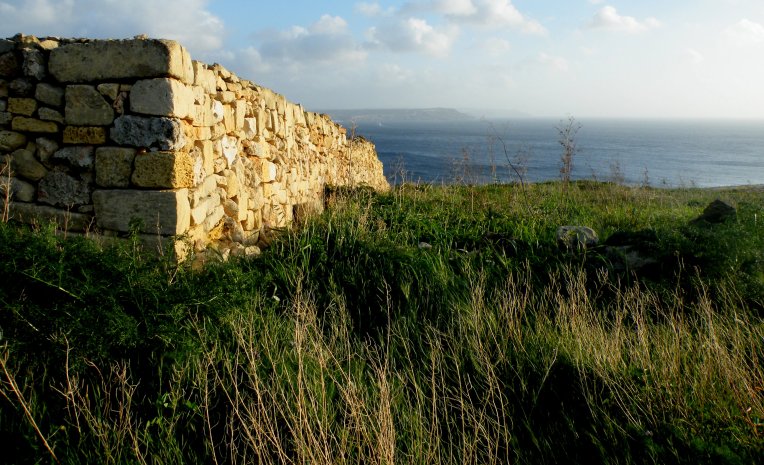
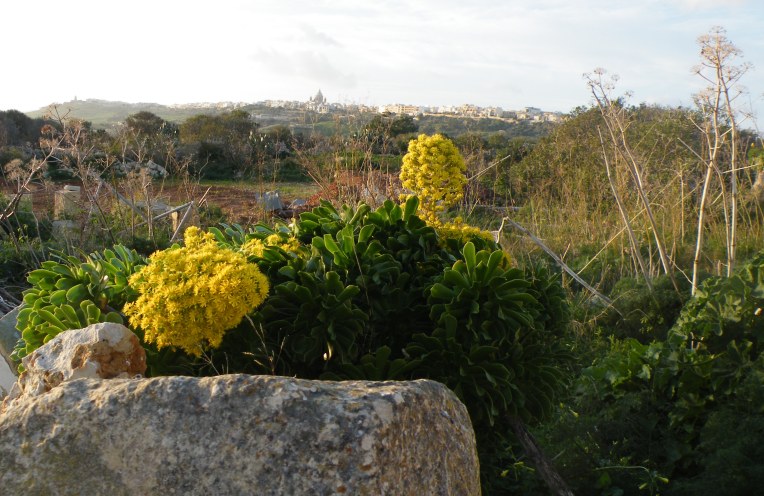
The road was climbing, lined with stone walls, bright limestone locally sourced, built by men long ago, sturdy and functional.  Due to the most recent rain plants are green, sharp new growth, buds of almond blossom and giant fennel are fat and ready to burst.
DSCF0692

DSCF0646

I see lots of wild flowers, a delight to the eye, colourful and bright they are fierce and upright even if the strong wind tries to blow them down.  My hair flies all over the place and I have to keep it back in order to look through my camera window and take a steady photo.  I relish the freshness and feel all the spider webs disappearing, all last year’s less beautiful happenings fade away, even all the problems of humankind, all the suffering and pain that people go through, all disappear for the time being. A new year starts and one hopes that it will finally bring Peace to the earth and with it kindness and happiness in every soul.  I know that is wishing for a lot but I still wish it.

DSCF0657

The road winds its way up the hill, I see houses, signs of life.  I think that I am coming to a hamlet but I don’t know what it is called.  It seems very nice and the views over Comino island and over Malta and the sea are wonderful.  I’m almost enticed to go into a tavern to have coffee but then I see that the sun is getting low in the sky and it is still a long walk back home so I decide to retrace my steps.  Such a beautiful place this is, I intend to walk this more often and check out more of the wild plants as the months go by.  It’s all down hill now, the sun is low in the sky, I see church towers of all the surrounding villages, there is Nadur, and Xewkija, and Ghajnsielem churches, the spires high toward the sky, the domes silhouetted against the setting sun.  I notice that all those villages are on heightened ground, hence they can be seen from far-a-way.  In my mind I can walk all over the island, it does not seem far!  In reality it would take me a long time, but it is good to dream at times.

DSCF0699

DSCF0727
I get home before dark, but not before I take a few more shots of these lovely surroundings. I see the ferries busy and many cars waiting in line, all on the way to Malta where life is eager to get back to normal after all the festivities. I make a mental note of what I will do tomorrow, another year is starting and I am wanting to jump right in. Like one of my friends said today, we are going to make a good one of it, we are going to enjoy each moment and live to the full.  Grateful for another chance, another opportunity, to be kind.
Happy New Year to all my dear friends, wishing you a year full of Blessings and Love, Peace and Goodwill.

AN EXHIBITION IN GHAJNSIELEM

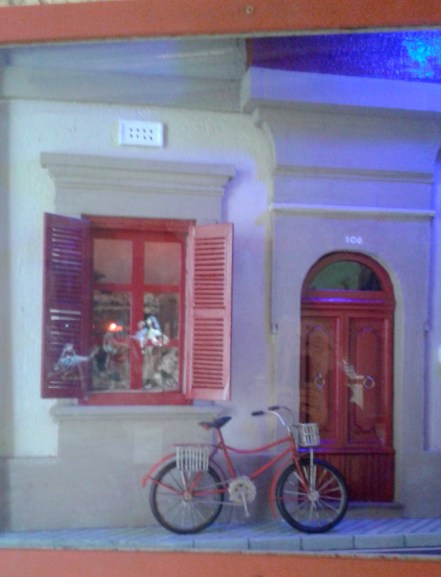
During my walk today I came upon a small exhibition of cribs in the local village. In Malta and Gozo it is very traditional to build nativity cribs named ‘presepju’, quite often a whole village scene is built around it too, the structure can become quite large and is always interesting as features are used that shows life, and incorporates items of farming or domestic scenes from long ago set in local landscape. The traditional figurines that are made here, are called ‘pasturi’ they are hand-made out of unfired clay or wax.

I have been fascinated by some of these cribs here in Gozo, last winter I saw some beautiful and very artistic ones in a shop window.  The clothing of the figurines quite elaborate, my favourite was one crib where the figurines were all dressed in medieval textiles and clothing design of that day.  This time too among the cribs in this exhibition there was use of textile in the making of one of the cribs and the effect was rather nice, down to the minutest details of for example a slipper, made in miniature with fine gold thread and use of deep reds and greens.  There is no doubt that a lot of loving and patient work goes into making these cribs and it is fine to see exhibitions of them all over the island around this time of the year.  I took some photos to show some of the variety for your perusal.

In this crib all the figurines have been dressed in beautiful textile.

2017-12-28 13.54.58
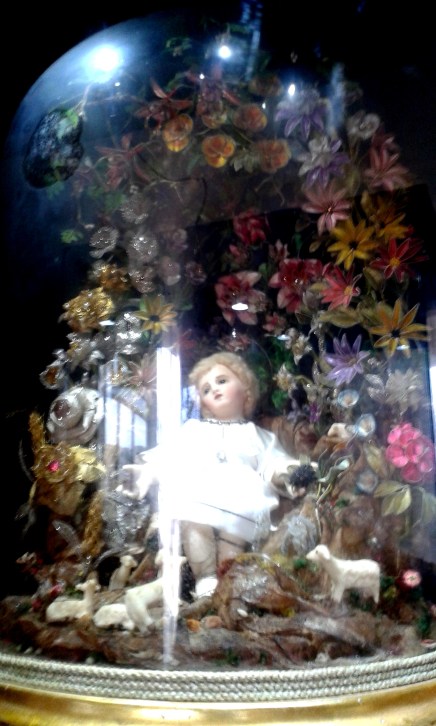
This Christ child is surrounded by traditional flowers made of metal wire, silk thread, beads, and or jewels. This work is done by hand and is called ‘ganutell’. I read that this beautiful art form was practised in monasteries. But it also mentions that the Maltese in the sixteenth century made use of the spiral gold and silver wire called canutiglia, and together with silk thread, glass beads, pearls, gems, and gold and silver wire would produce these beautiful flowers which are mostly kept under glass domes now – and here is one of them. One of my Gozitan friends has made me a flower bunch like that, she told me that it is very intricate work, and I believe her. For more information on Ganutell see this link: https://www.google.com.mt/search?q=ganutell+malta&sa=X&dcr=0&tbm=isch&tbo=u&source=univ&ved=0ahUKEwj8trq0v63YAhULbxQKHW10DQcQsAQILg&biw=1366&bih=622

2017-12-28 13.53.45
Another one of the Christmas traditions in Gozo is putting a crib in the window, it is an old custom, and I saw it a lot in Victoria last winter. Here is an example, made as part of the exhibition.

And these are then some of the ‘pasturi’ made in unfired clay, some of them painted.

More ‘pasturi’ but larger this time.

blog on exhibition in Ghajnsielem These is a collection of all the participant of this exhibition, I just wanted to include it in case anyone would like to know.
It was an unexpected and nice surprise to come across during my walk to fetch some milk today, things like this always teach me something more about Gozo and the Gozitans for which I am very glad and thankful.

GANDIKOTA FORT

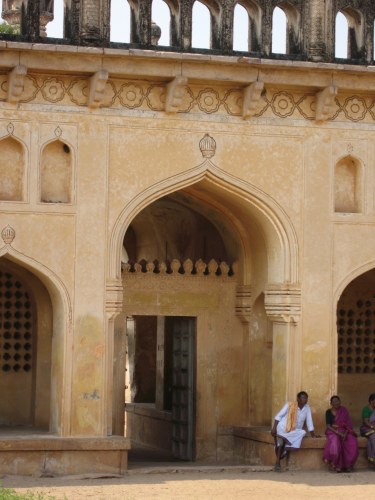
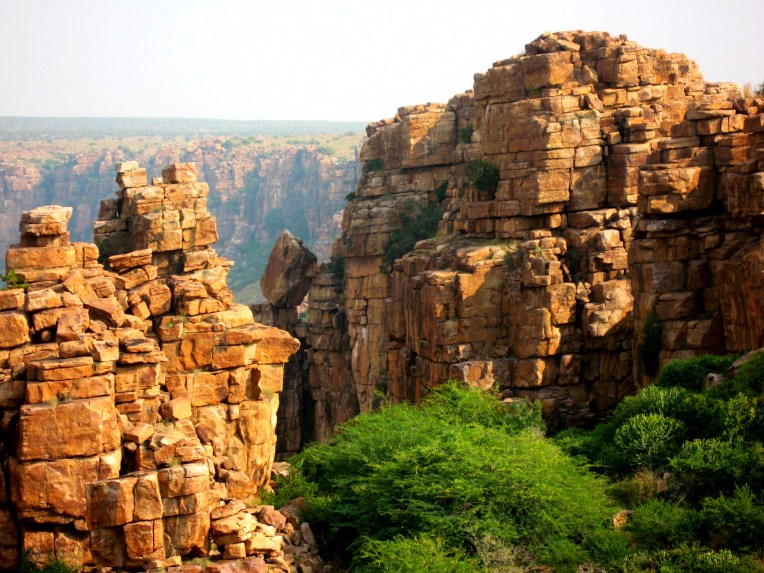
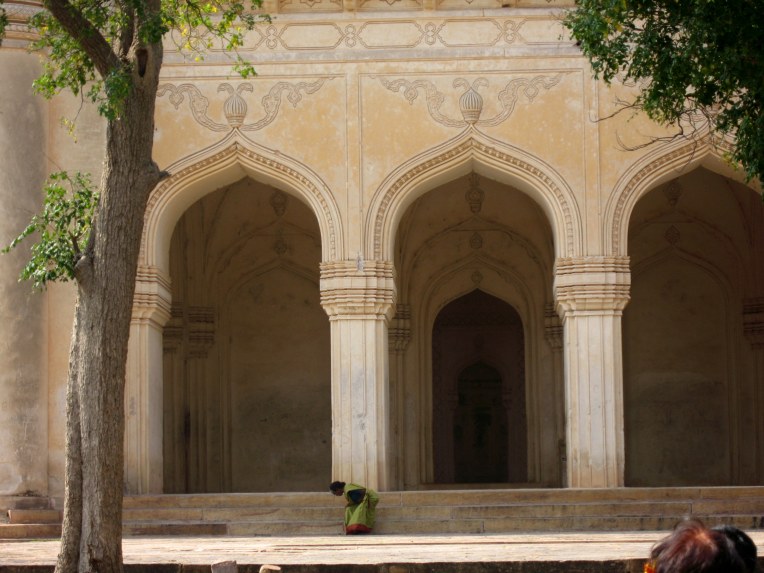
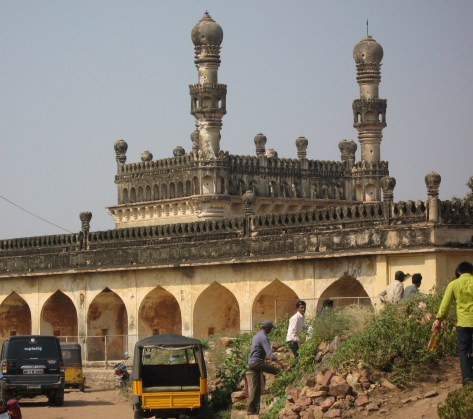
In India, somewhere about 15 km from Jammalamadugu in the Kadapa district, in Andhra Pradesh, there lies a village called Gandikota. It lies on the right bank of the river Pennar.  This river creates a deep gorge while it runs through the ancient red granite rocks of the Erramala hills, whole big bolders of them, a magnificent sight!  About seven years ago I was there. It was new years day of 2010 and together with some friends we visited the fort there and the temples and mosque all well maintained ruins now. Gandikota Fort was constructed around the 12th century during the Pemmasani Dynasty, and became one of the most prominent forts in the country. Gandi is the Telegu name for gorge and the village and Fort got their name as a result of that. There was quite a bit to see at Gandikota, most immediately when you enter the area there is the impressive ancient Jamia Masjid mosque with its beautiful architecture, its elegant arches. Then there is the granary which is a very robust and dark building, very cool inside while intense heat outside, only air vaults letting in a tiny ray of sunlight.  Before long the eye catches another interesting building, this is the ruin of the Ranganatha Swamy Temple, very impressive with its magnificent carvings and pillars. The carvings depicting scenes from the Mahabharata and Ramayana. There are also the ruins of the Madhavaraya Temple and some other ruins in the vicinity.

IMG_0435

IMG_0418

IMG_0430

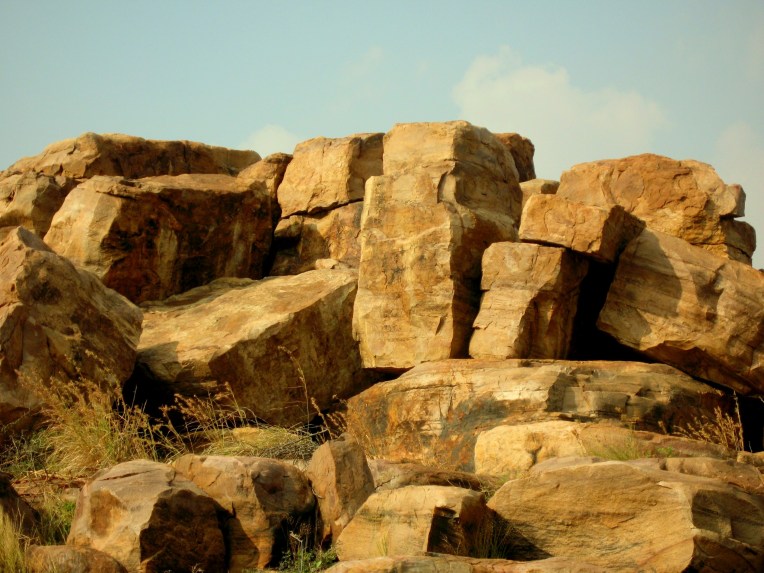
The rock structures of the gorge are magnificent, the red granite majestic in huge blocks precariously grace the tops of the gorge, you have to climb over them to get to the edge and see the view. Granite is an igneous rock made up of a variety of mineral, like quartz, feldspar, mica, and hornblende. The composition of small amounts of mica, amphiboles, and other mineral is what gives granite its red colour.

IMG_0512

IMG_0500
I spent many months in this vicinity over several years but alas it is now seven years ago I was there last.  This visit was one of the outstanding natural and archaeological beautiful places that I visited in Andhra Pradesh, but there are many more. It’s been too long since my last visit to India, me thinks.

THE SILK FLOSS TREE

Ceiba speciosa or Silkfloss tree

This is the flower of a most beautiful and exotic tree, it is called the Silk-floss tree or in Latin Ceiba speciosa . It is a deciduous tree that belongs to the mallow family.  A native of South America I have watched it growing and flowering here on Gozo and what a delight it has been, at first to see the beautiful yellow and cream flowers – though for some reason some of the flowers on this tree turned out to be pink, then to see the flowers wilt and one by one fall off to expose the fruits, and today when we walked in that area again I saw the fruit fully grown and some had burst to expose their fluffy white silky material.  It was only hard to reach high enough to get good photos, so these will have to do.  While doing some research on this tree I realised that it is not from this species that kapok is produced, namely this white silky fibre, which as children our pillows were filed with. This made me more determined to look up as much information as possible, it heightened my interest in this tree species. Of course it is always interesting to learn what the uses are of any plant or tree. I learnt that the kapok is produced by another Ceiba, the C. pentandra, this species is found growing in the tropics, it does not grow in Malta or Gozo as far as anyone I have asked knows.

20171008_170358

So going back to the C.speciosa our local Silk-floss tree, I noticed the other day that there are fruits or seed pods to be seen. And then I found this white fibre underneath the tree, it was as close as I could get to see the texture. White, fluffy and silky is how I would describe it and the seeds are embedded in this white fibre. I now know that it is not the real kapok. Though the fibres of the C.speciosa can be used in a similar manner as those of the C.pentandra. The C.pentandra is cultivated in South East Asia for its seed fibre. I also found that kapok is the lightest natural fibre in the world, with a density nearly five times as light as cotton. I read that this fibre was used in the design of the first life jackets because of its buoyancy. As a child I remember seeing kapok, feeling it, and found that it was quite dense actually. Something tells me that it is not used much anymore these days, you never hear of it being used, maybe because it is highly inflammable. I also seem to remember that while it was lovely to have natural fibres in our pillows, it did become lumpy quite quickly, so maybe it just isn’t a practical material for today’s needs.

In my research I then came across the Red Silk Cotton Tree, Ceiba Bombax. Also from the family Malvaceae. What is used from this species are the unopened flower buds, they are called Marathi Moggu and are a fragrant spice indigenous to south India’s Chettinad region, used in its regional cooking. They also go under the name of Kapok Buds and are roasted to bring out their flavour. In Thailand they are traditionally used in curries.

A fruit hanging down, and one of the flowers well passed its blooming time, fallen on the grass. C.speciosa

Photos below, here can be seen the seed pod and some of the fluffy material, also a seed pod that fell off the tree before it matured.

20171122_162320

Some more facts are: The flowers of the Ceiba trees are an important source of nectar and pollen for honey bees, although apparently they are often pollinated by bats. http://www.iisc.ernet.in/currsci/may252005/1679.pdf
Native tribes along the Amazon River harvest kapok fiber to wrap around their blowgun darts. It is grown commercially in some countries but to harvest and separate the fibers is labour-intensive and done manually so it is probably another reason why it is not very popular anymore. Then it is also difficult to spin.
Another use I read about is the oil that the seeds produce, this is used in manufacturing of soap and sometimes it is used as a fertilizer.
I guess this is about all I found out about the Ceiba tree, the three different species that I examined a little. Only one of them I found growing in Gozo. (C.speciosa). One mature tree, at least some years old, but close by I found a very young one that has been planted by the council. Nice to see this.

I am on such an exciting and interesting journey here, getting to know more about the native plants, the rocks, the trees, the agricultural practices, the people (Gozitans) and their traditions, the vernacular architecture, and then sharing some of it via my writing.
I would like to thank you for reading some of my story.

FLASHBACK TO SOUTH INDIA

I would like to share some much treasured memories of my travels in South of India with you all.  Somehow being in Gozo reminds me of my time in India, not sure what it is that brings up the memories but there you are. A page out of my travel journal describes a trip that I made by taxi from Tiruvannamalai in Tamil Nadu to Tirupathi in Andhra Pradesh, it was a most interesting and beautiful journey.

We left very early in the morning while it was still dark, this meant that we would be able to watch the sun rise over the landscape.
I was simply glued to the window of the taxi, this was a large comfortable Indian taxi, in front the driver and our friend Ramesh and beside me the friend that I was sharing the journey with.
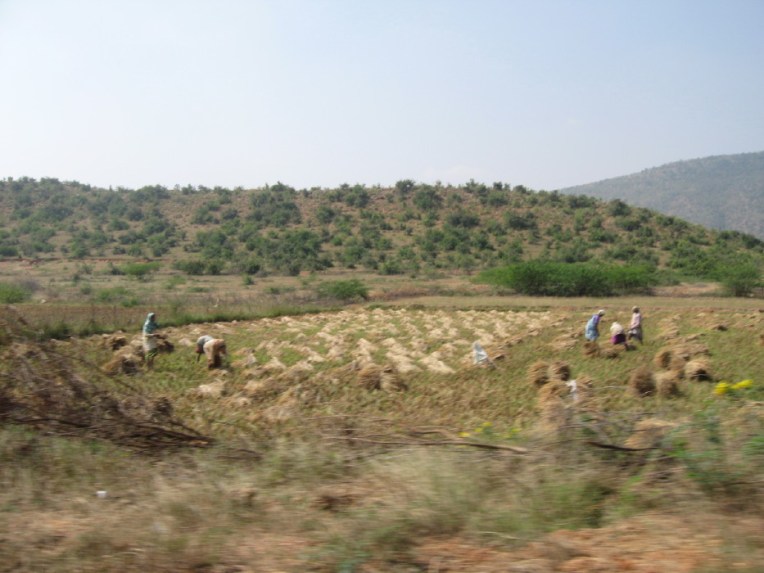
We travelled fast at first, there were many signs of people, of life starting to happen in the little hamlets which we passed, though I saw far less people than I had seen in Tiruvannamalai the last few weeks because of Deepam Festival.  I saw the sun rise over the farmers already working on the land, early and in the cool of the morning.

IMG_4860
The landscape started to change, the mountains became quite different in shape, edges more sharp and irregular.
The vegetation and the trees became very lush. In the hamlets along the roadside we passed women getting their children ready for school, we saw them carrying colourful plastic water containers on their head. We passed men herding large flocks of goats with silky coats.

IMG_4884
Many of the houses and huts, some of them circular in shape, were made of woven materials, making full use of locally produces building materials, the roofs becoming a bit higher as we got nearer to Andhra Pradesh, but we also passed many of the cement houses, they have flat roofs with railings and stairs leading up to the roof. Roofs are made good use of in India, these houses too were changing in appearance becoming more elaborate in their decorations, often with iron and stone trellises.

Andhra Pradesh
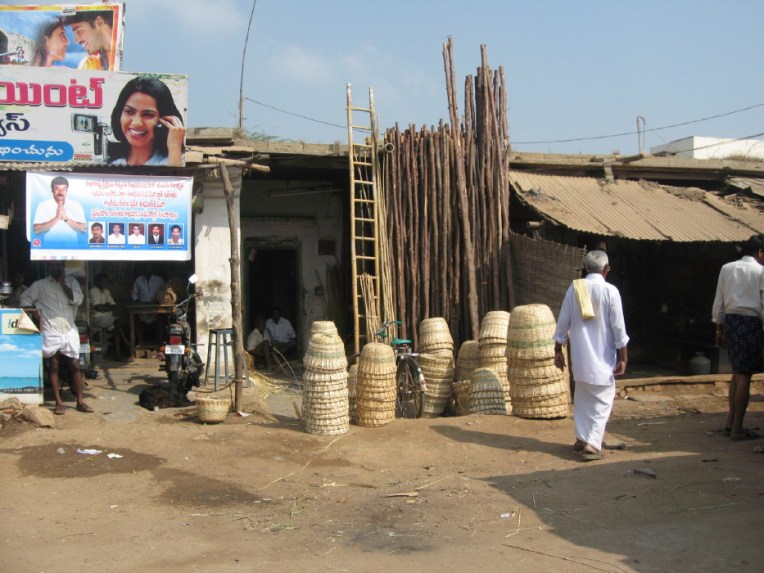
Many farmsteads have chickens running around. These hamlets and roadside villages are centres of commercial activity, shops, teashops, workshops, craft shops were people were working at making the crafts such as basketry.

IMG_5324

Outside the villages and along the road there were also many brick making places where people would be making the bricks and they would all be piled up and then baked either in the sun or in a special system of piling them and firing them.
Lots of basket weaving places near to Vellore also. Vellore is a large town with lots of colourful shrines and temples along the road, their use of colour reminding me of the choice of colour used in Celtic art, very vivid and bright.
It was very hot in the taxi, we were drinking some water to keep going.
There was so much to see along the way. I noticed two high Termite heaps which really impressed me.
The journey now took us into a much more agricultural land, with lots of crops tended along the roadside, crops such as peanuts and rice.

IMG_5338

Wonderful trees also, and banana plantations. In Kanumolapati we came across a very ancient Hindu temple, but the closer we came to Tirupathi the fewer the Hindu temples became, I was now seeing the equally lovely and interesting minarets of the mosques, some of them very beautiful.

In Kadapa town we had a bit to eat at the AP Tourism restaurant which had very good value for money, lovely food and good restroom facilities.
This journey took 12 hours, we stopped off at Agaral about 20km outside Tirupathi at the Park Avenue Hotel Gardens to have some excellent Thai.

All my memories of India are very precious to me.


THAT MOMENT WHEN THE SUN RISES

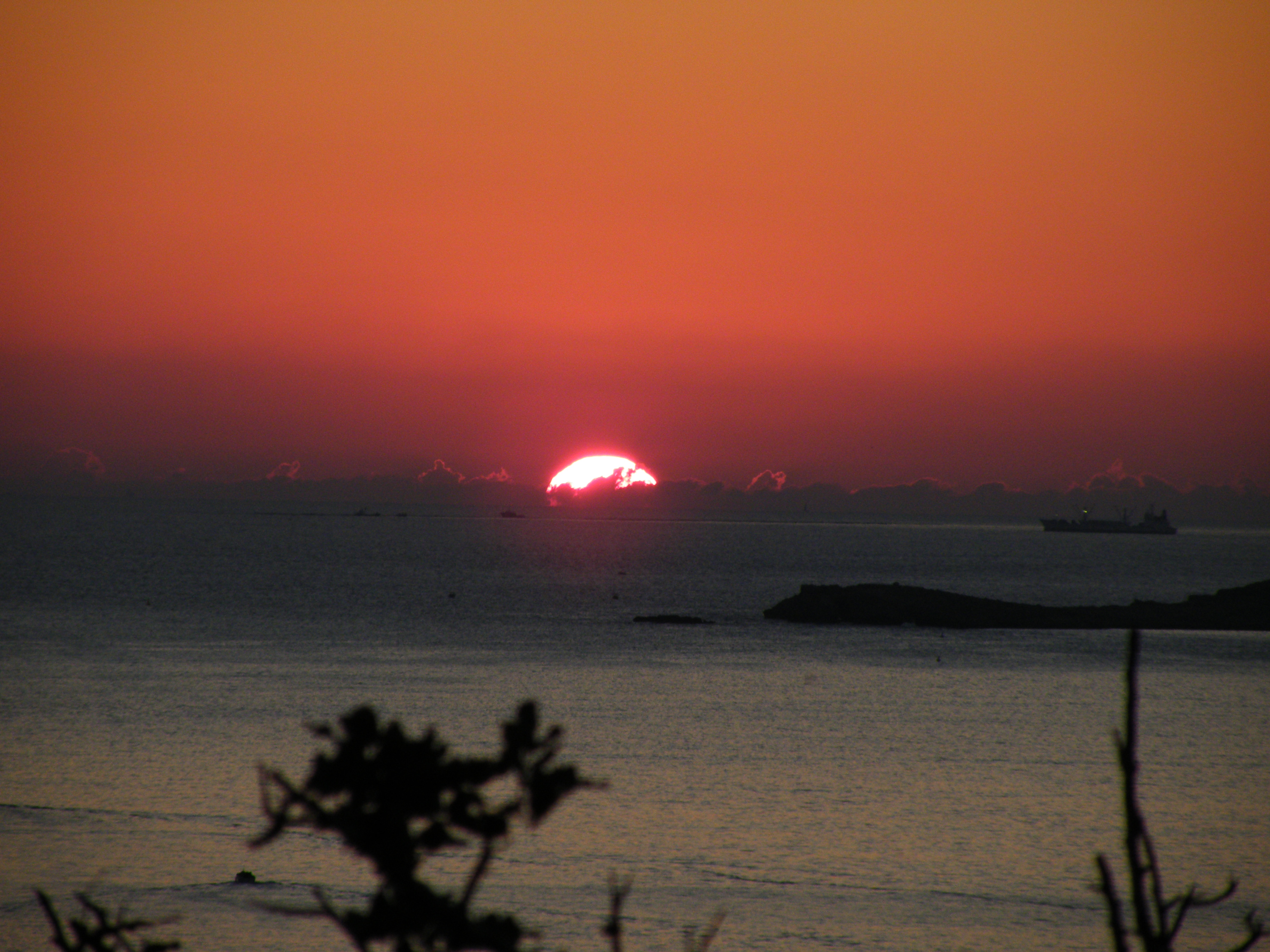
I was waiting patiently early in the morning, the sky had already begun to have a glow but nothing yet had appeared on the horizon, until all of a sudden there was the first glimmer of a sun.  The moment was magic, and I felt my heart fill with happiness, joy and gratitude, there was another day about to start, another day was breaking and in what a glorious way!  What a powerful moment!
DSCF3380

20171018_154801 Another day has started in which to explore, and see the beauty around me, and be intrigued by all the little adventures that this day would bring.

The gray-green leaves of the Olive tree, a beautiful flower, the bright colours of the Luzzu boat.

20171025_180121The view out of the window of my lace making class in Victoria.
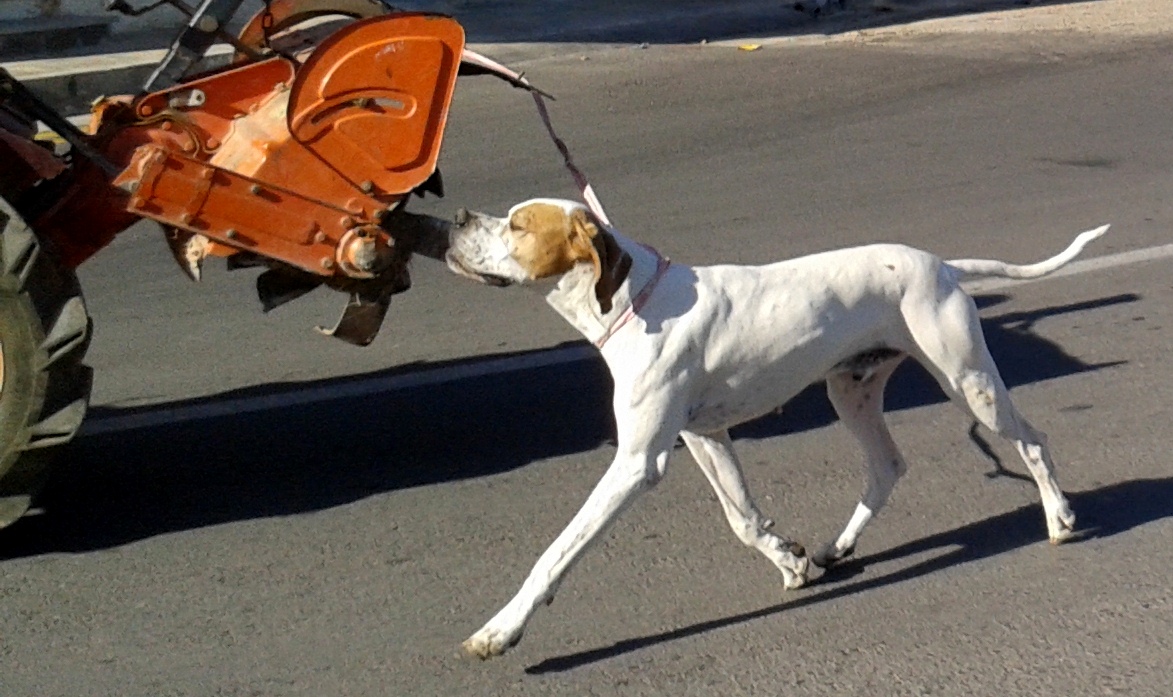
20171025_152530The humour seen in this proud dog trotting beside its owner in the funniest way.

20171025_151014And the funniest of all, me taking the wrong bus on my way to Victoria for my lace class and ending up doing a tour of almost the whole island before I got off the bus in Xaghra and taking another bus to town.  I so enjoyed this little detour and could only laugh at my own mistake!
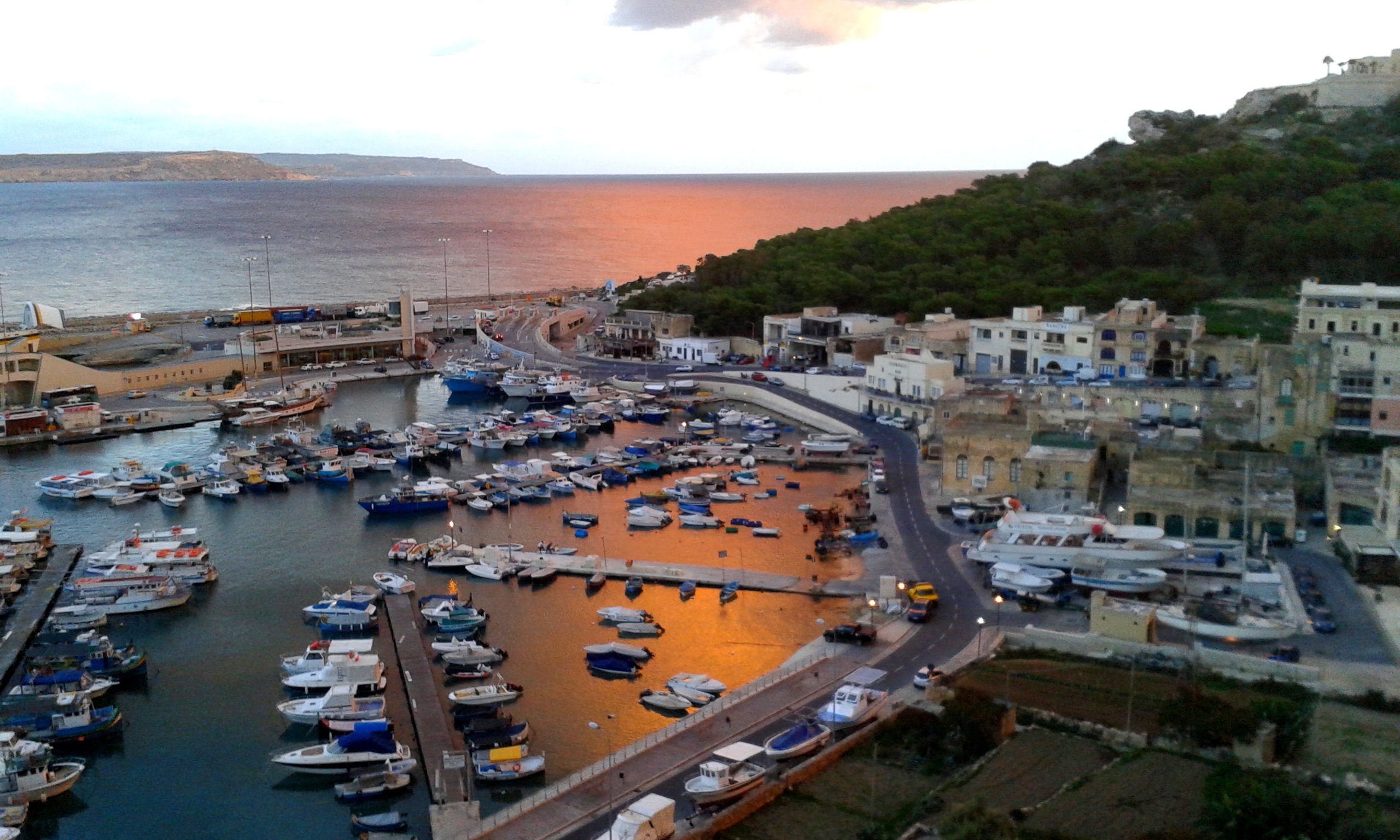
20171024_181143
And when the day is done and a glorious sun is setting, painting beauty for long moments more, then, well then it’s time to happily be grateful again.