“Darkness cannot drive out darkness: only light can do that. Hate cannot drive out hate: only love can do that.”
Martin Luther King Jr.
PART TWO OF A WINTER GARDEN IN CAMBRIDGESHIRE
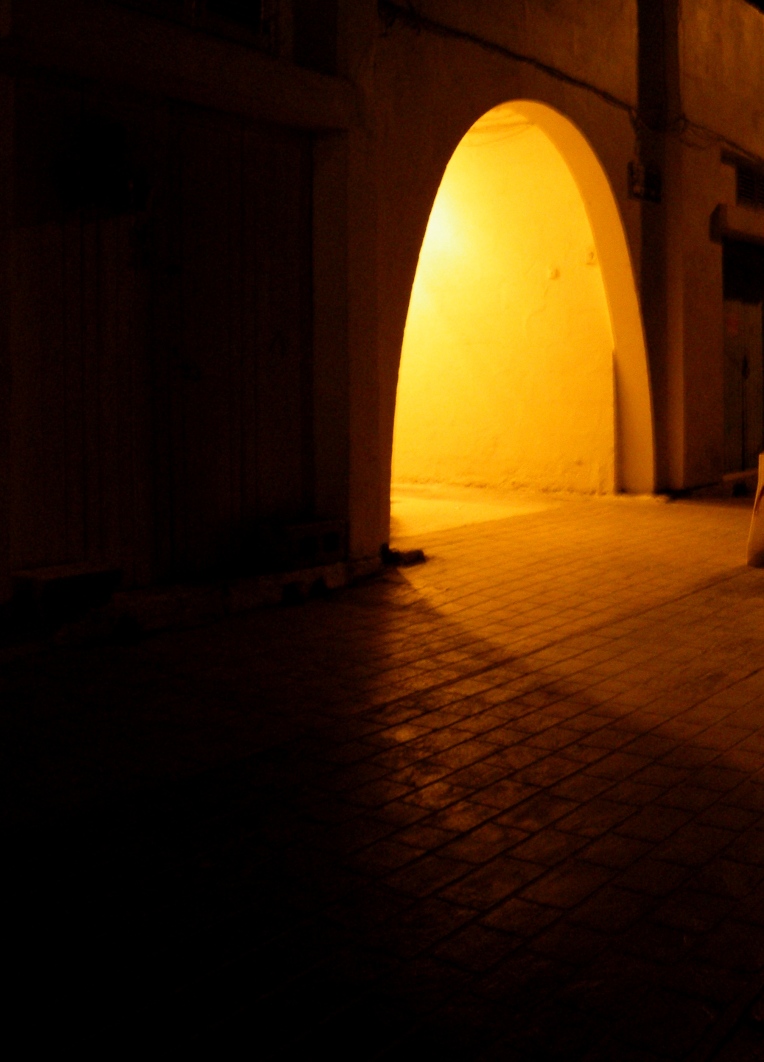
So we had just walked through the arch and entered that part of the garden where nature does more or less its own thing, though on the right there is a productive kitchen garden, which put my own to shame when it comes to neatness. And on the left we walked across grass overshadowed by a variety of lovely trees, mostly native to the Uk, and some already fully in blossom. This is the wilder part of the garden, it is a very important area, thinking of the many bees, bumblebees and other insects which are near extinction, or have decreased in number in recent years, it is good to have an area where they can be undisturbed and feed to their hearts delight. Here is more shadow because of the trees, it is also the quieter part of the garden, where one could sit and read, or just watch nature’s magic happen.
Then in the yet another part of the garden a lot of clearing had been done just recently, overgrowth of roses from a neighboring garden had been removed. In a garden this size there is always some work to do, and this is reflected in the beauty and the variety of the plants.
Here the borders, even though it was so early in the year show a lot of different colors and textures, as reflected in my next collage. A variety of different Hellebores is to be seen nearer the house.


Mahonia aquifolium


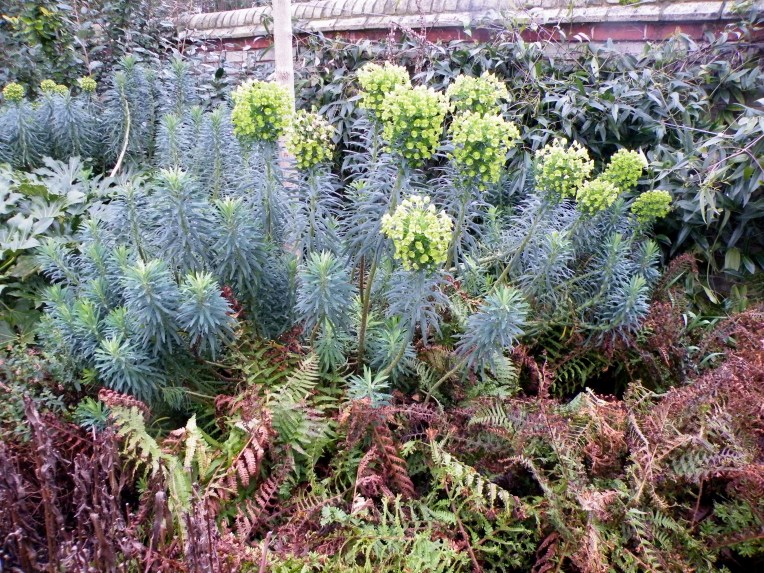
Ferns, and also Euphorbias make a lovely display.
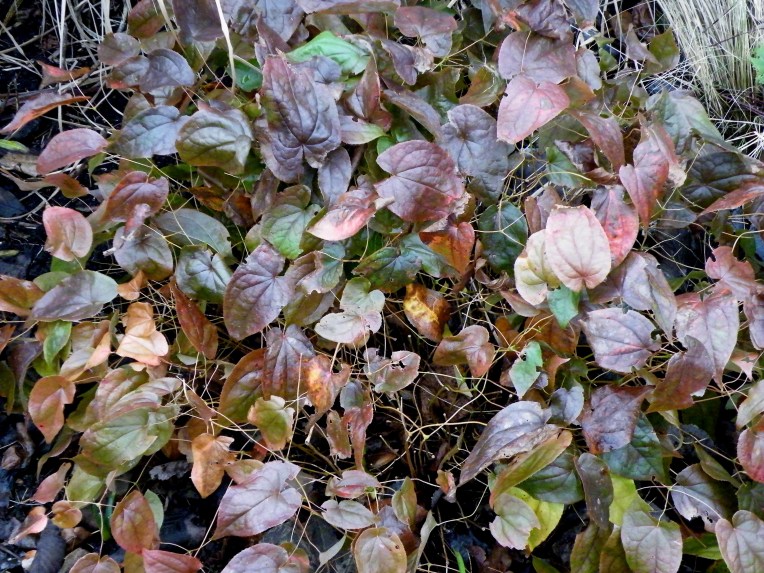
The colorful leaves of the Epimedium versicolor are a great ground cover.
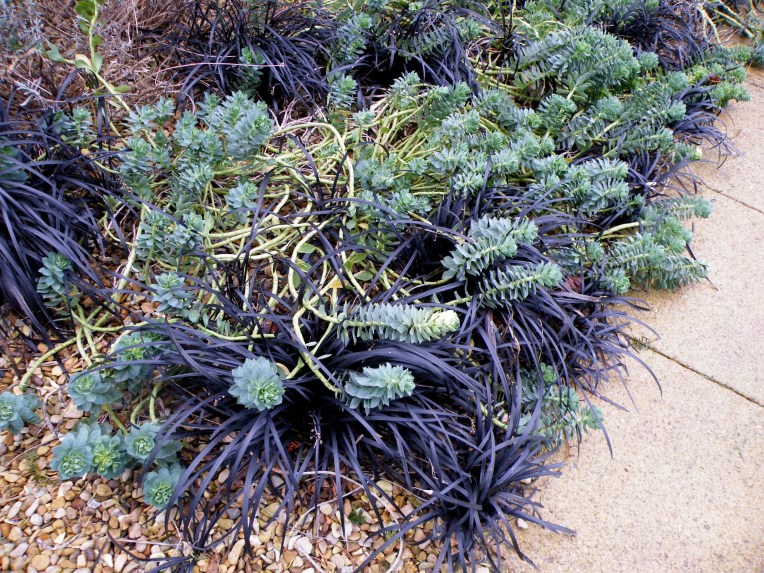
A succulent creeping among the black foliage, the black thin leaves conjure up images of being at the beach looking at some type of seaweed.


I see boxes for a variety of birds which I am sure they are happy to use, and the white bell-like flowers add a lovely touch, all these early flowers are so important for insects, it is where they get the first nectar of the season which will help them recover after the lean winter months. All of this has been thought of and planned for.
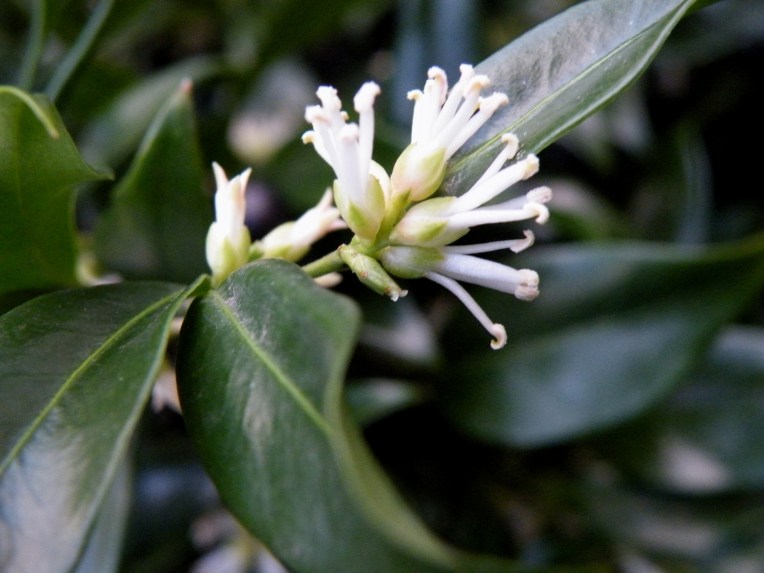
 This is one more subject that I would like to highlight, it is called Sarcococca confusa or Sweet Box, its scent will delight anyone and perfume a whole area, and its black berries are very attractive too. I am glad that I got to learn about this plant, as one of my future plans is to bring more scent into my own garden.
I’ve really enjoyed my visit to this garden, there is more one could say about what grows there, I have not even touched on the herbs which grow close to the house. Of course as my visit was in winter, I am sure that there is a lot more to see in summer. I am already looking forward to my next visit. I get ideas from visiting other people’s gardens, some of which I will try and use in my own garden. I’m certainly very interested in creating colour for my garden in the winter, it would cheer us all up during those dull and misty days.
My thanks go to Ruth and Colin for their kind permission to use their garden in my blog writing.
A WINTER GARDEN IN CAMBRIDGESHIRE
During the very early spring days of 2016 I had the privilege to visit a beautiful garden in the South-East midlands of Britain, in Cambridgeshire. I received kind permission to use photos and information here in my blog from the lady who is the creator of this marvellous garden.
What appealed most to me was the way the eye was led effortless through a variety of colours and textures, shrubs, purposely dried flower heads, trees and their undergrowth, borders, arches, hidden corners, effective hedging and ornamental pebbles, trellises, wooden fencing, all making this garden into a whole that works, and that even in winter can, with ease, hold the interest of any visitor.
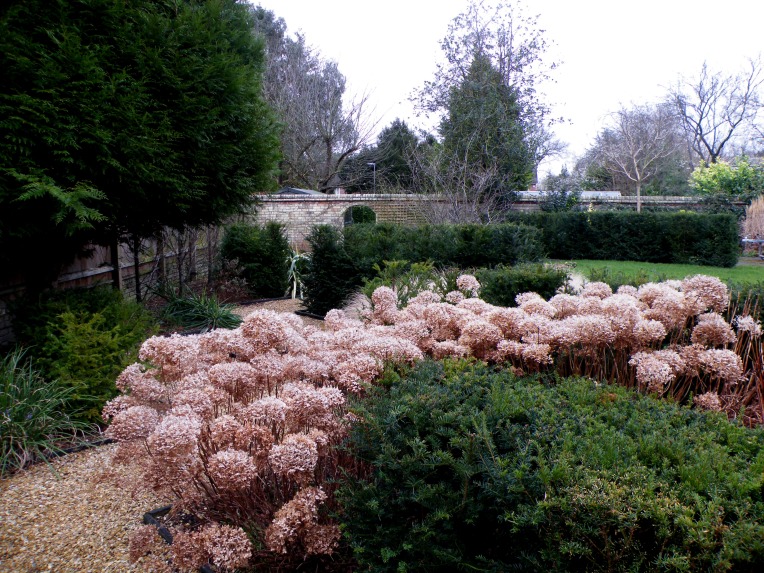
The hydrangea arborescence Annabelle, and the dry grasses here add some lovely beige colour in stark contrast to the evergreens. The Iris Unguicularis flowers give a magnificent bright blue among it’s own rather dull foliage. The Gold Dust Variegated Aucuba, looks indeed as if it has been dusted with gold, it is a lovely subject. The spiky foliage of the, what I think is a Cordyline australis Variegata, but I could be wrong because I can’t rightly remember the name I was given, highlight sharply the more rounded subjects around it. I enjoy such a variety of shapes and patterns.


Iris unguicularis


As you walk through this lovely arch you have entered into a grassy area where you will find a variety of trees and even some hidden corners, the undergrowth at this time are made up of colourful daffodils and snowdrops. You also enter a very organised and productive vegetable plot, all of it sheltered from harsh winter gales by the high fencing and the trees. I found jasmine climbing along the hedgerow here, not quite flowering, but that must give a lovely scent in it’s season. Everything in this garden. as in the general area, is ahead of it’s time this year, I’ve heard so many people say this both in Ireland, and also here in the UK, blossoms are well ahead, the magnolia flowers are almost open. Daffodils are blooming gloriously.


There is more to say and show about this lovely garden, but I could not load anymore photos, I want to talk about the ornamental shrubs and flowers in the borders, among other things, so I will follow this blog entry up with another one. I hope you enjoy as much as I do.
THE LAND WHERE LEMONS GROW – a wonderful book.
The past week or so has taken me through the history of citrus growth in Italy, this via Helena Attlee’s wonderful book which I’m reading. My senses are titillated by her words describing the scents and perfume of different lemons and oranges, their colours vibrant against a blue Mediterranean sky. Descriptions of use of these delicious fruits in local foods, drinks, candied skins, and marmalades bring the book to life. Helene brings one on a journey of the region back in time, and tells how the citrus industry took root there, something I did not know anything about, she tells how the Arabs first introduced the citrus trees to Italy. She covers the growth of them in Sicily and goes into some of the history of the Mafia there which is connected to what was a developing industry of growing citrus fruit and exporting it all over Europe and as far away as Russia.
Recently I caught a whiff of an orange blossom while in a garden centre in Cambridge, the scent was delicate, the flowers pale and beautiful.
One aspect of all I read has delighted me very much. It is the story of the essential oil of Nerola, an expensive oil that I once owned and the scent of which was most pleasant, lifting the senses totally. This oil is even now used as a principal ingredient in the manufacturing of modern perfumes. The Chinotto trees of Savona which produce a sour orange are used in the production of Nerola oil, it’s extracted from the citrus blossoms and fruit skins. Helena devotes a delightful chapter describing all of this.
I also learnt that the best marmalade ever is made from the organically grown oranges called tangelo, the flavour is supposed to be something else, it’s not available everywhere, but supposed to be exported to America, and available in London at Sloane Square under the name San Giuliano marmalade. I’d sure would like to try some one day.
Helene Attlee’s travelogue is exciting and written in a fluent, easy style. Oh and one other result from reading this book, I will never walk into a supermarket again and look at the display of citrus fruits in the same way, and that is a very pleasant result as I do not enjoy grocery shopping.
But honestly there is so much to read up on citrus fruits, the trees, industry, botany, cultivation and so on that it could keep one busy for a very long and pleasant time.


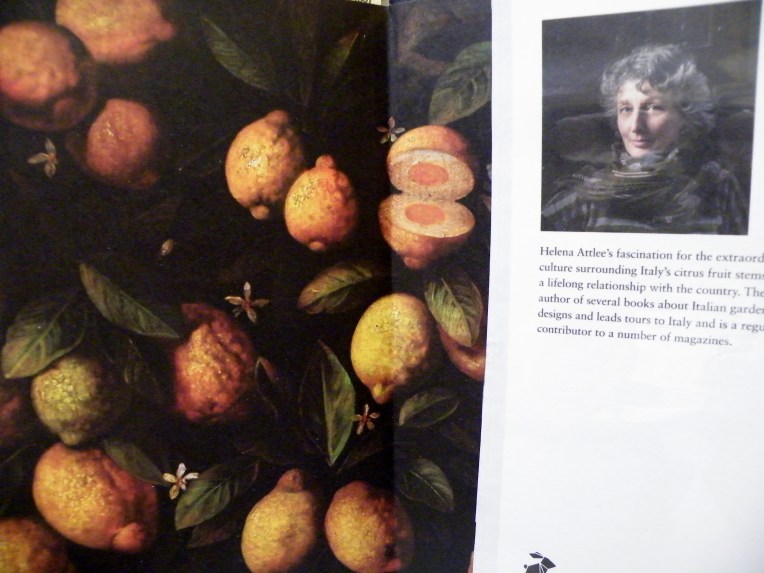
The inside of the cover from the book features Bartolomeo Bimbi’s painting of the many varieties of lemon grown in the garden of Cosimo de’ Medici, and a photo of the author.
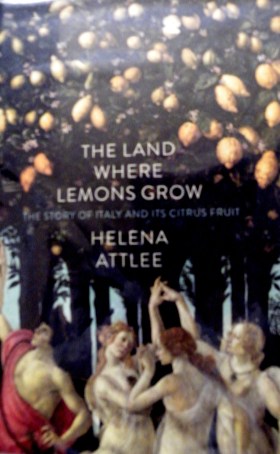 Cover of the book, available in the library system.
YOUNG TENDER SHOOTS AND COLOURS
I took a walk around the garden this mild spring afternoon. I went to see what vegetables are still growing, and what young tender shoots or flowers are hiding here and there, and of course they were. I came across a whole range of fresh young growth that shot up all of a sudden because of the sunshine in the past week.
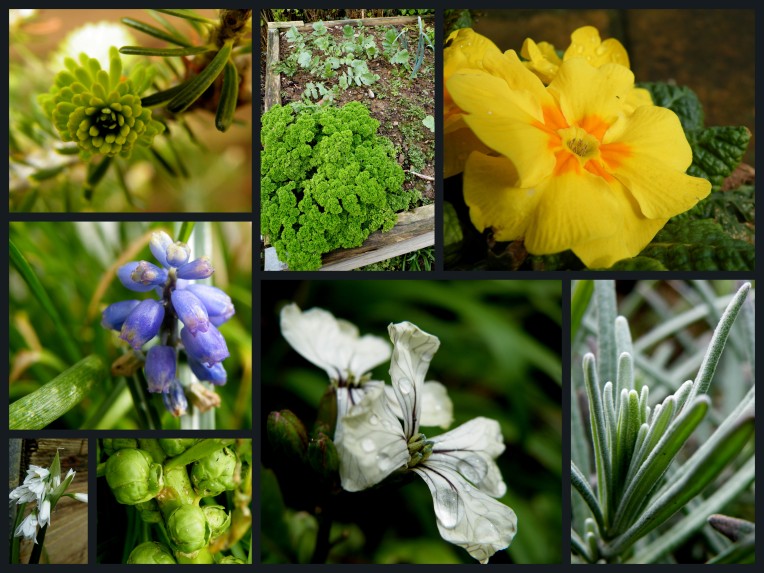
The comfrey, tansy, lungwort, hypericum, foxglove, wild leeks, are all throwing out young shoots, some are near flowering. My winter garden did not produce as much as I had planned, partly because the slugs ate some of the produce, and partly because the rain and storms destroyed some of the vegetables, in fact the soil became too wet for anything to grow. But the Brussels sprouts are still growing strongly, small as they are, they are looking good enough. My white round radishes are doing well, as are the beetroots and the leeks. And the kale is still lasting, even if we ate from the plants regularly. One of my kale plants has grown over 1.50m and is looking fabulous, I am leaving it as an experiment, it is now growing new small leaves among the large old ones, I want to see what happens next. The lavender plants are shooting up well, the grey green young leaves adding to the variety of colours now in the garden, as are the primroses and grape hyacinths, they are just about flowering, they too are bringing some very welcome colour to the garden. And our little Korean fir tree is really doing well, ever since I put it outside again after Christmas it has been showing an abundance of shoots, leaves but also cones, beautiful.
In another week or so we shall be going away for a month, and so my garden will have to take care of itself, which I am sure it is very well capable of, I am already curious what I will find when we return, will there be a lot of wild plants, to be sure there will be, I remember from last year that the goose grass had overtaken the garden fast enough. I will let it be, I’ll tell my grandchildren to come and take away the produce that is there though. One job that I will try and fit in is to spread some leaf manure over the raised beds, I think the soil will benefit from it greatly and I have plenty of it.
And now soon for us it will be looking at the flora, the insects, the architecture, the folklore, the rocks, and the people of the island of Malta, a whole new experience awaits.
WHAT A BEAUTIFUL DAY!
Back in February 2014 I published this write up in my blog, I was only writing for one month. Because today was such a beautiful day I decided to re-blog this.
A LITTLE FROSTY, BUT SUNSHINE
Some of these mornings lately are frosty, and the garden looks a little white, but the nice thing about it is that we get sunshine along with it, so very much needed here in West Cork. Clear the air too. The garden is waiting for attention, but my mind is on other things right now, and it’s all good. All will be in order for a fabulous growing season.

A MEETING OF GIY (Grow it Yourself)
Tonight was the first meeting this spring of the local GIY group in Skibbereen, the town where I live. It was well enough attended and all those there shared some of their own wisdom and garden lore, this made the meeting very interesting and motivating. One of the persons had issues growing coriander and was looking for tips on how to succeed, one of us suggested that he would start showing the seeds straight away, saying that February, is the ideal time to sow coriander because of the short amount of daylight still at this time, and to sow the seeds against a North facing wall. Another person brought up growing basil and yes of course it is not easy to grow basil here because of the climate. There was advice about growing blight resistant potatoes, I was actually surprised that blight is still a problem in these days. There was chat about growing more flowers to facilitate the bees. I brought up the question about trees, should we be growing fruit producing trees, or should we stick with the decorative trees. I am leaning very much towards taking down our larger trees and growing apple or pear trees instead, but the jury is still out on this. Another person said she was looking for ideas to use in the school where she works, for the children. Then there was the person who was disappointed that her rhubarb had disappeared, she was given advice to try and use Rock phosphate but to keep it away from the leaves, other advice I heard was to use fishbone meal and to scatter that around the soil to improve the growth of sweet peas, and lots more. I think of course we need to use discretion, but also to remember that some of these people are well seasoned gardeners and vegetable growers.
The link to the GIY website is:
http://www.giyinternational.org/
But before all this we had been shown a video about the ‘Incredible Edible West Cork’ initiative, this is an initiative where the community is encouraged to grow vegetables anywhere they find a space, be it in containers, in corners, along roads, little plots, elderly peoples gardens etc… and the food produced should all be for people to take away free, it is a lovely initiative and actually all the participants in the meeting showed enthusiasm for this idea.
A link to their site: http://westcorkgardentrail.com/incredible-edible-west-cork/
We also discussed our local community garden and how we see the new growing season, volunteers were requested for a variety of jobs, including taking school groups and showing them around and helping the children to help with the garden work. We were told that last year children grew potatoes there and each child went home with a couple of potatoes at the end of the growing season which of course is lovely and a great encouragement to these kids.
We finished up the night with swapping seeds, and sowing some, and of course more chatting about seeds and growing…
It was a very enjoyable and inspiring meeting. My hands are getting very itchy to start work in our garden, though right now the soil is still too wet, but I will be sowing some seed in the next few days.


FROSTY MORNING
This morning a glorious sun rose over the hills to the East, a bright blue sky welcomed me from my dream-filled sleep. The grass fields across the valley looked like well ironed patches, smooth and very green. And in the garden there I found jewels. Jewels because it had frozen during the night, but already the thaw had set in, some of the vegetables and little plants were still beautifully laced with ice. Texture and colour, a feast for the eye.
A precious new morning, a beautiful new day.
I feel energized from this sunshine,
something to be very grateful for.


 agoyvaerts