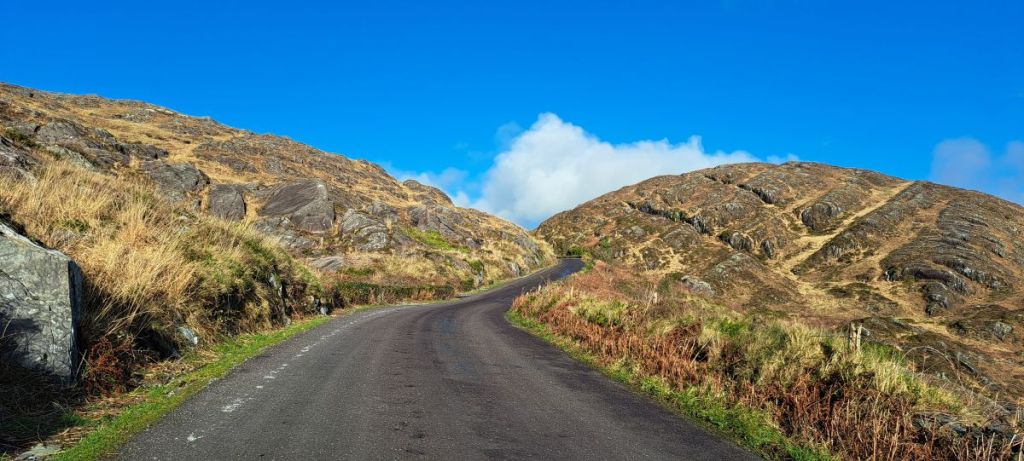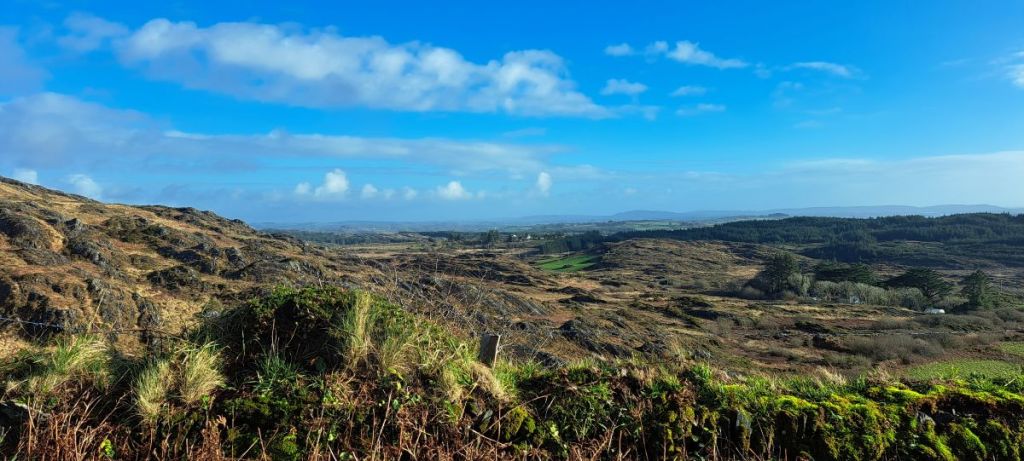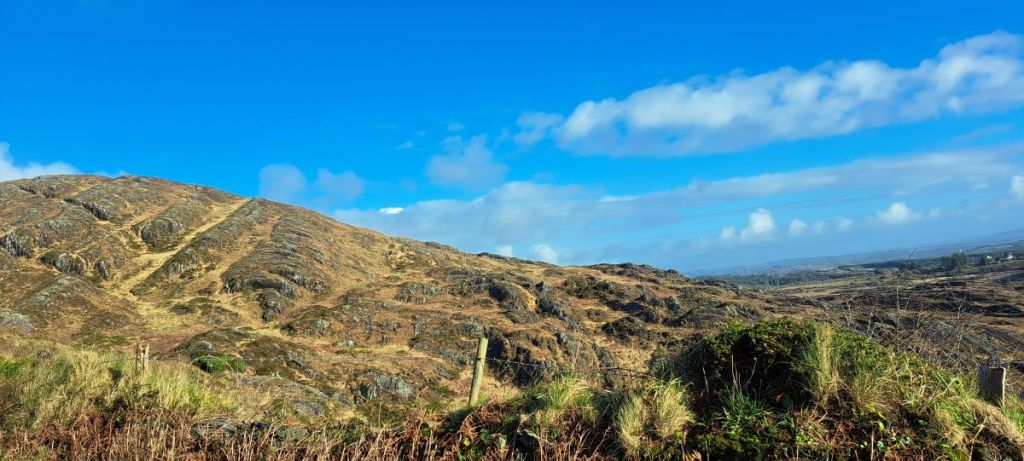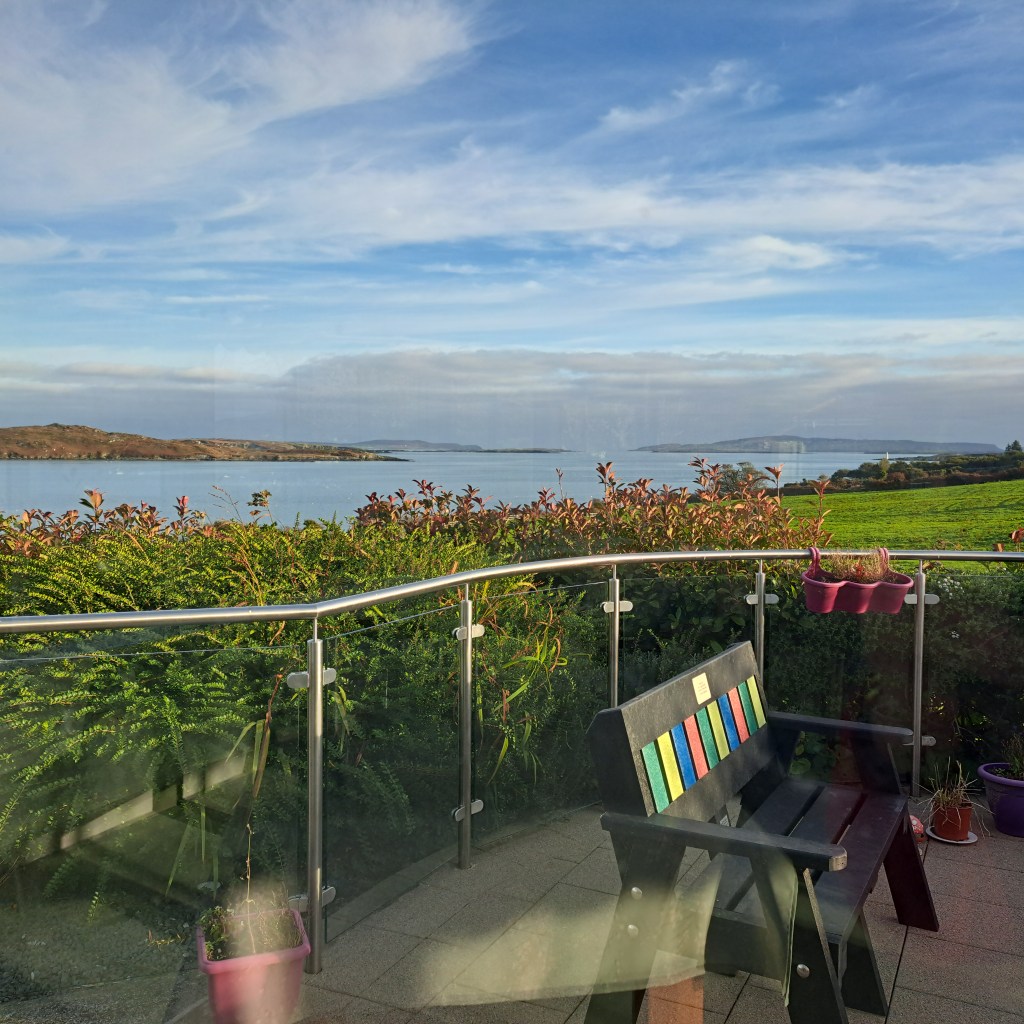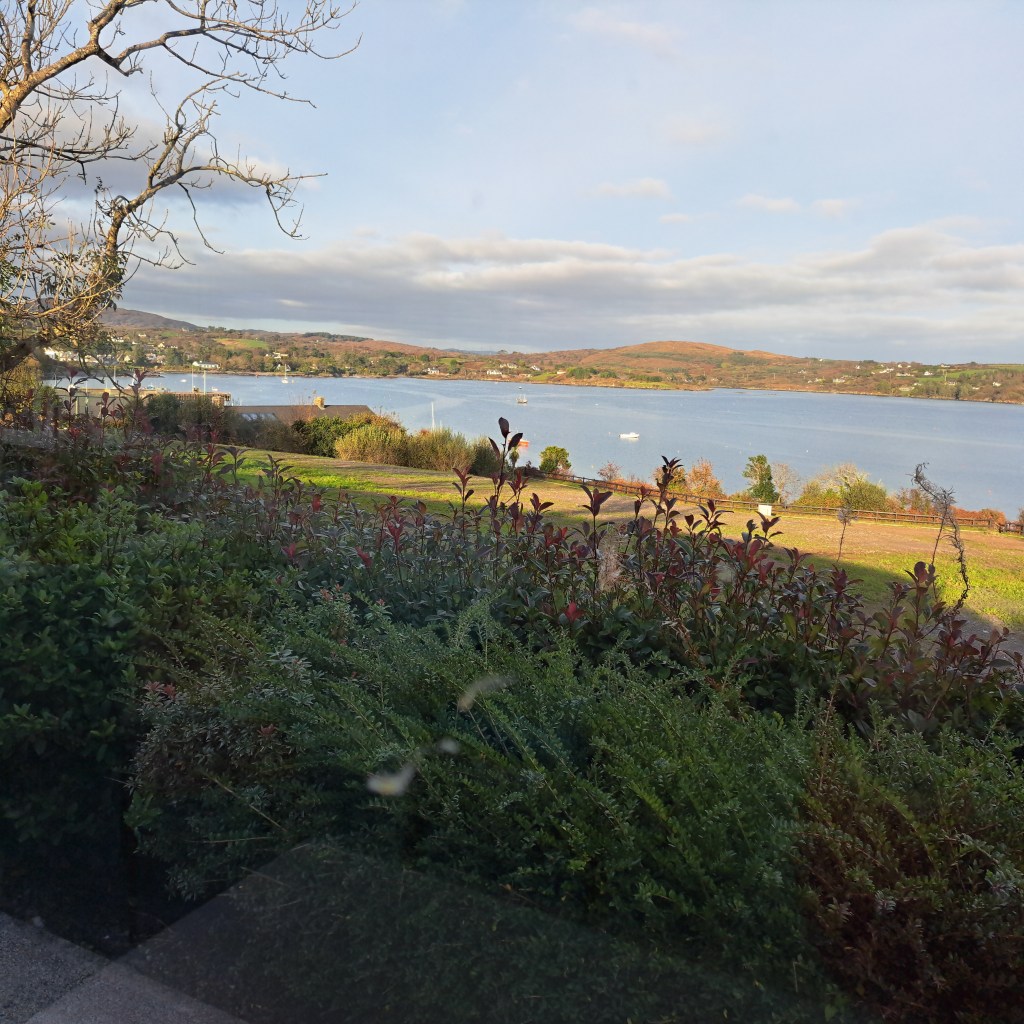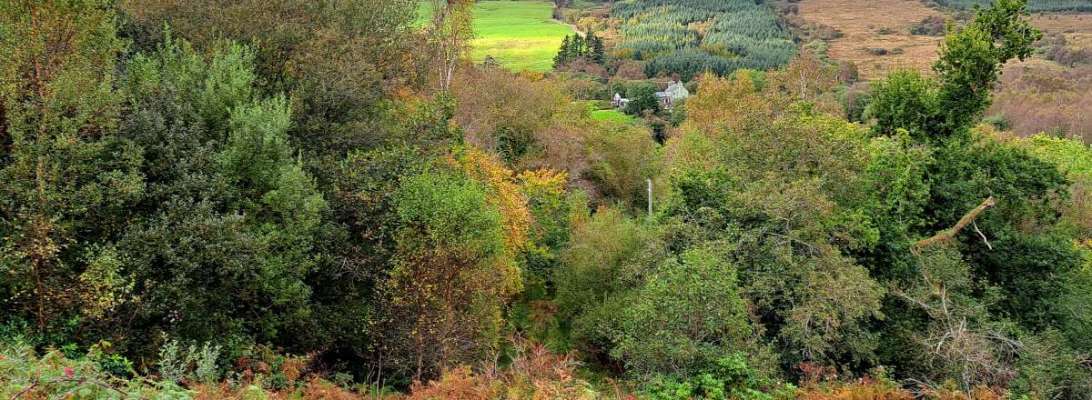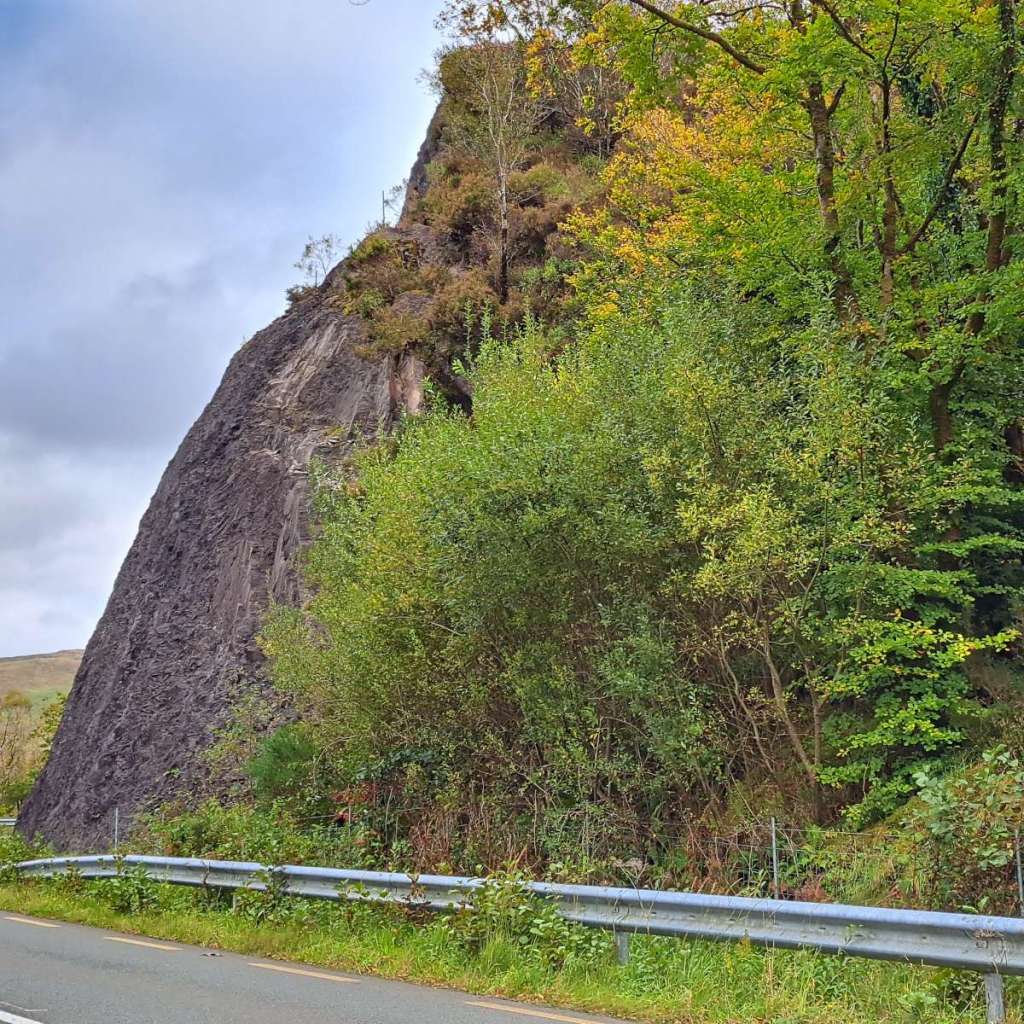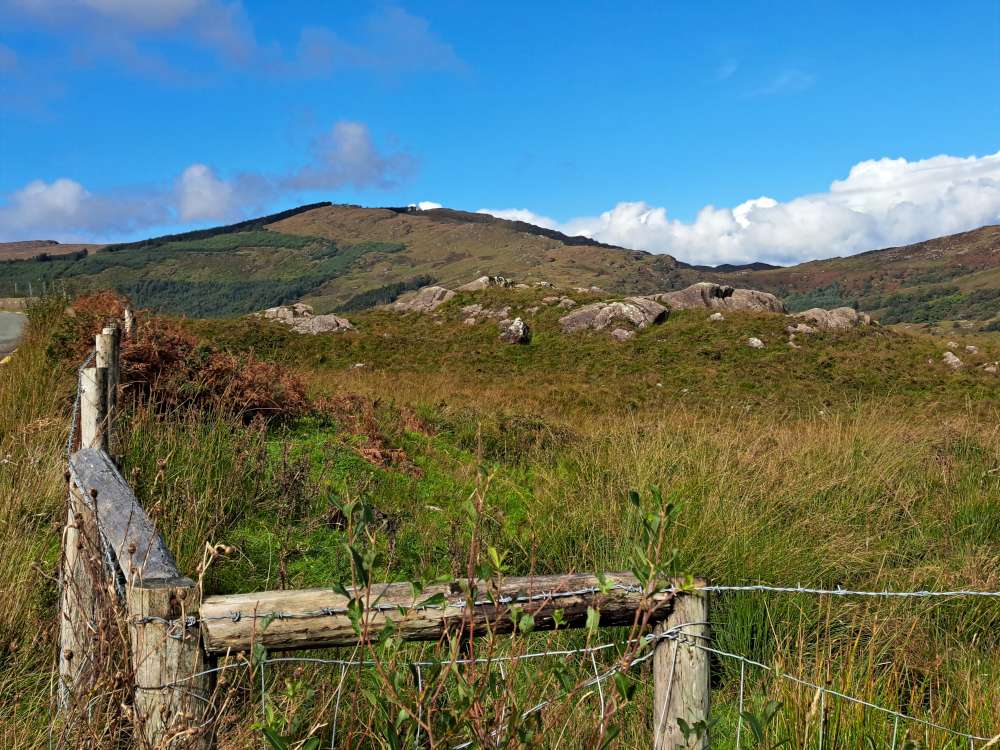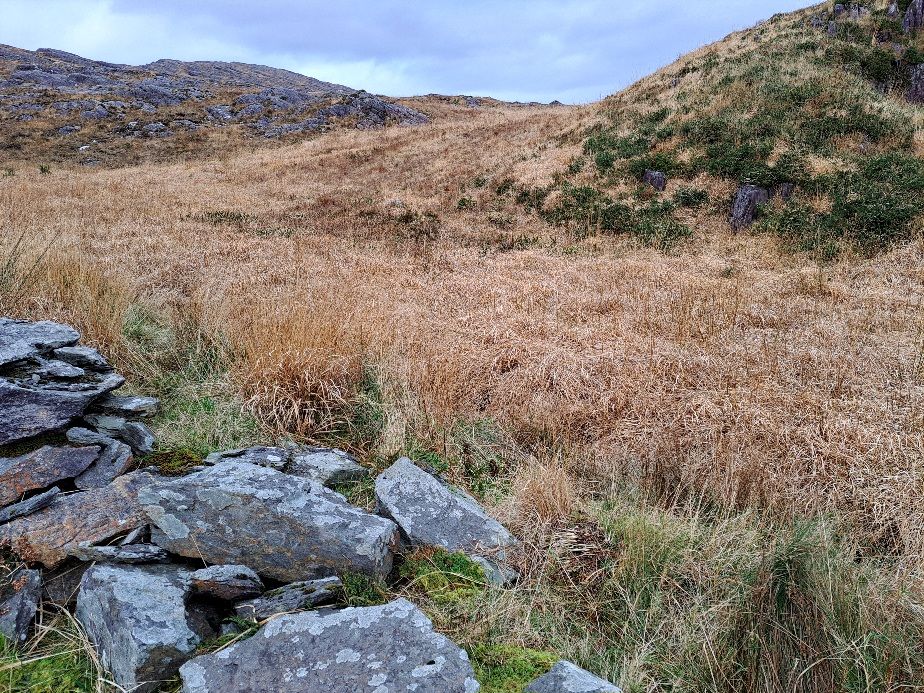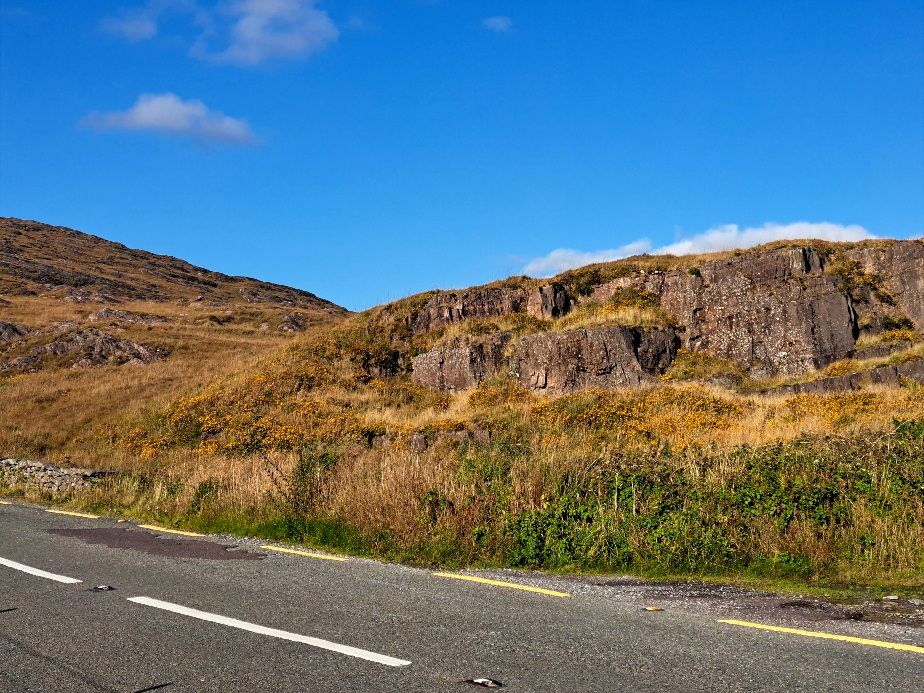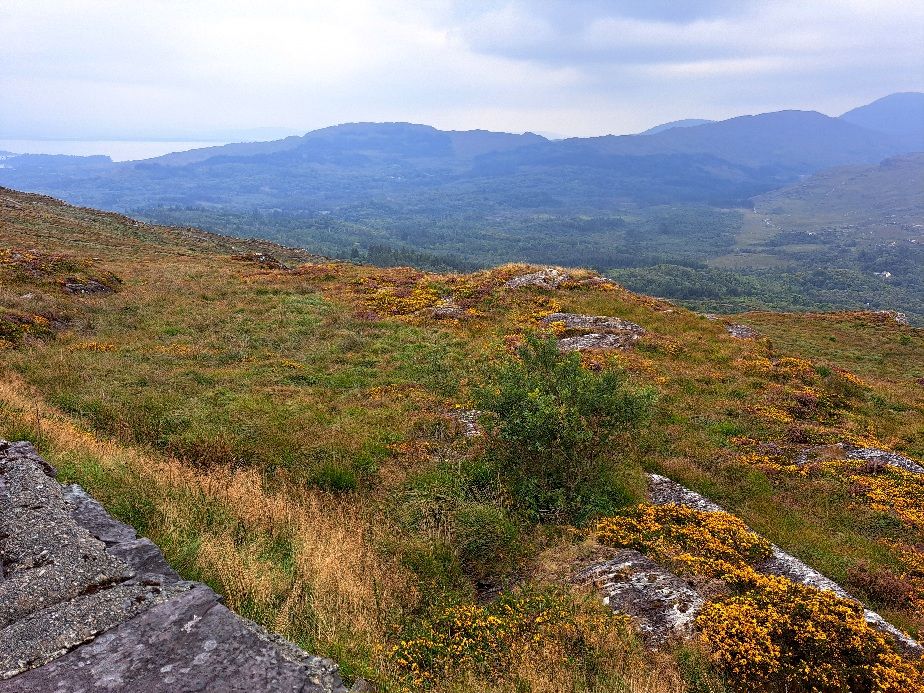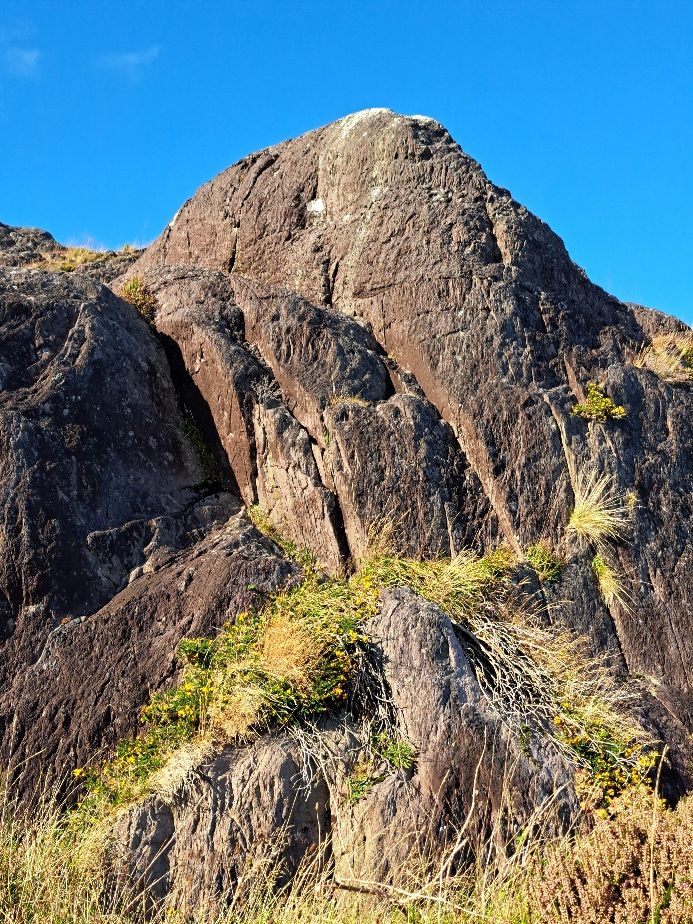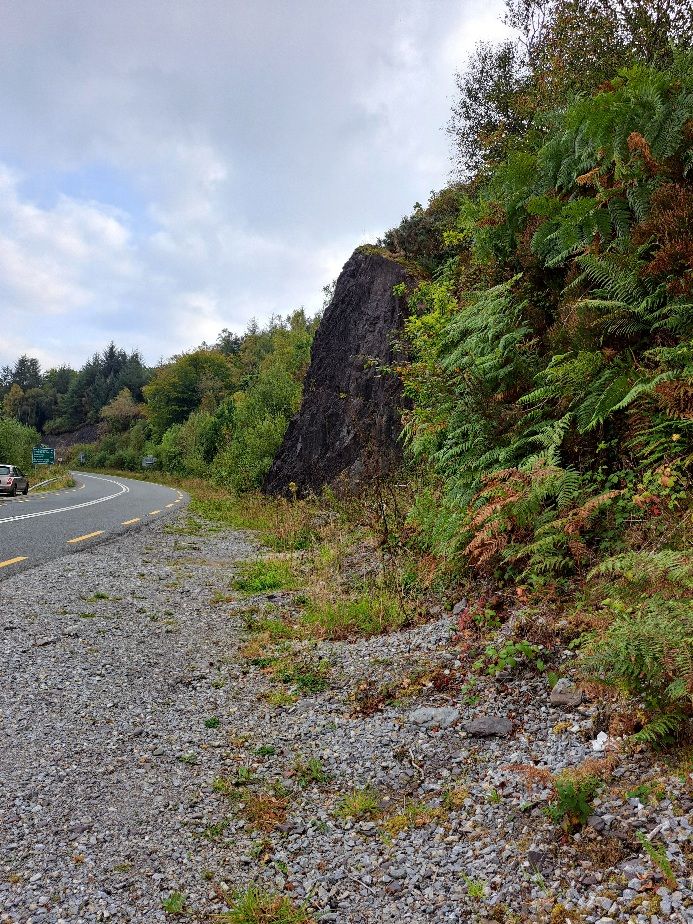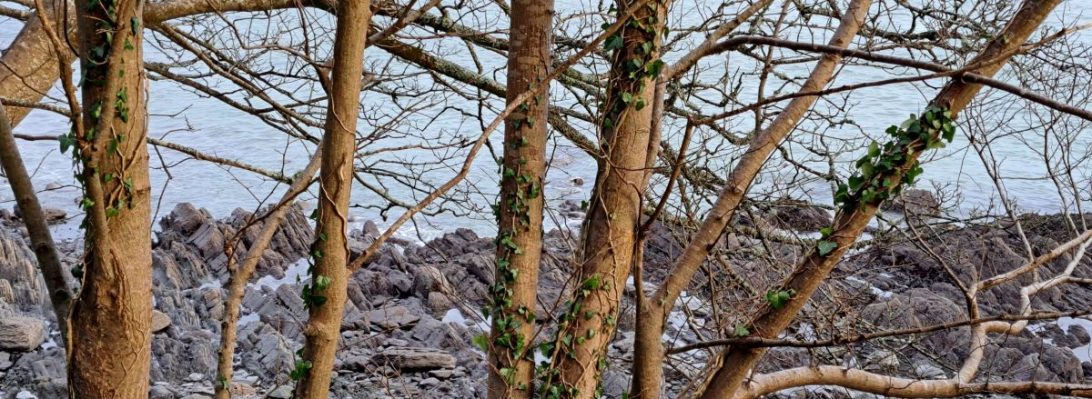
Along the road, somewhere in county Kerry I recently did a discovery. While on one of my journeys I stopped to take autumn photos and also to take a look at this cottage. I had often wondered while passing who would have lived there long ago, and why the people left, and where did they go, maybe across the sea to America as a lot of Irish people emigrated there in the late 19th or early 20th century. Anyway the house is boarded up but still looks in good repair. It is nestled among beech and other native trees, now beautifully coloured, and it looks out down the valley with hills in the distance. Some of the land is bog-like with a variety of grasses and sedges, some rocky outcrops and low bushes, and lots of bracken, beech and birch trees, a mixture of colour at this time of year.
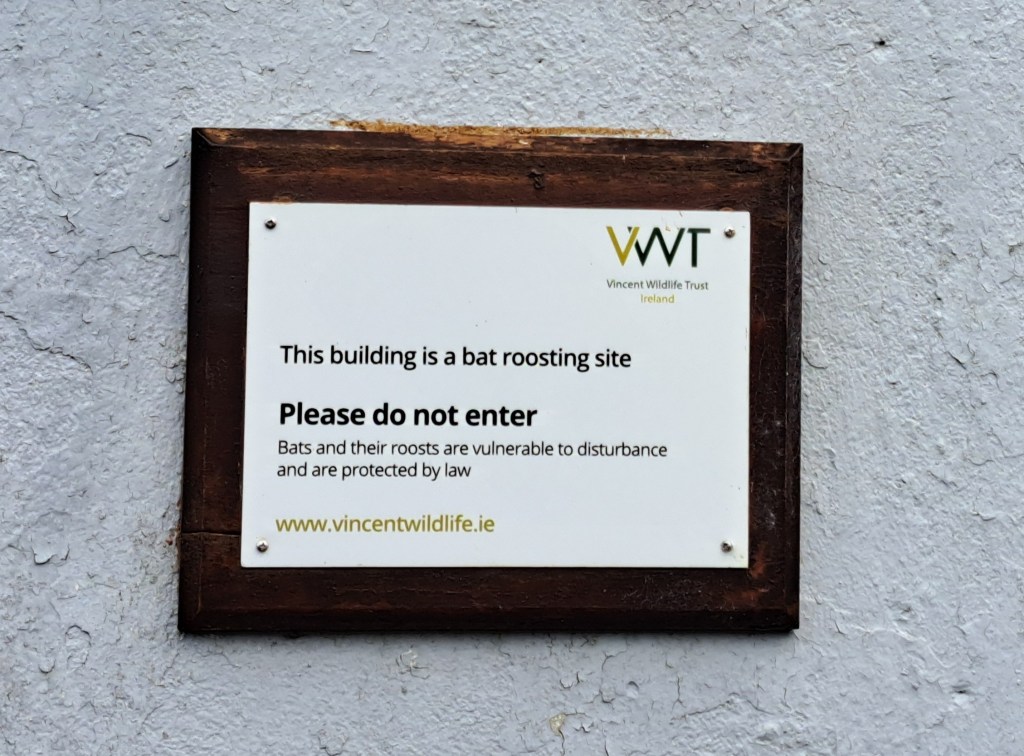
To my surprise I found a notice fastened to the wall of this cottage, it happens to be a roosting place for bats, and in particular for the lesser horseshoe bat. An organisation covering both Ireland and England called the ‘Vincent Wildlife Trust’ has a long and successful history of establishing and managing reserves for rare bat species. It manages 37 sites in Ireland, England, and Wales, all of which are roosts of the greater or lesser horseshoe bat. In Ireland, the Trust manages 12 reserves for the lesser horseshoe bat. And so this cottage has been put to very good use.
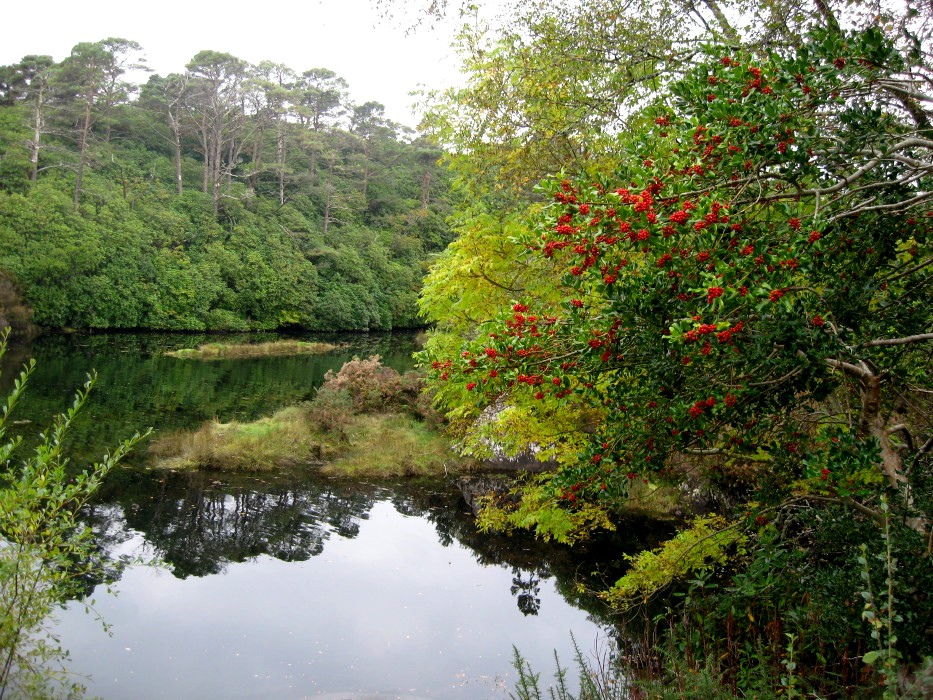
Some days ago I took the notion to spend a few days in Glengarriff in West Cork. Glengarriff is a peaceful village lying in a lush valley surrounded to the south and east by the Caha and Shehy mountain ranges and to the west by the Bantry Bay. Its climate is subtropical and this is seen in the lush plant growth, home to several rare plants and trees, like the Strawberry tree (Arbutus unedo) and the royal Fern (Osmunda regalis) for example. Close by are the Italian gardens, situated on a small island better known as Illnacullin island, a beautiful place to visit.
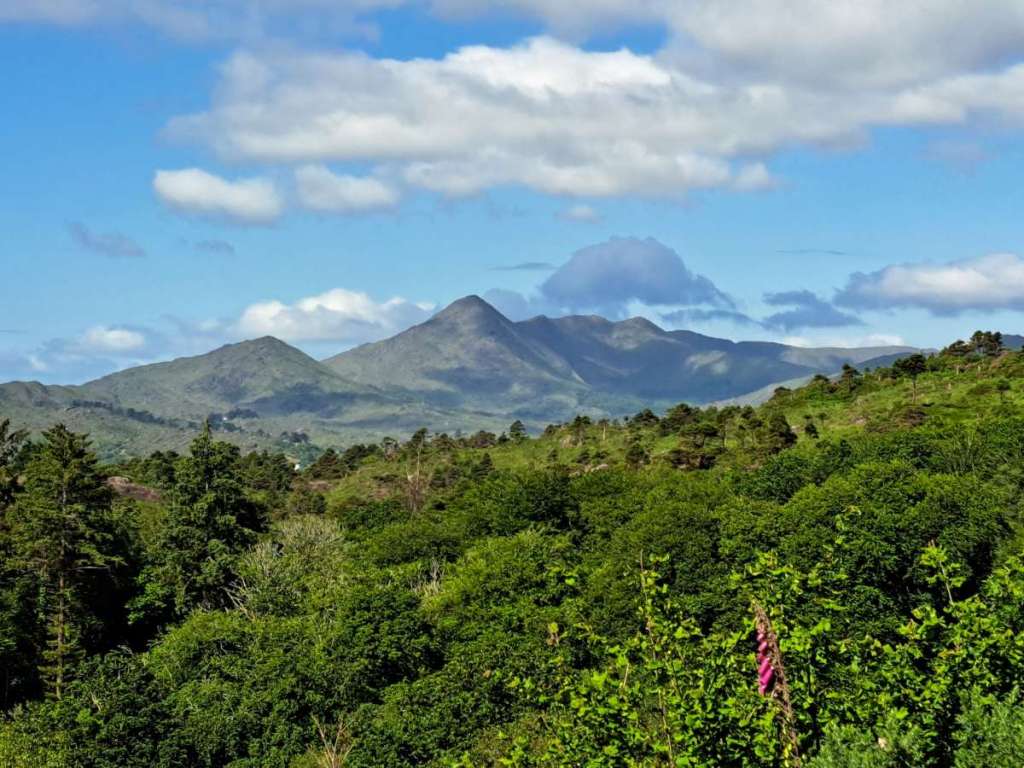
Sugar mountain and Shrone hill, part of the Caha mountains in which glacial valley Glengarriff lies.
The Blue Pool, accessible right from the village
I think that most of all Glengarriff is a place where you can relax and unwind, but also a place where, in the village itself, people congregate in and outside of pubs and eateries, and so a lovely ambience resides. I often travel through this little village, I always stop to soak up what Glengarriff really is, a place of beauty, of peace. Even the scent is full of fragrance, the fragrance of fresh air, of oxygen. Very restorative!
Early spring in the village 2025
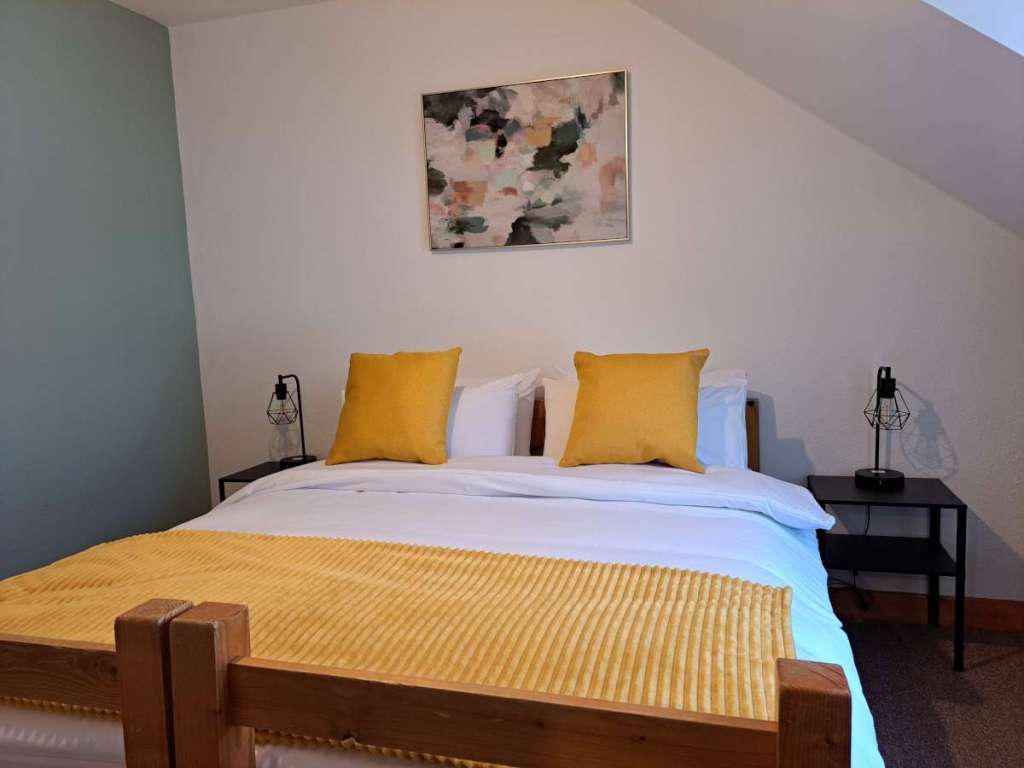
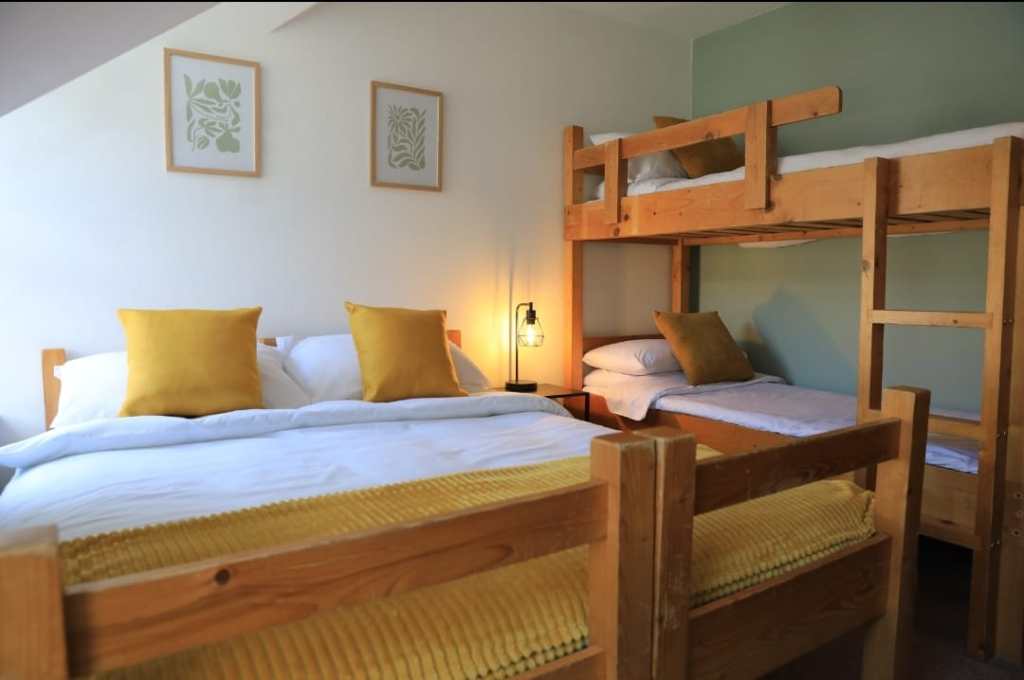
Why am I writing about Glengarriff? First of all I love the place and have spent time there, and secondly because of where I stayed. I like to put the Glengarriff Hostel on the map because it is an amazing place. I’ve always loved and travelled using hostels, and this is one of the best. What a nice way to travel and meet new places and people in a way that is adventurous and affordable. Glengarriff Hostel has a mixed dorm, a female dorm, family and private rooms. A comfortable sitting room and a great kitchen with a terrace looking out towards the Blue Pool and Shrone hill. Find out more on https://glenhostel.ie/
The Hostel with Shrone hill behind itPrivate roomChill out roomKitchenEntranceOne of the dormsFamily room
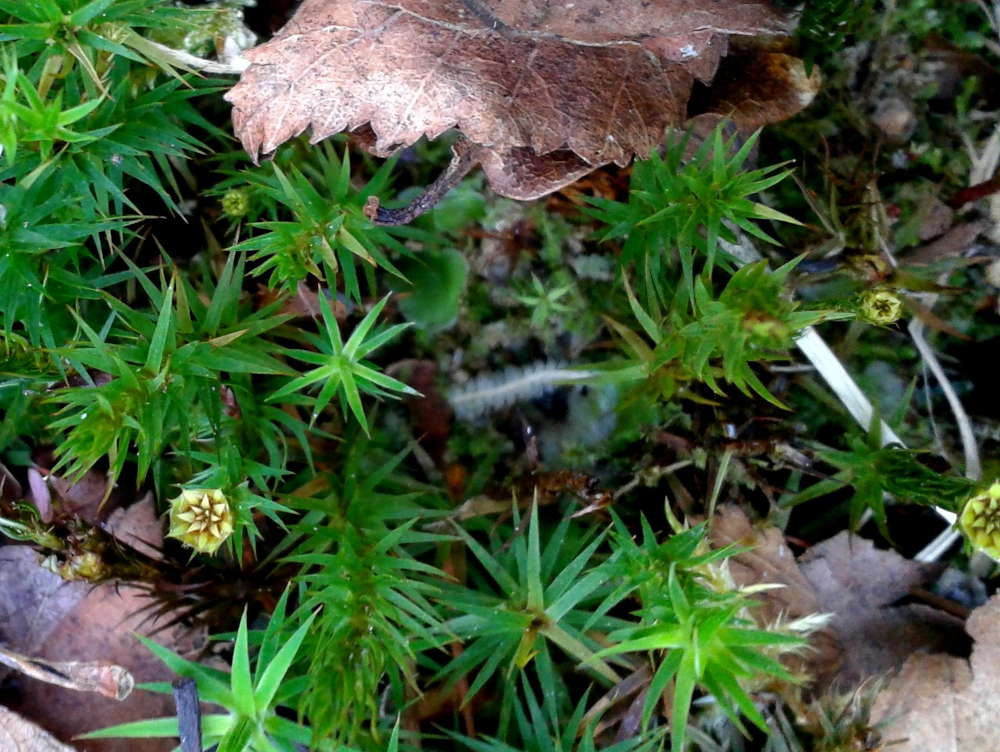
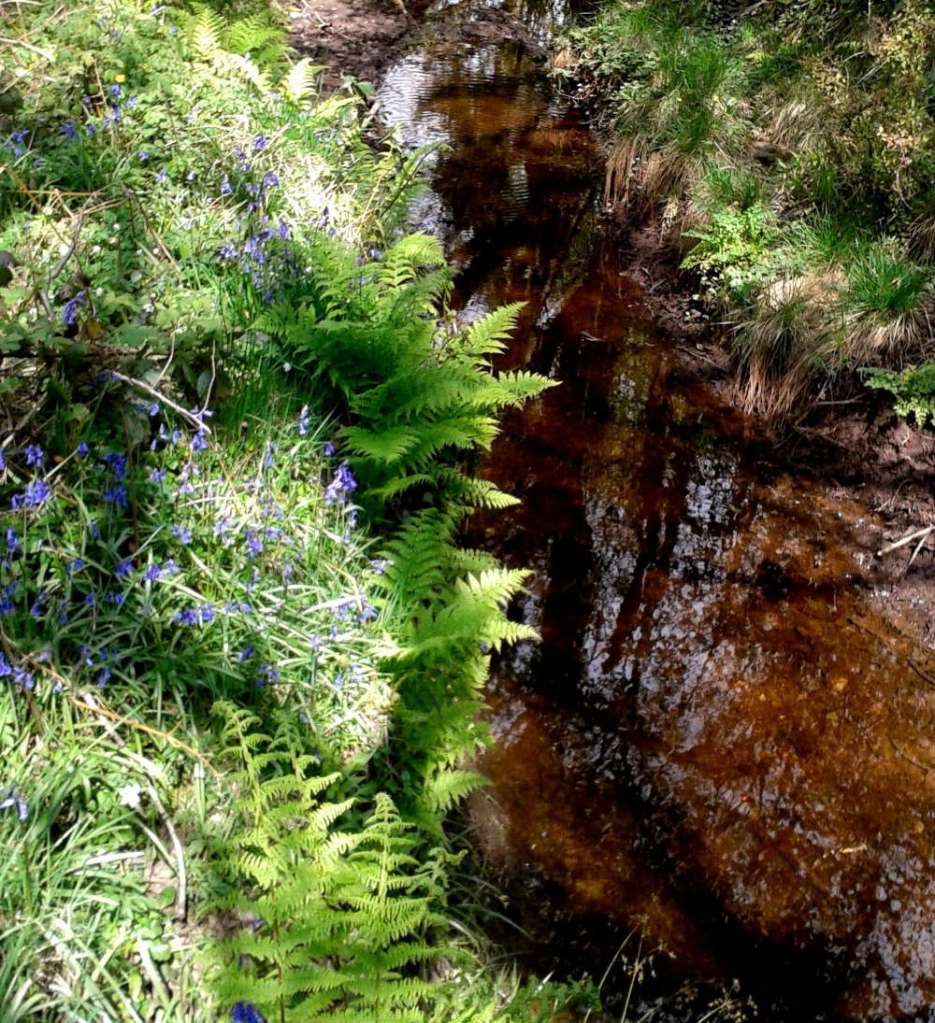
One of my favourite things about Glengarriff is the Nature Reserve which is just a stone’s throw away from the village on the Kenmare road. This is an original Oak forest, lined with pathways and walking trails, both long and short. Very interesting are the lichens, the mosses and the polypody ferns found here. The Glengarriff river runs through this forest. Both this reserve and the surrounding area is a wonderful place for hikers, hill walkers and for those interested in geology, botany and nature in general. People who like the sea can also live it up in Glengarriff, there are boat trips, fishing, and swimming.
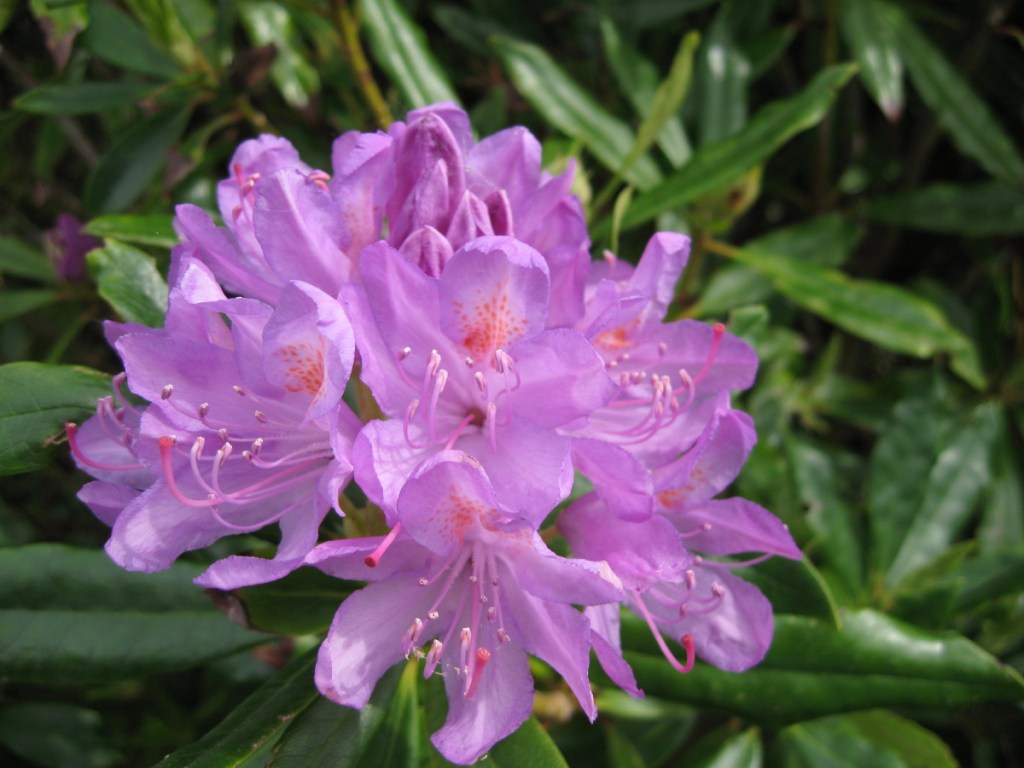
Irish spurge Euphorbiacae hybernaWild Rhododendron Along the coastline at Glengarriff
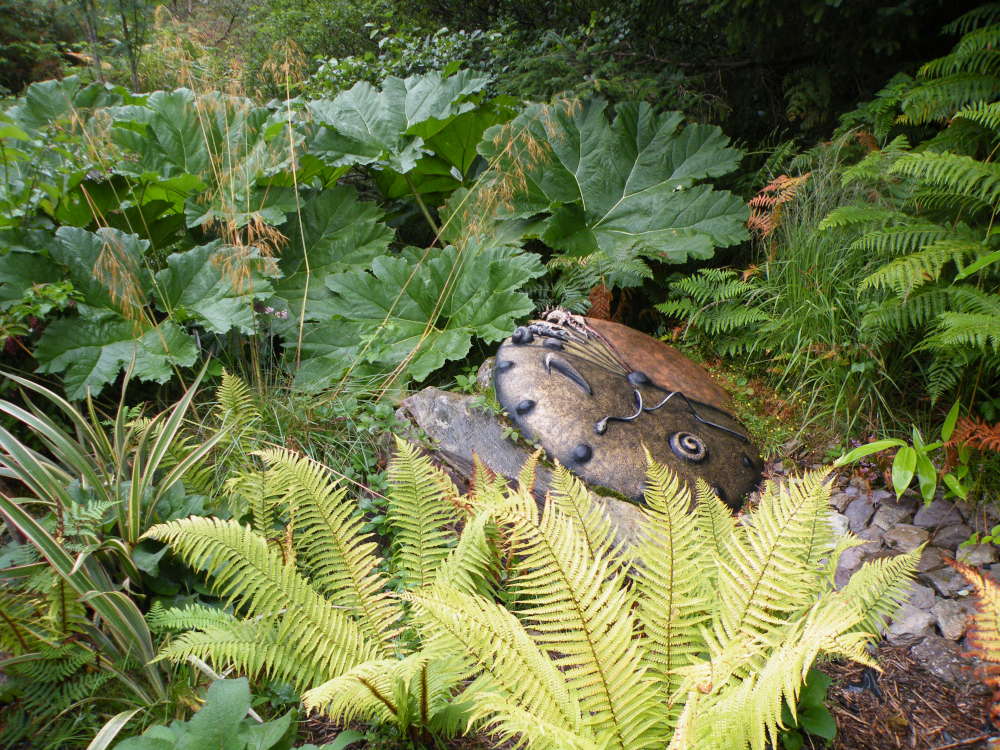
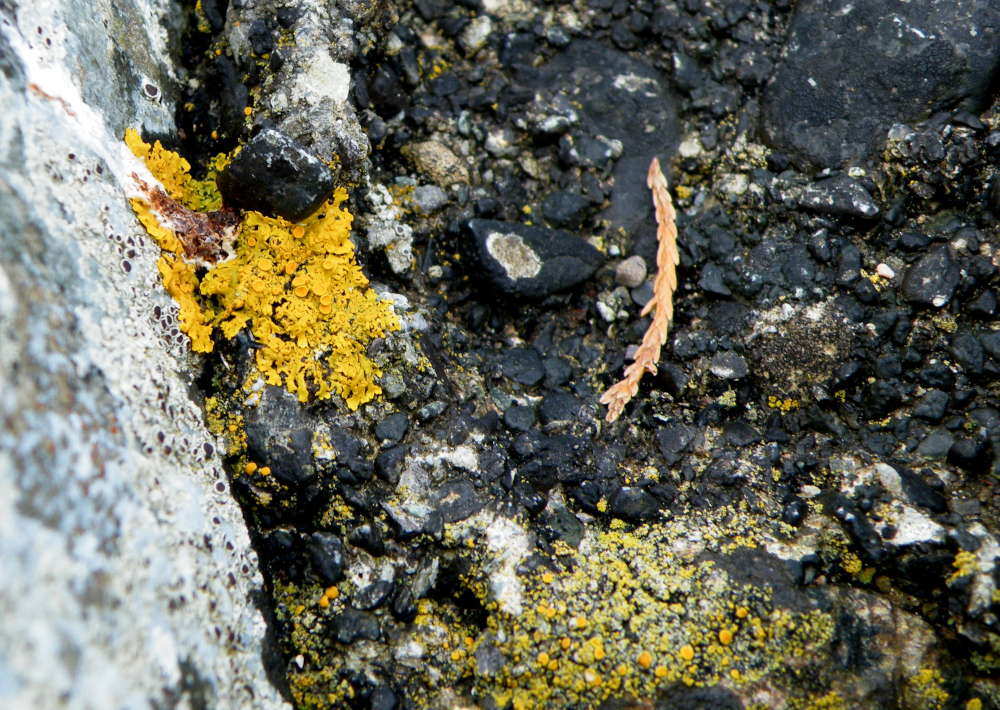
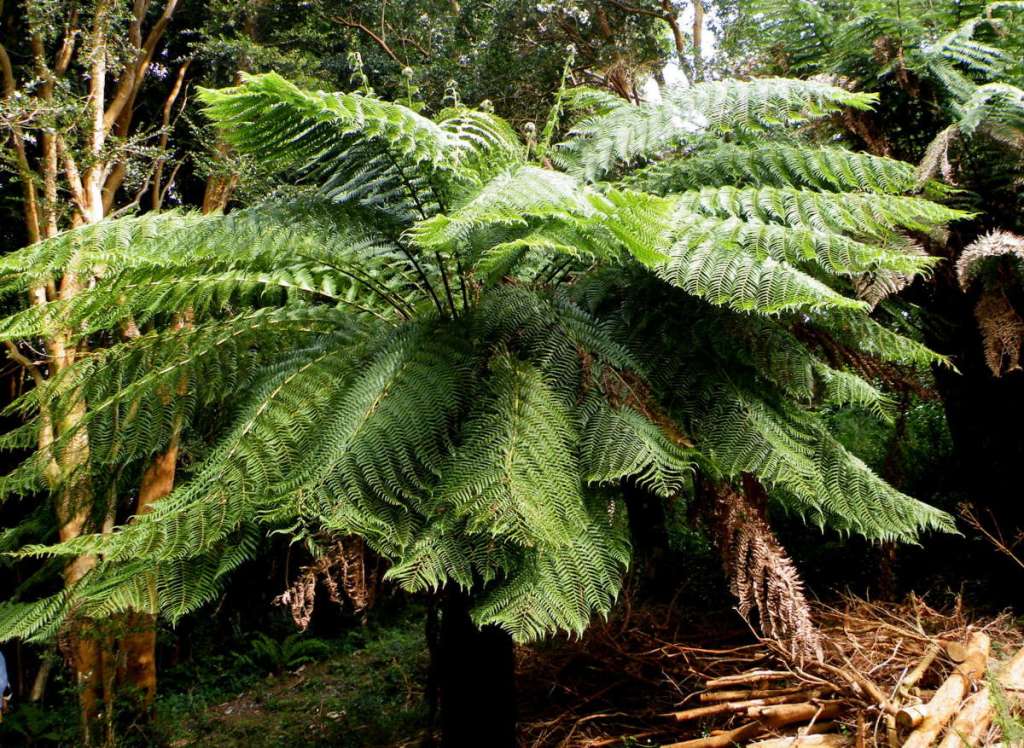
For the horticulturist there are several gardens to visit with interesting and sub-tropical species. Springing to mind are The Bamboo Gardens, The Ewe Experience, Garnish island. And Ardnatrush gardens which are my favourite, this is the garden developed by botanist Ellen Hutchins and where she did research into seaweeds among other things. Here are some photos I took there at my last visit.
Gunnera manicata at Ewe ExperienceLichen at ArdnatrushMy brother Johan and ITree Fern – Dicksonia antarctica at Ellen Hutchins gardens
Following is a link to a website about Ellen Hutchins:
Glengarriff is easily reached by bus from Cork, via Bantry and from Killarney via Kenmare.
I’ve enjoyed looking up some websites for information, but basically I’m quite familiar with the gardens, the botany and the interesting things about Glengarriff. It is the place where in 1965 my family emigrated to from Antwerp in Belgium. Us eleven children have since dispersed all over Ireland and Belgium too, with a huge number of descendants.
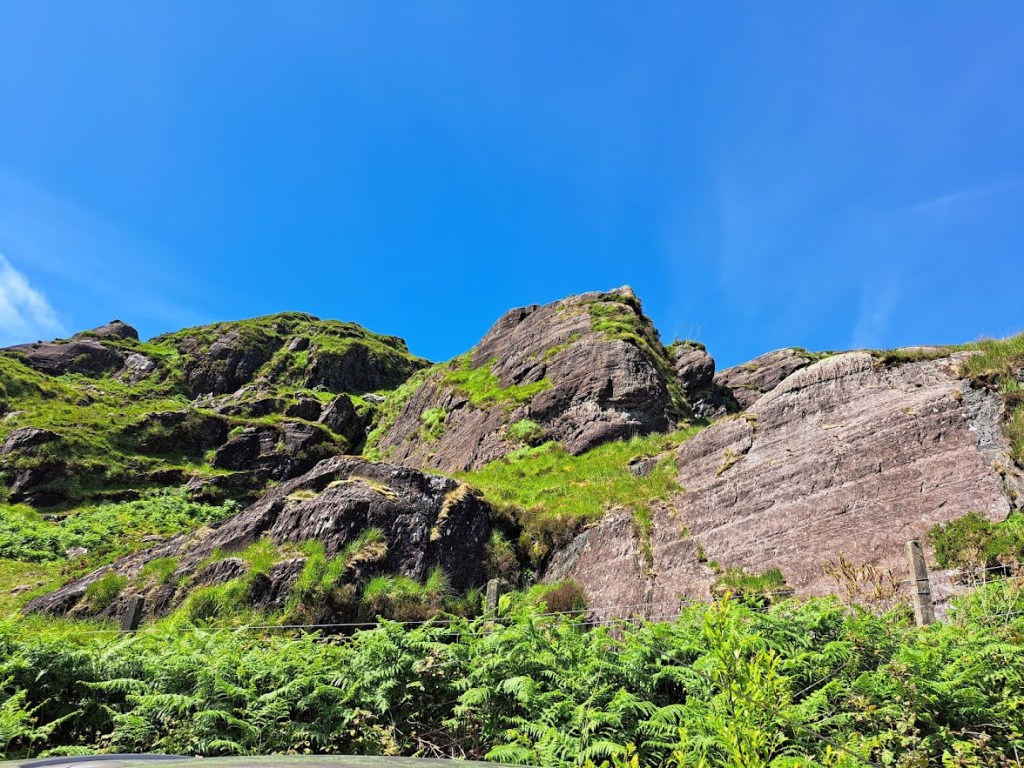
The surrounding mountains are a great place for the geologist.
Travelling through the Caha mountains during winter I find that there is plenty of interest to see and get excited about even just along the way. While some of my drives are taken in bad weather conditions, heavy mist, rain and or wind, most of the time I’ve experienced dry and also regularly sunny weather.
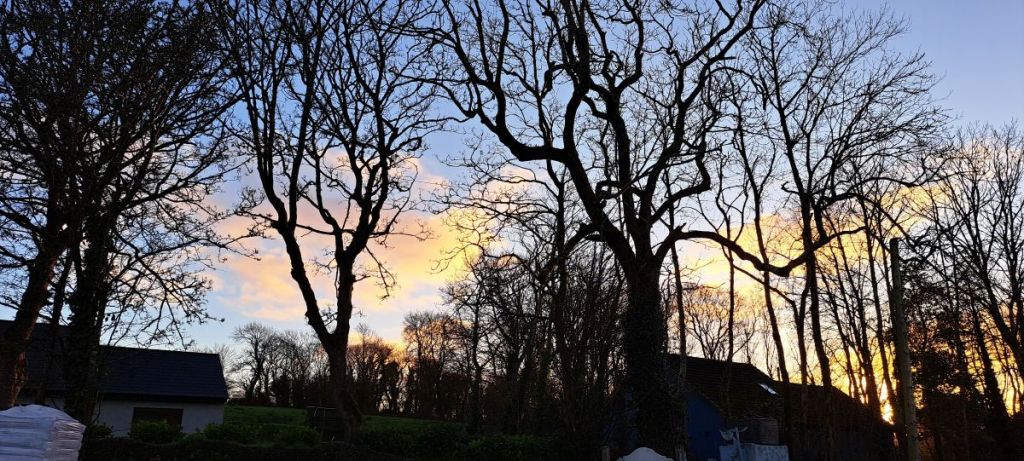
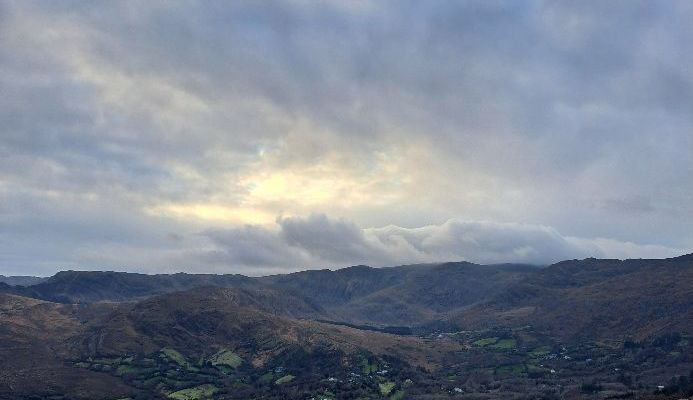
Most of all, this winter I find the skies fascinating. The colours, subtle, in pastel pink, light blue, ashen grey or radiant white, and even as if with a magic brush, diffused streaks of periwinkle purple. I’ve seen it all in skies over the Bantry Bay, over the Caha mountains and over the Glengarriff valeys. Ever changing skies with light of a beautiful quality. It certainly holds the attention of the traveller. These days I drive home when the sun is setting, adding another marvel of light, the setting sun, often spectacular!
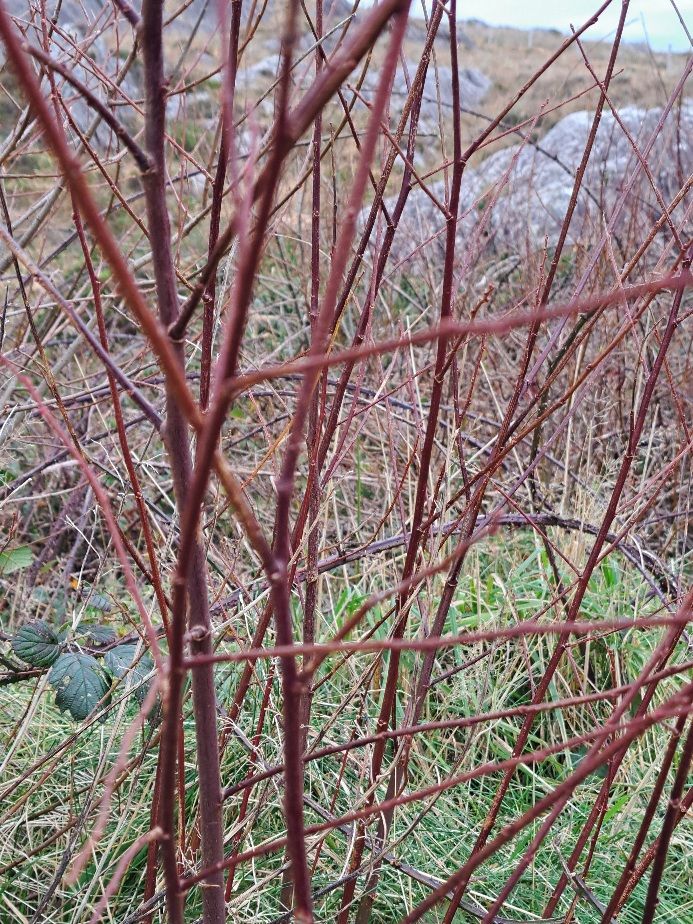
Looking down into the valley there is a whole palette of different browns, beiges and forest greens. A true feast for the eyes. As can be seen in the photo below Glengarriff National Forest has a lot of birch trees growing, and apart from their stark white trunks, their branches are particularly beautiful at the moment. Every time I pass clusters of them I try to think how to name their colour, a type of maroon, or a vintage wine, or does it look more like an English lavender, burgundy, gothic mulberry or umbral umber. It is hard to pinpoint exactly the colour of those branches, and it also depends how the light shines on them and how the rain brightens them.
Birch trees in the distance
A variety of other branches, among them the deep red of the dogwoods is always very nice in a landscape, and so is the drama of the bleached grasses, rushes and sedges covering whole stretches of hillsides with cream blonde colours or even rusty browns.
Darkness falls early these days, painting the landscape mainly in moss green, dark brown or black, though the mountains in the distance do give us some mauve. The landscape changes constantly, it is very noticeably when driving higher up, clouds throwing huge shadows over the valleys interspersed with stretches of sunlight. As I said there is a lot of interest even in winter on my journey. Probably much more to discover yet and that leaves me with a feeling of ever more excitement.
I came across two photos of winter foliage recently, these are paintings of the Danish painter Peder Mork Monsted, (1859-1941) from his ‘Winter’ series. I thought it shows the colouring of the birch trees beautifully and rather well. I think his work very nice. (Referenced from Gallery of Art) with thanks.
Molly Gallivan’s cottage is named after Molly, who lived in this cottage hundreds of years ago, she was a widow and mother with seven small children. And showing entrepreneur tendencies she came up with the idea to supplement her small income by opening a “Sibheen” (illegal pub) where she sold her home made “Poitin” that was locally known as “Molly’s Mountain Dew”
In 1840 a mountain road was built linking County Cork and County Kerry, which led from Glengarriff over the mountains to Kenmare and was called the Caha Pass. This road happens to pass Molly’s cottage and when more and more travellers and tourists took this road Molly saw another good way to increase her income. She set up her own cottage industry and started to sell home spun woollens and knitted Aran jumpers which her neighbours helped her to make while the local sheep farmers provided the wool. Such a resourceful woman was Molly.
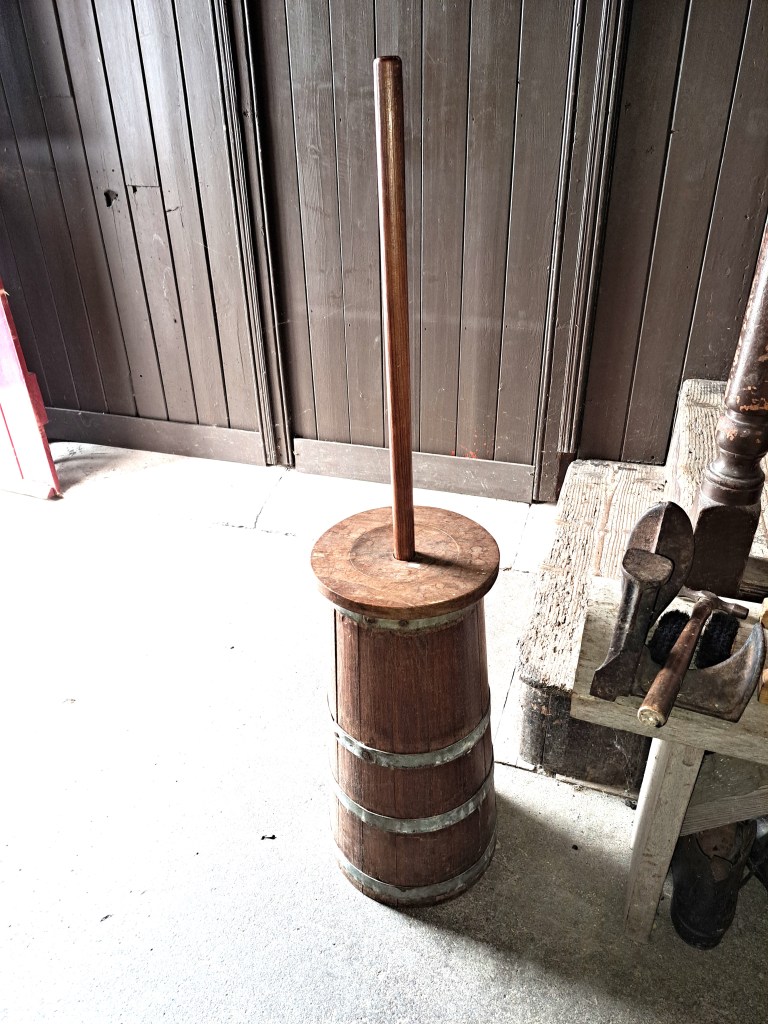
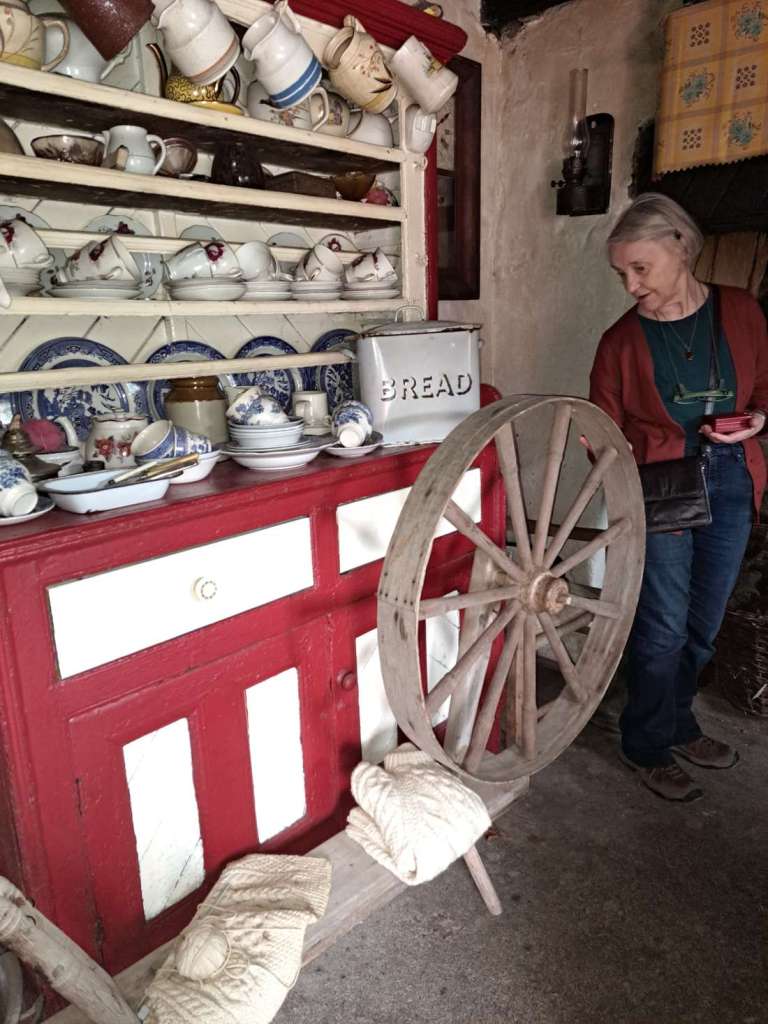
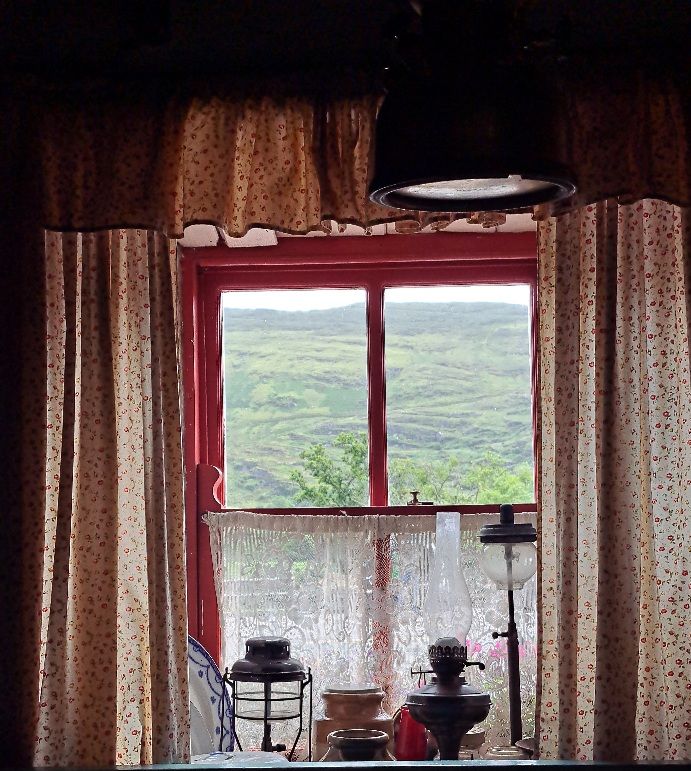
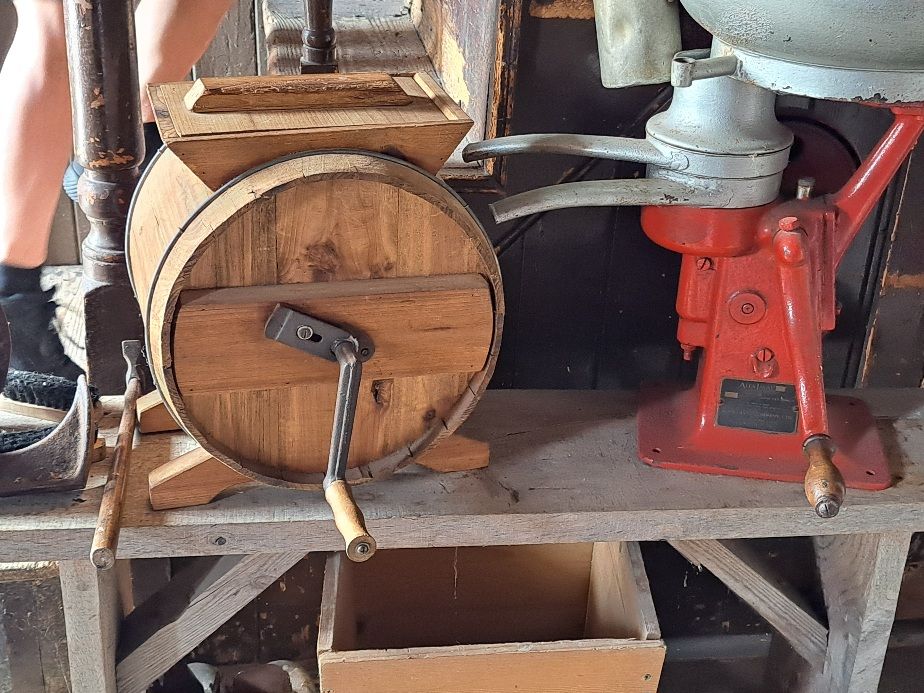
In the following photos are some of the lovely authentic items that Molly used to look after her family, a butter churn among them. In this kitchen traditional Irish scones are made till today, I’ve tasted them when I visited with my sister Josephine. We both find it interesting to see what utensils women would have used here less than one hundred years ago.
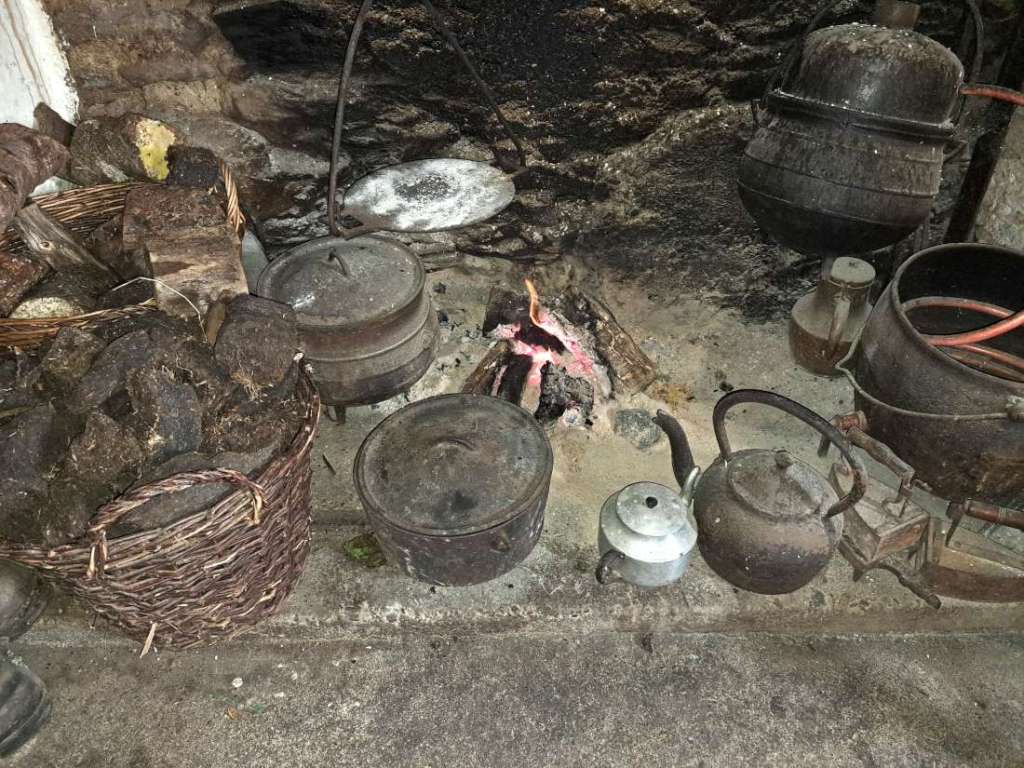
Looking at the heart there are several items, one of them is a shallow black pot in which a soda bread was made. The dough would be put in and the pot would be put in the fire and hot pieces of turf placed on top of the lid. The resulting bread tasted delicious. I see a flat round gridle too which was used in the making of gridle bread using rough flour, some maise flour, sour milk, bread soda and an egg. Here I found a video showing how: https://youtu.be/PpoTNWOKWtY There was always a large pot to boil the potatoes which were always popular in rural Ireland.
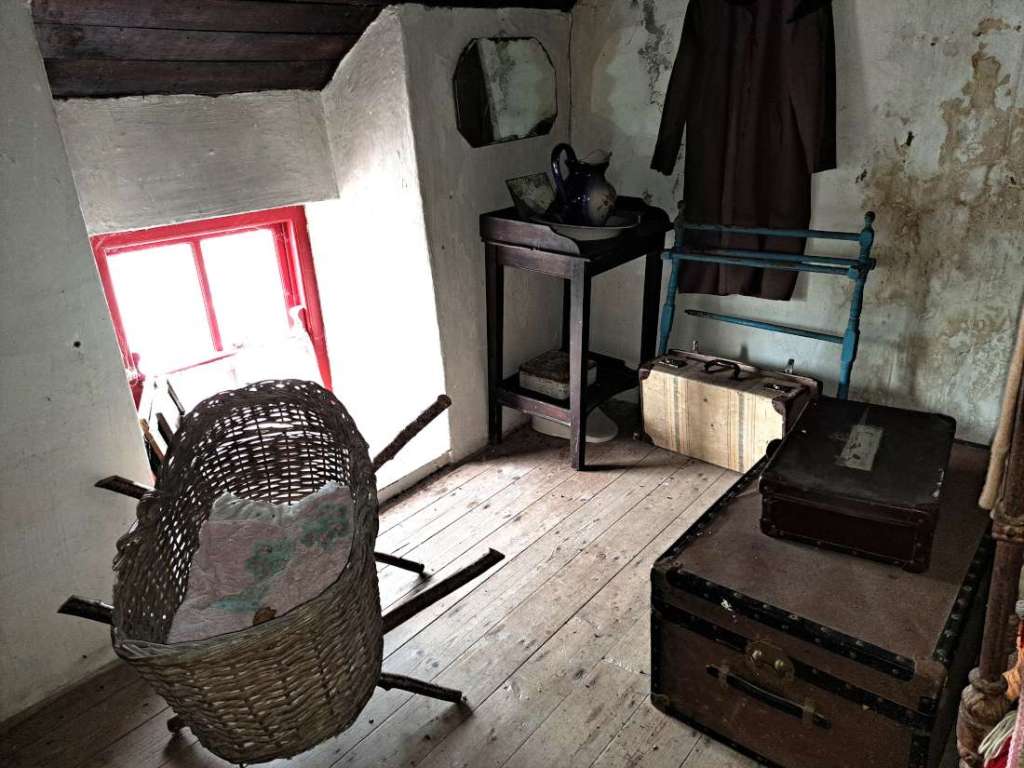
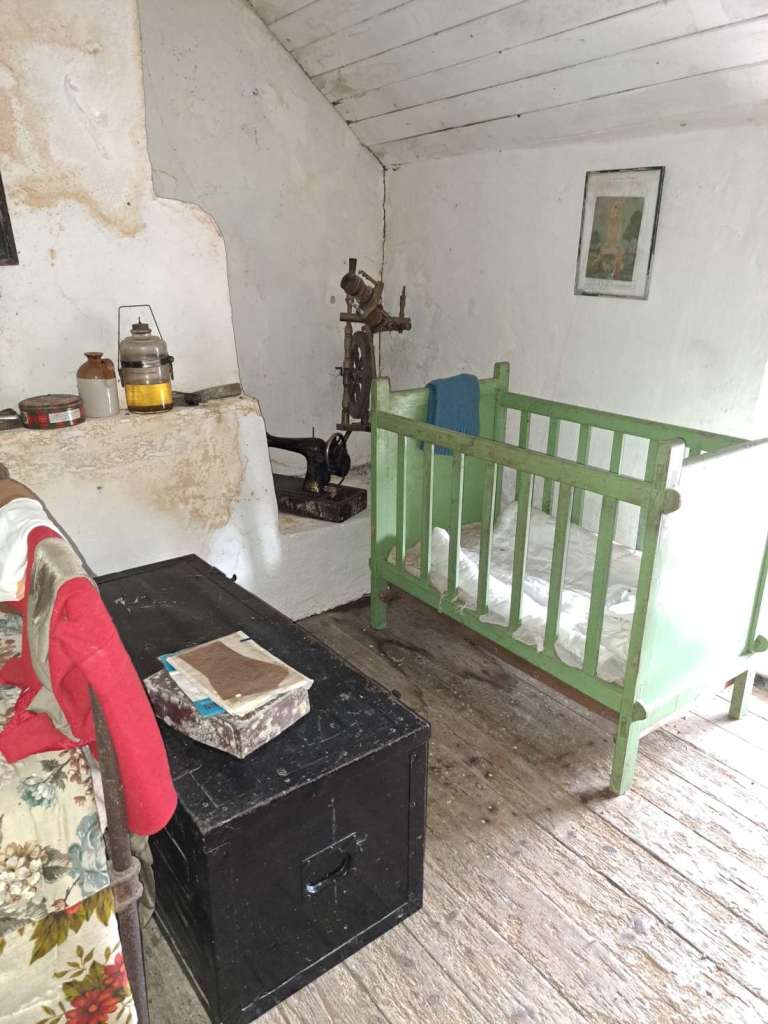
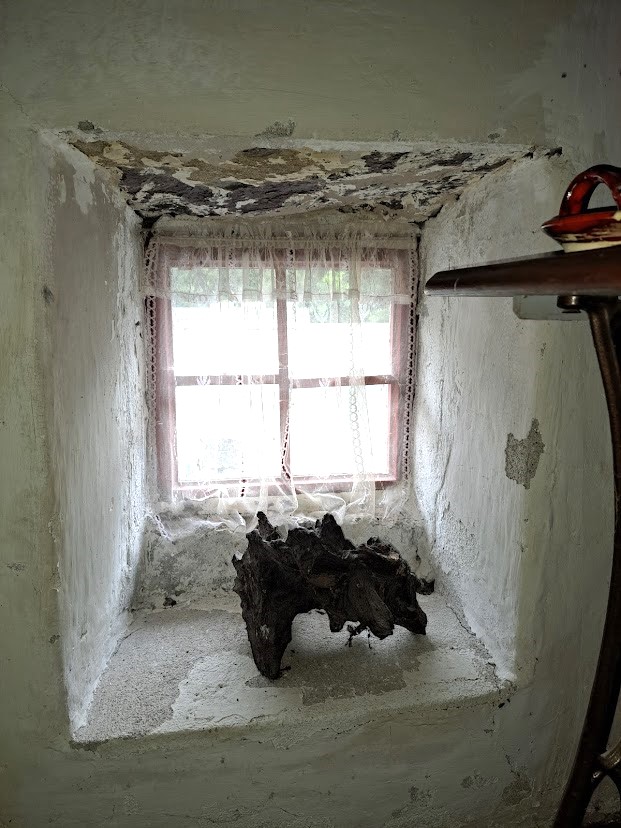
The upstairs in Molly’s cottage actually has two bedrooms and a bed also on the landing. The windows are tiny. There is a rustic cradle. I spot a small spinning wheel in the corner of one of the bedrooms. Electricity came to these areas only in the 1960ies. Her sewing machine would have been worked by hand, same as the spinning wheel and the loom. It was a simple life, but it cannot have been easy always.
We had a lovely cup of tea when we stopped by there during my sister’s visit. And of course we sampled the homemade scones. We also visited the shop area with the lovely selection of Irish woollen items and other Irish goods.
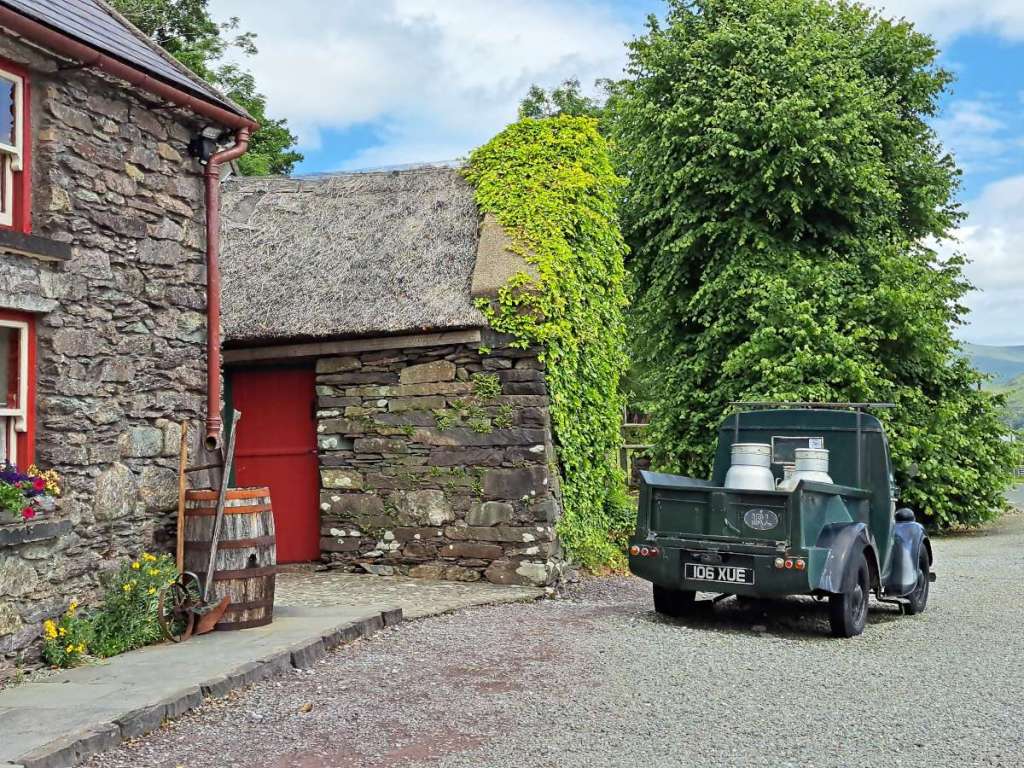
The cottage seen from the N71. Also some of the out-houses one of which is probably where Molly made her illegal “Poitin”, her mountain dew as it was called. The original cottage was only one story part of which can still be seen here in the photo.
I hope you enjoyed learning a little about Molly Gallivan’s life and her cottage. She must have been a great woman!
The cottage is found in Bonane in County Kerry. Bonane is situated in a valley between the Caha and the Shehy mountains and the sea. The cottage overlooks some of this valley. Bonane is know for its many ancient historical sites. Among the sites are pre-famine house ruins and field systems, bronze age copper mines and much more, fascinating stuff. Today Molly’s cottage and traditional farm depicts the lifestyle in the valley as it was during the early 1900s.
This photo shows the road over the Caha Pass going down into Bonane with a beautiful view of the Macgillycuddy Reeks in Killarney in the distance, among them is Carrantuohill, the highest mountain in Ireland at 1038m. It gets climbed often, recently my sister, brother and other members of the family enjoyed getting to the top. I took this photo and had waited all summer for the right moment to get a clear view of those mountains, it was already deep into September when I got the right conditions, it shows how the land had already started to get a rusty colour, beautiful!
The landscape has been sometimes dark and mysterious lately, this photo I took the day after a large storm sent torrents of rain down the mountains. It made for a most beautiful journey.
Because of the large amount of rain that fell Barley lake (situated in the Caha mountains) could be seen from the tunnel road quite clearly, while I was literally driving through the clouds. Lots of waterfalls everywhere. Beautiful!
The sky is often quite spectacular to watch. In Ireland neither the rain, nor the sun are ever far away and the clouds are ever present in fascinating forms.
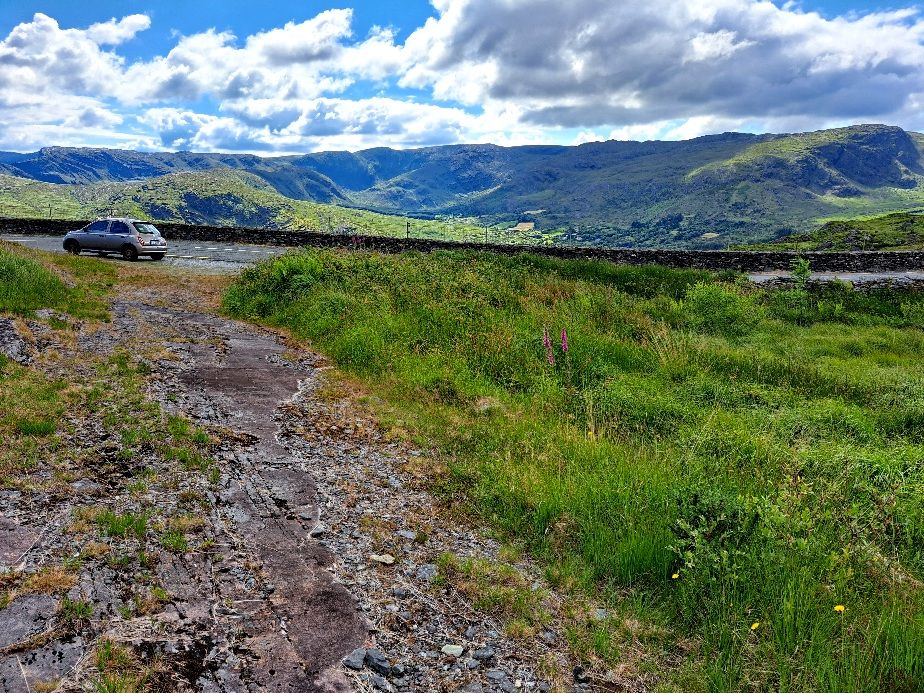
On better days, a roadside picnic with a lovely view over the valley below is a must stop for me. The quietness, even if this is a main mountain road, is so very peaceful.
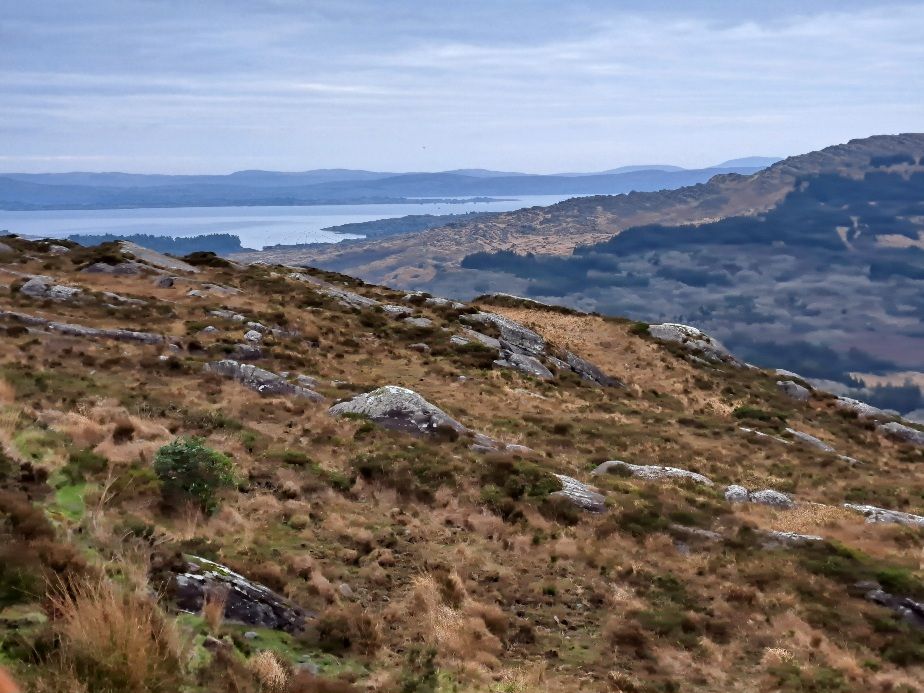
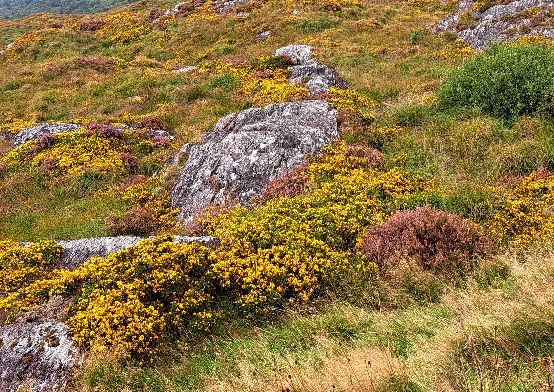
Some more photos of last months journeys to Kenmare. The landscape is changing its colours fast. I often climb up some of the rocks and find all sorts of interest. The flora is mainly brown sedges now and some of the young gorse plants that were still flowering, and the end of the heathers, also the beautiful seedheads of the bog asphodel, a lovely bright orange!
There are plenty of places where I can stop and look at the views or whatever else I want to find. Lower down in the valleys there is a lot more plant growth. Higher up the rocks are a huge fascination of mine.
On this journey there are, in their natural environment, still a lot of old barns and cottages, these are still in use and have been beautifully restored, though some are left as interesting ruins. The traditional cottage of this area of Ireland is a small stone-built house, two windows with a door in the middle, I think two up and two down they call it in vernacular architecture. Here in this photo gallery is one of those traditional cottages, well restored and used, it’s on the road down into the valley of Bonane on the way to Kenmare. It’s very nice to have a stop there and my sister Josephine and I had tea and traditional scones there last summer, but about this place which by the way is called Molly Gallivan’s cottage (after the original owner) I will tell in another blog to come. Visiting places like this goes back a long way in our family.
And as you can see from my photos there is so much a journey of a mere 71km can provide, even on a weekly basis. There is never ending interest, what with the changing seasons. And the sheer amount of interesting facets one comes across on such a journey make it certainly very enjoyable. Wow!
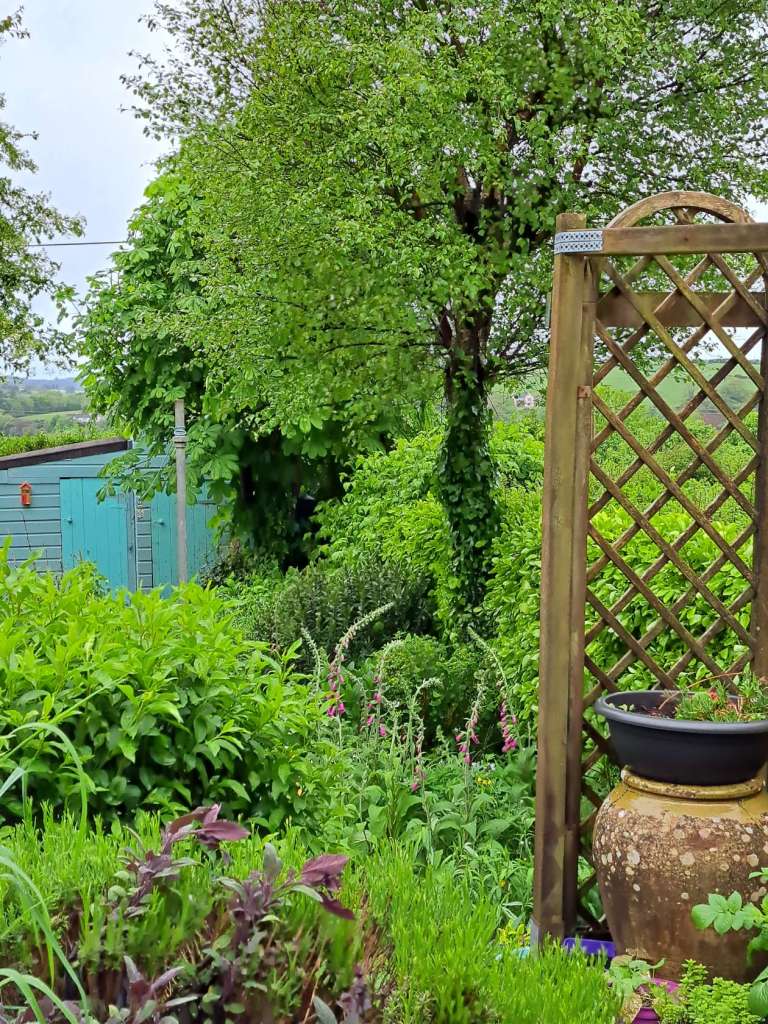
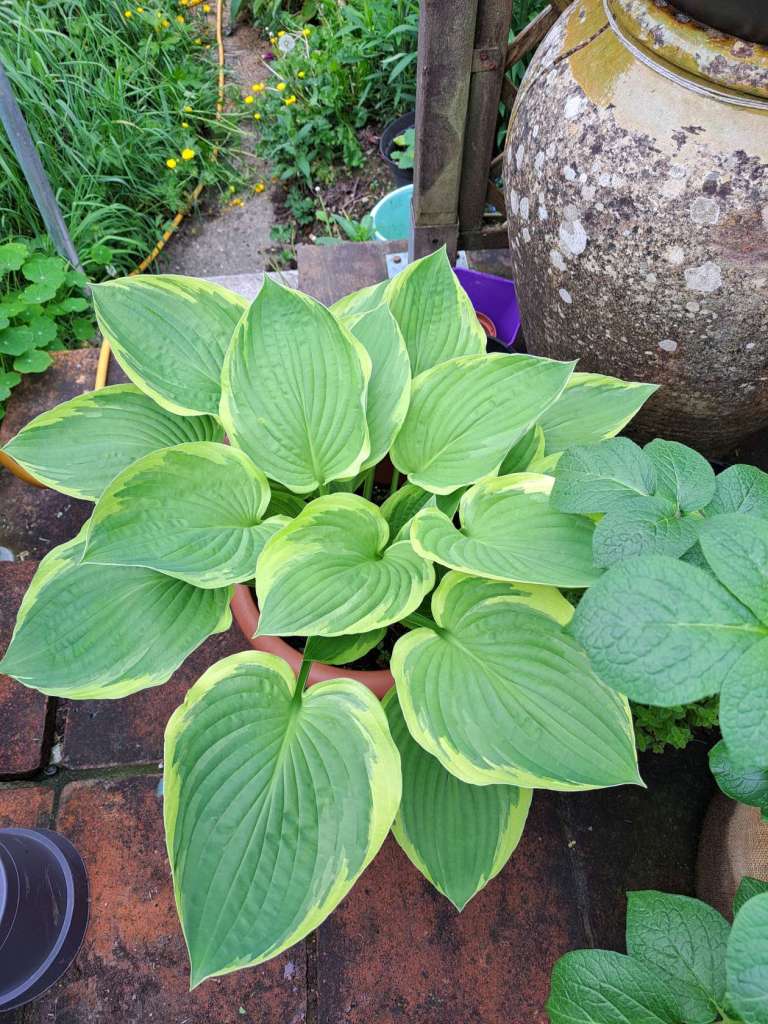
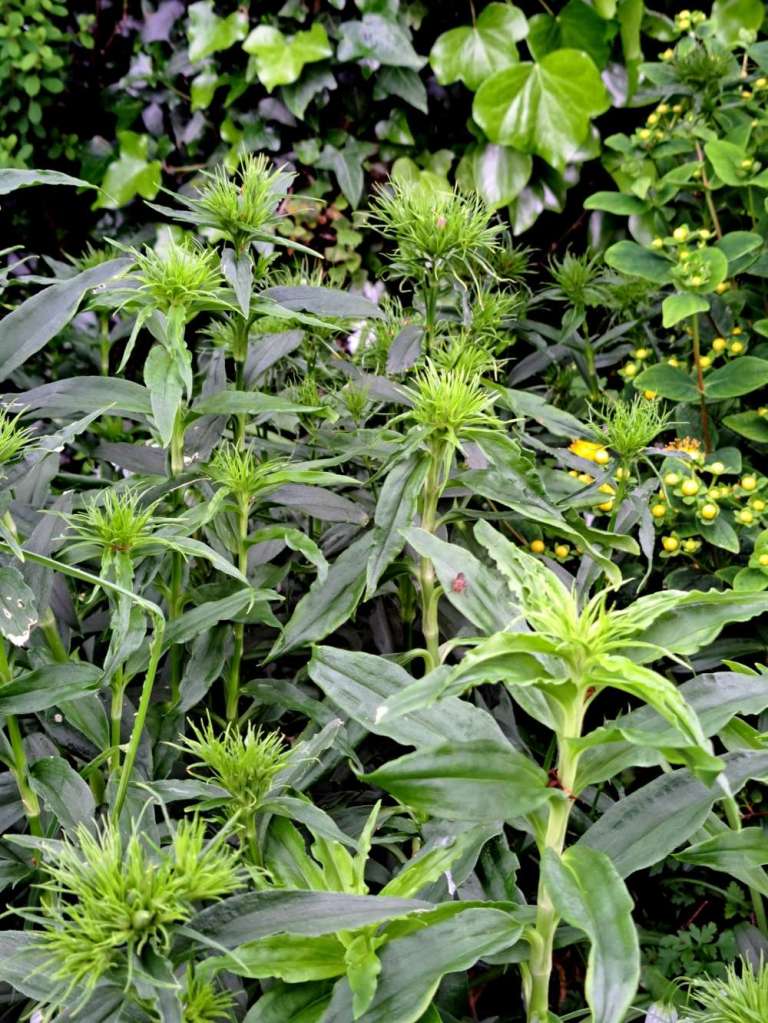
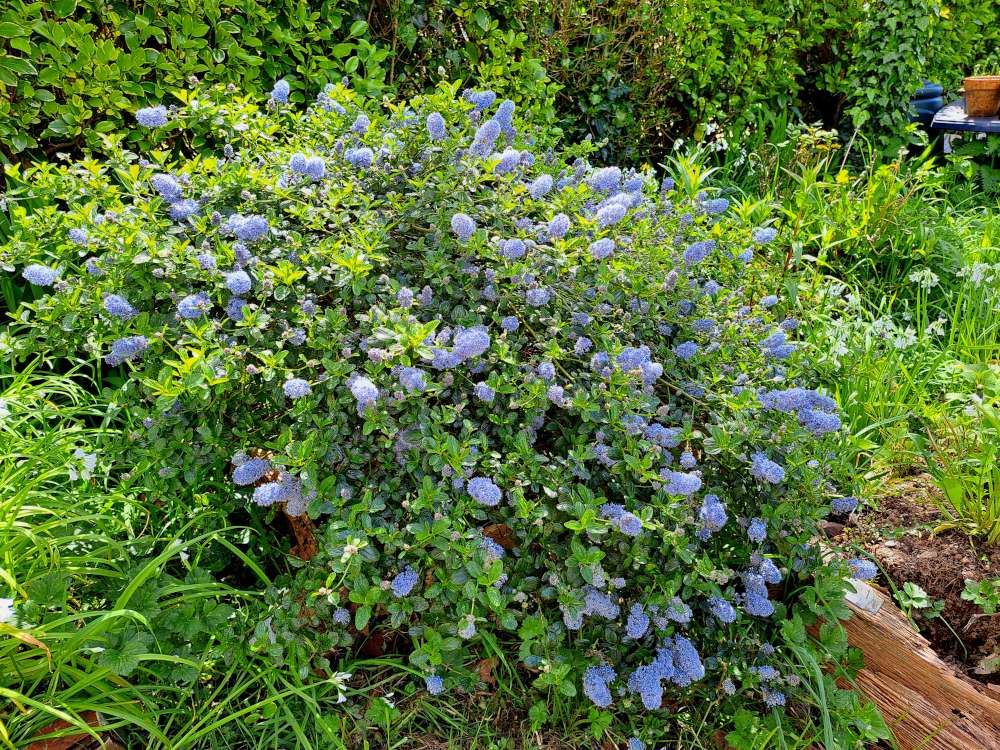
In our wild garden, and wild it is at the moment, I’m finding that everything is green, beautiful shades of green, but yet there are some colours to be seen too. I haven’t had much time, and less inclination to garden in the past few months and now everything has overgrown. But it’s beautiful, and there has been a lovely crop of very yellow buttercups in what is now a small meadow rather than a small lawn, I’ve really enjoyed that sight. The Californian lilac has also flowered in a pale blue. And the wild foxgloves that self-seed every year are in full bloom, a beautiful shade of pink.
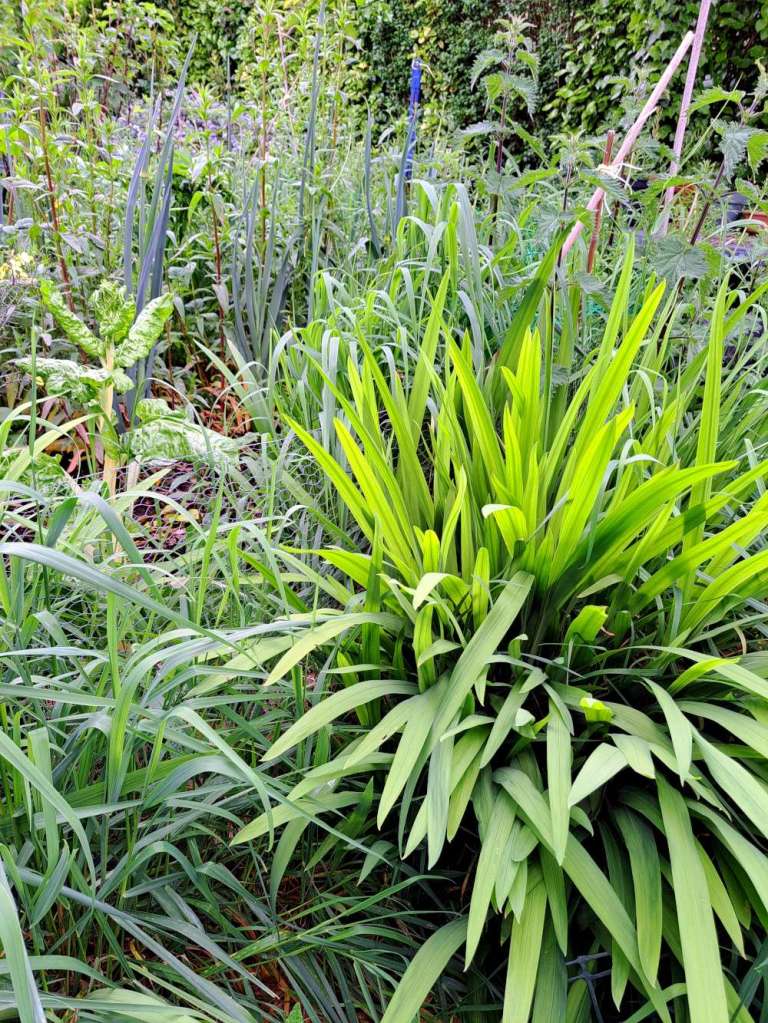
I like the garden to be lush, and to have secluded spaces where I can sit on the old bench, or totally in the back under the oak tree and surrounded by nettles and foliage of montbretia foliage not yet flowering, protected by the sheds from the cooling wind. I often pick this spot for breakfast on fine days, the sun is only just hitting that spot then and it’s a lovely light. The old bench under the hawthorn tree is another one of my favourites, but I have to watch it as it is the domain of the sparrows and there are often droppings from above, not so nice in my tea.
I am not seeing many pollinators in the garden this year yet, probably because the weather has been rather unpredictable, I’m hoping they’ll come soon. I’ve seldom seen the garden so lush, or else my memory is failing me (which I doubt}. The month of May is of course the most beautiful month in Ireland, and often one of the warmest, not so this May, in fact I’ve had to light the stove today. Probably June will be better.
I’ll let you have a stroll through our garden for now. Enjoy!
Bright beauty of buttercups (Ranunculus)
Foxgloves (digitalis purpurea)
Californian lilac (Ceanonthus)
I hope to be back to my regular blog contributions, there is a lot of material which I can develop and plenty of photos to go with it. As I get used to the changes in my life I’ll get inspired again to share some of the beauty of Ireland, and of my past and future travels. And I look forward to interacting again with the blogs of all my friends and followers.
The story of the Kalanchoe blossfeldiana is a nice one, at least in our household it is. Over the years I was often given one of these plants, and that in a variety of colours, red, white, yellow and rose mainly, but one year I received one with orange flowers, a real beauty! In fact they were all beauties. They fitted in alright with my other houseplants but I soon realised that the kalanchoe has something special, a strong will of its own, it grows how it wants, and rightly so. After it has finished flowering for the first time, I cut away all the large leaves. It then goes into its dormant period for a while. Eventually it starts to grow again and quickly show flower buds, they take long before they bloom open. The leaves it now produces are a lot smaller, growing into lovely rosette patterns. The stems grow of course depending on the light source. I leave my Kalanchoes (5) outside all summer but protect them from too much rain. I take them in during the autumn as they are not frost tolerant. I love seeing them coming into flower year after year. At times the colours of the flowers change, for example, my orange one never became orange again. As the years go by they are inclined to grow into very individual and interesting shapes.
Kalanchoe is actually a genus of around 125 species of tropical, succulent flowering plants. They are native to Madagascar and tropical Africa. I was surprised to read that the plant we call ‘mother of thousands’ is also a type of kalanchoe.
Although the genus kalanchoe was first described in 1763 by the French botanist Michel Adamson, it only became generally available and was commercialized in the 20th century after botanist Robert Blossfeld brought it to Germany and Paris. He found it growing in the cool region of the Tsarantanana Mountains in Madagascar. I know it to be a very adaptable plant.
Of interest is that Kalanchoe plants belong to the stonecrop (Crassulaceae) family.
The plant has been used in folk medicine, but is also studied in scientific circles. Co-incidentally a friend of ours in Tamil Nadu (South India) sent me a photo only recently of a flowering Bryophyllum Pinnatum which is also classed a subgenus within the genus kalanchoe. Bryophyllum is a group of plant species also of the family Crassulaceae and is native to Madagascar. Apparently these plants are used not only against kidney stones but in folk medicine are known to have anti-inflammatory, anti-oxidant and anti-histamine properties, also used for cancer treatment. Especially mentioned were the Kane and Kurichiyar Tribal Communities of Kerala. In Ethiopia this genus of plants is or was used for wound healing or tooth ache. In the Philippines as a muscle relaxant. For cats and dogs the Kalanchoe plant is toxic by the way.
A little clarification about Kalanchoe plant classification:
Crassulaceae is the family
Kalanchoe is the genus
Bryophyllum is the section or subgenus
Kalanchoe blossfeld is the species (and that is the species in the photos above and below).
The kalanchoe plant is known as a symbol of persistence and eternal love. In China where it is also a popular plant it is favoured at the New Year for its connection to prosperity.
On this first Sunday morning of the New Year I decided to visit the small seaside village of Union Hall in West Cork. It lies just 15 minutes drive from where we live and though it had frozen during the night, the sun was pouring over the land warming and beautifying everything. I drove past Rineen Forest which is located on an inlet of the North Atlantic Ocean, on the eastern side of the townland of Castlehaven. I’ve often walked in this forest together with my grandchildren and family. It is a great stretch of interesting trees and contains the remains of a lime kiln. The birds too are forever singing and there is a wealth of wild plants, a lovely place. But I was on my way down to Union Hall a further five minutes’ drive along a steep and winding road.
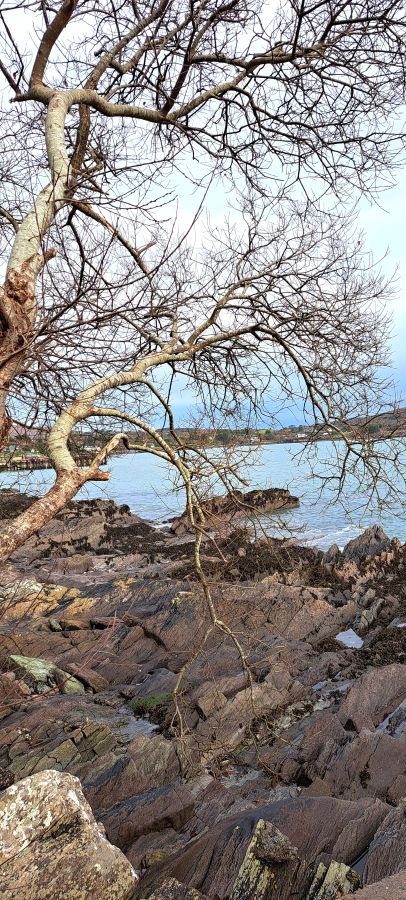
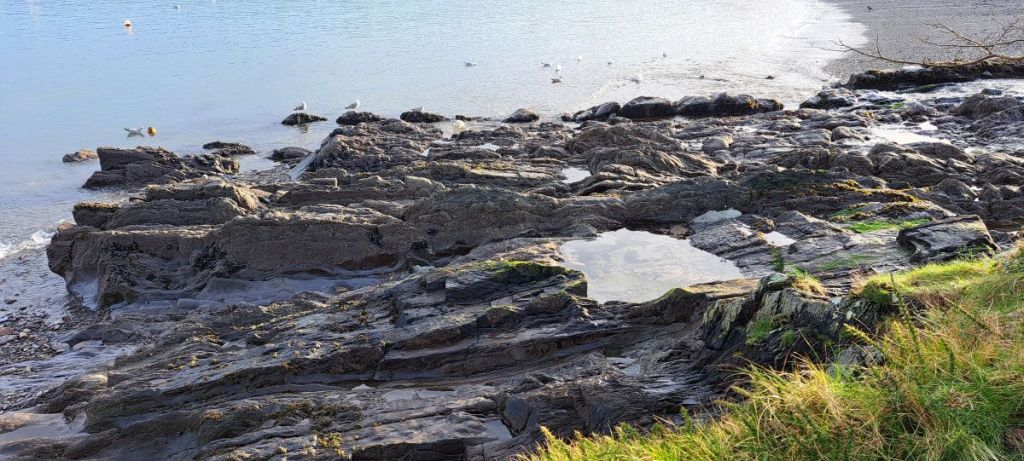
Union Hall, is a small fishing village, it is very scenic and peaceful there. I love walking along the seashore, especially to see the activity of the seabirds and the many lichen on the stone walls. The road leads out of the village and onto the pier where there is a colourful variety of fishing nets, lobster pods and fishing boats. I chose the place for a silent walk as I wanted to start the year with a clear head. Locals did greet me and I did exchange a few words with other walkers and their dogs. An occasional cry from the seagulls and other seabirds resounded over the water. My breathing deepened from the sheer tranquillity and the refreshing sea air. A calm descended over me like only a connection with nature can do.
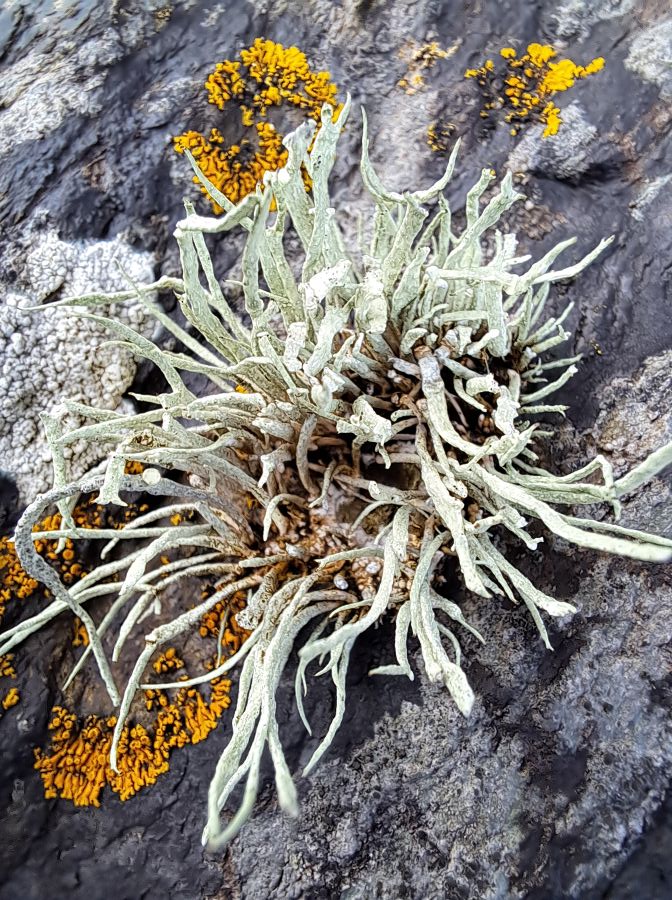
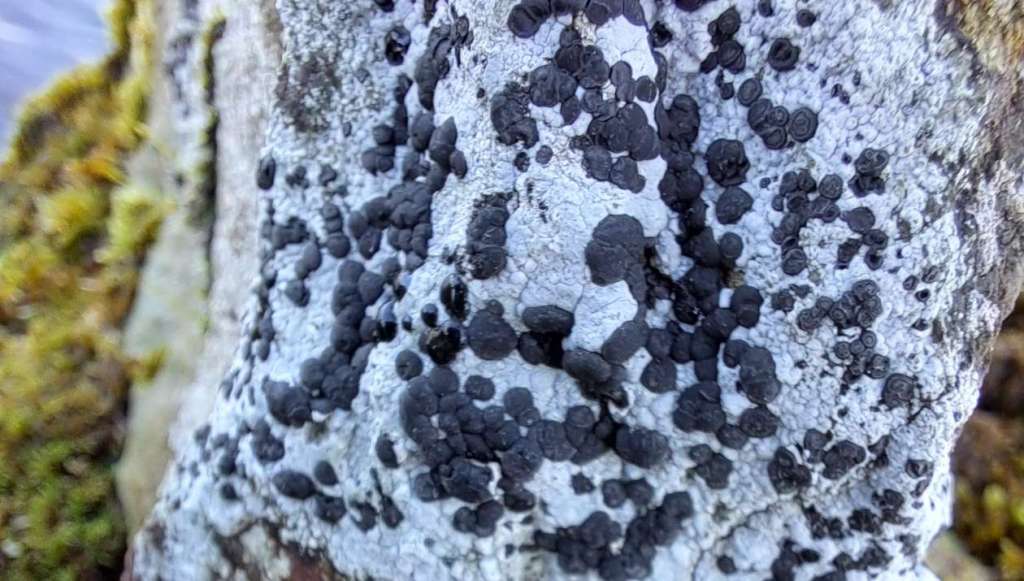
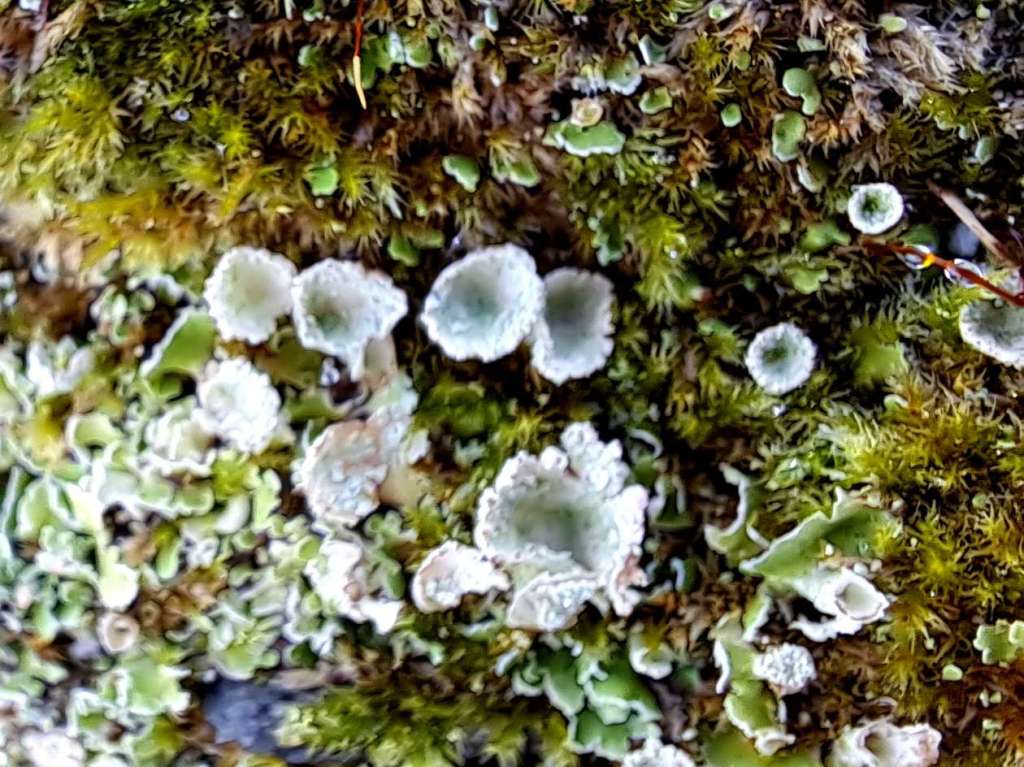
Over Christmas I obtained a little book on lichens, mainly about lichens of the National Forest in Glengarriff, but visiting that forest is for another time. Reading through it did heighten my already interest in the lichen of the area here and I naturally took some photos of those I found while on my walk. Lichens are fascinating, they are neither plants nor animals, they are living things that live in symbiosis with fungi. They are often very beautiful and intriguing. I’ll learn more about them this coming year I think.
lichen or mossRosehips
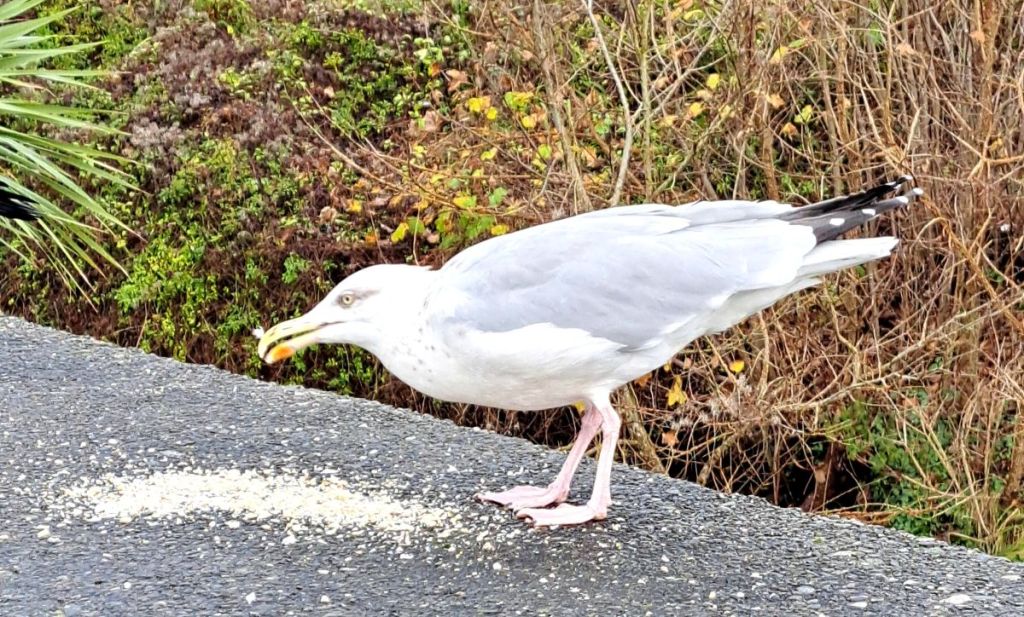
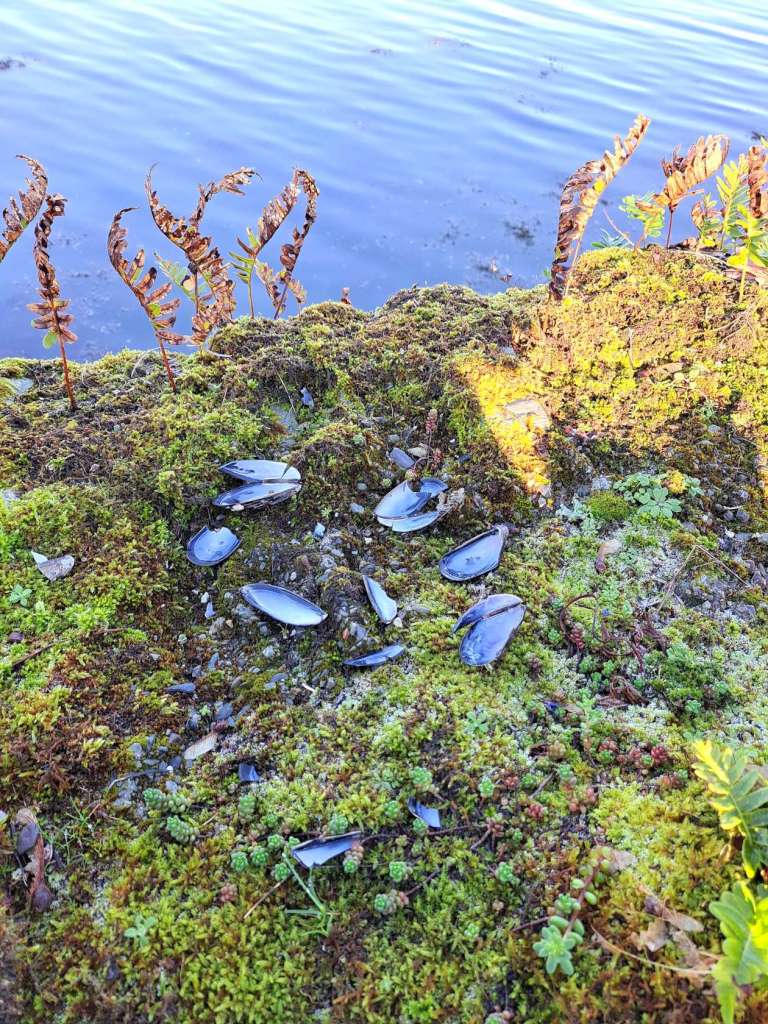
In the photo above are the mussel shells, the remains from meals of seabirds, mainly seagulls who drop those on the sea walls to break open feast on the contents.
Dapper daisies after a frosty nightGorse flowering
Interesting looking old stone building, some sort of store no doubt. Much more to discover about this little place!
I would like to share some scenes of Connemara, I hope that it captures for you the rugged beauty that Connemara is. Situated in the West of Ireland it is a most fascinating place for lovers of archaeology or geology, or just for lovers of peace, quiet, and a special type of beauty. This view is of a stone beach near Galway city, it was a paradise for me.Inland the landscape is quite barren with bogland, rushes, and low growing gorse which gave a yellow hue to the most fantastic shades of brown and ochre all around. In all its barren land, there is lushness to be found too, the tender young green here of rhododendrons. Dull days, showers of rain, mist. And as a little diversion some cattle being moved to another field. I love cows in a landscape, in paintings of pastoral life they often make the painting work I think.On the road again, I was driving very slowly indeed so I could watch the scenery, as long as there was no traffic behind, and I was lucky that the roads were relatively quiet. I am used to driving along country roads and I usually take in plants and other interesting things that I pass.The last day we just chilled out in the hotel, I read, drank cups of tea with Ian, and I also visited the rocky beach across from the hotel where I had a very interesting time looking at and for rocks. It was a very windy day indeed, with rain thrown in as well. FigwortWalls of rock, so many, and brilliantly made so many decades ago. A figwort plant still flowering, and a piece of Galway granite. The variety and beauty of the rocks at this beach was amazing.Peaceful lake, lovely scent of autumn, and the air as fresh as is possible to imagine, you could taste it on the tip of your tongue, delicious!Here is one of the authentic longish cottages in the vernacular style. A little gem. And another mysterious scene from the mountainous regions where the clouds hung low.
These are lovely memories of our time spent in Connemara. I hope you enjoyed a bit of our journey too.
We took this journey during early autumn 2019 to celebrate our marriage a few days earlier, it was a fantastic journey and I am thinking back to it during this time of lockdowns, no doubt we will be travelling in Ireland and no further afield this coming summer, we hope so anyway – a staycation they have called it – well we cannot complain, we are not short of interest or beauty in this island.